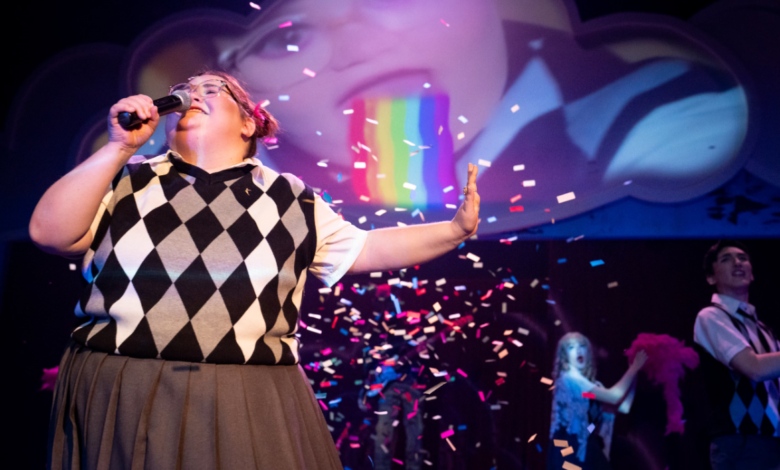
During my final year of undergrad, I was cast as Constance, the token fat character in the Ride the Cyclone, a musical about dead kids trapped in purgatory who become a mechanical fortune teller’s puppets. What I didn’t anticipate was how much I would have to unpack to ensure Constance did not become a target for mockery. She is written as the fat, naive pushover whose body is routinely the punchline. Despite her close friendship with Ocean, Ocean drops casual microaggressions throughout the show…
“Sure, she has some self-esteem issues, but why wouldn’t she?”
“She serves me a Coke and a medium fry, and no thanks, I don’t want that supersize cause that’s low class—diabetes in a cup.”
“I was working toward something. I was building a life. You were satisfied doing nothing, making cupcakes, eating them. You are what Taoists call an uncarved block.”
Through Ocean’s words, I was forced to sit in and simultaneously sound out the real internal shame and societal hatred associated with my body, my own identity, and the space I inhabit. I wasn’t interested in redeeming her or her relationship with Ocean; I was interested in refusing the assumptions the script made about her fatness.
The text frames Constance’s size and soft-spoken nature as a symptom of low self-esteem, inviting the audience to laugh at her compliance with Ocean’s behavior. A core conflict of the story is that the characters are being controlled by the fortune teller during all musical numbers, operating as puppets, so I knew Constance’s soft-spoken nature was critical to her storyline and the characters around her. But I made sure to amplify when she did feel joy, inviting the audience to bear witness to her autonomy. This allowed me, and Constance, the space to breathe and observe behavior around us. She was not a pushover; she simply wasn’t sure how to approach Ocean’s ignorance with care. When I reached Constance’s solo number, “Sugar Cloud,” a direct tribute to finally standing up for herself, the joy was not just sweet—it celebrated her understanding of life and all of its complexities.
After a performance, an audience member told me that I had “given Constance life when the writers would not.” I went into the dressing room, and I cried. That comment sat with me for weeks. In my journal, I expanded the thought: Within the microaggressive language and the writers’ narrow understanding of a character they created, Constance existed as a contradiction, a ghost in theory, yet an elephant in the room.
This realization lit a fire under me. More importantly, I began questioning how season selection and casting opportunities determine the kinds of artistic risks students are permitted to take throughout their education. In conversations with other colleagues, I began to look beyond individual casting decisions and examine the university’s approach to theatre pedagogy. We repeatedly surfaced similar concerns in conversation about opportunities within the program. The same actors and the same types were being cast in strangely similar roles. Students with varying identities and backgrounds invest tens of thousands of dollars in an education intended to expand their craft, yet they are often given material and opportunities that can limit creative risk and, in turn, the evolution of their artistic voices. As my own experience demonstrated, these opportunities reveal how entrenched institutional practices override even well-meaning efforts toward change.
Dr. Sabrina Strings, a sociologist and author, challenged my understanding of what being fat, white, and queer really meant. In reading her book Fearing the Black Body: The Racial Origins of Fat Phobia, it reveals anti-fatness, also known as “Fat Phobia,” as more nuanced than a personal or aesthetic issue. “The fear of the imagined ‘fat black woman,’” she writes, “was created by racial and religious ideologies that have been used to both degrade black women and discipline white women.” My own experiences with fatness, while real and consequential, exist within a system that was never created with me as its primary target. Strings’s work situates Fat Phobia within a larger history of anti-Blackness, forcing me to reconsider the ways race and body size intersect in both society and the spaces I inhabit. Fat Phobia, and this idea of advocating for body neutrality, remains a point of conflict for dominant society because it interrogates a system that has long used the body as a marker of value, discipline, and social hierarchy.
For educational and artistic institutions, this raises an important question: If your ADEI efforts fail to confront these underlying structures, do they merely reproduce exclusion in more palatable forms?
In returning to Hairspray’s relevance in the twenty-first century, and Turnblad as a beacon of hope I hung onto as a child, I learned some details about the casting process. “We need a young girl who is—what shall we say—chubby/fat/big. But a healthy version of a fat girl, because she is dancing her ass off for two hours,” said Bernard Tesley, casting director of the 2002 Broadway production. The first time I read this quote, I wasn’t shocked. This is the exact discipline Strings references. This discipline can be reflected in the opportunities afforded to my peers and me.
In 2023, I attended my region’s Kennedy Center American College Theatre Festival. During an open forum, we discussed what casting can look like when visual aesthetics shaped by unconscious bias are deprioritized. The facilitators used The Wizard of Oz as an example, highlighting how a story that has historically relied on familiar archetypes can instead be cast expansively without reducing anyone to a token or relying on “type” to determine capability. The conversation echoed what theatre practitionersLavina Jadhwani and Victor Vazquez describe as identity-conscious casting. In Victor’s words, “We are actively and radically making space for all the different ways that actors exist in this world.” Rather than asking artists to ignore identity, this approach recognizes that race, gender, body size, disability, and other lived experiences shape how performers move through the world while resisting the assumption that those identities should determine the limits of their artistic potential.