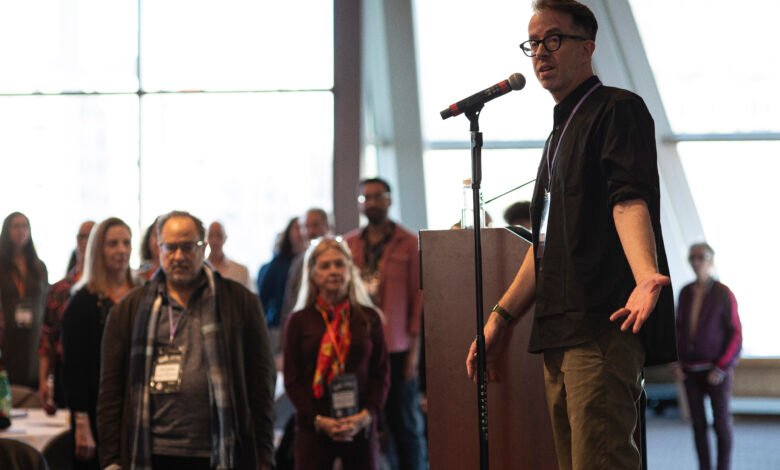
We can read maps before we can read words, Landsman explained, and so there is a level of intuitiveness to drawing one. In the first round of avoidance maps, participants were asked to draw a map of something they avoid in their personal lives. The maps that emerged represented space at all scales, from avoiding a particular seat at a favorite bar to avoiding an entire nation. People drew the routes between the subway and home that they avoid, the parts of their state they won’t drive through, the judgement and expectations they’re dodging. As I observed them explain their maps to others at their table, I noticed two main reasons for their avoidance. The first was interpersonal. People wanted to keep out of sight of their ex, or walk a couple blocks out of their way to avoid a kind but chatty neighbor, or stay out of the region where their estranged family lives. The second motive was safety. Some maps navigated around blocks with higher gun violence, highway routes with known Immigration and Customs Enforcement (ICE) activity, or states with laws against reproductive freedoms. At the end of this share-out, there was no challenge to confront what we avoid—no call to action at all. Instead, folks knew their own spaces differently and had new language to communicate this knowledge.
At the end of this share-out, there was no challenge to confront what we avoid—no call to action at all. Instead, folks knew their own spaces differently and had new language to communicate this knowledge.
In a second round of the avoidance maps, participants created a new set of avoidance maps for their professional lives. What do you avoid in your work? The facilitators grounded this round in Paolo Freire’s invitation to “make the road by walking,” a phrase they linked to the existence of paths of desire in the real world. People walk the way they want to, not the way they’re told, and so the process of mapping can lead to revolution. In this way, these maps contain traces of desire and therefore utopia.
Perhaps in an enactment of this aspiration and idealism, the second set of maps were noticeably less tied to physical space. Again, we entered the realm of metaphor. People drew the red tape they work around and the hoops they jump through to access even limited resources. They drew spirals that meant relentlessness, boxes that held their fear of accidentally harming someone, and footsteps that signified organizational longevity. At the close of the activity, they were invited to reflect on fieldwide avoidances aloud. Having accustomed themselves utterly to the language of the map, it seemed nobody knew quite what to say.
Holding the door open is exhausting, but worth it when an artist walks through–and doubly so when a community follows them in. That’s what seemed to happen, at least, when the door of the Under the Radar Symposium was held open this year. Artists rushed in to remind their colleagues to listen, to innovate, and to carry stories forward with care. They asked provocative questions about the boundaries of art making as it brushes up against audiences, institutions, technology, and government. They built a secure container for people to confront what they’ve been avoiding without demanding an immediate redirection of that avoidance. In all of this, they quietly insisted for art at the heart of community—and for humanity at the core of art.