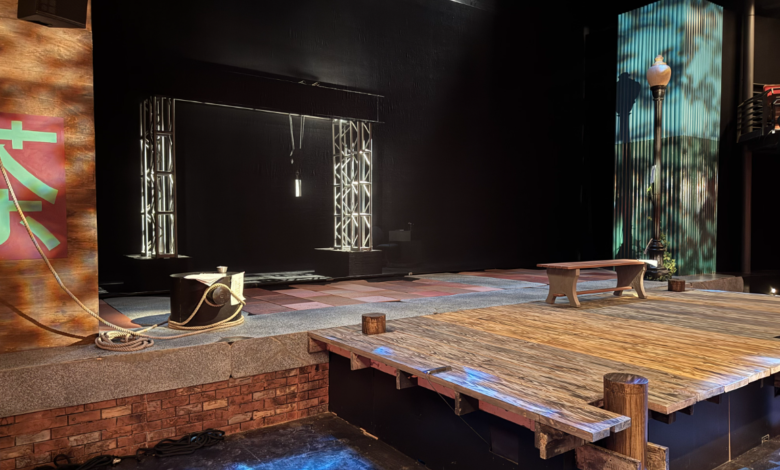
In Canton Waterfront, two stories unfold hundreds of years apart in Baltimore. In 1785, Keiheen and Keisun Shek, brothers who sailed from China to Baltimore as workers to unload and reload a trade ship, are stuck. The owner of the ship, Captain O’Donnell, sold it while they were on their journey, and the new owner won’t be running the route back to China. The brothers are stranded in an unfamiliar city, surrounded by people speaking a language they do not know. (This is actual Baltimore history. According to the United States Department of State, these are the first documented Chinese people to land in the United States.) Years pass, and an opportunity to return to China arises, but they choose to stay in the United States. The brothers have diverging views on what they should do to succeed in this country. Keisun begins to get involved in Captain O’Donnell’s drug trade, which Keiheen is vehemently against. Ultimately after agreeing to part ways, Keiheen plans to blow up the very first shipment of opium, and Keisun shouts after him and draws attention, getting Keiheen killed by the guards.
A parallel storyline occurs in 2024, following cousins Cynthia Tam and Bonnie Shek, who represent Shek Industries and are descendants of Keiheen and Keisun. They have traveled across the world (Cynthia from China and Bonnie from London) to Baltimore right after the Francis Scott Key Bridge collapse, offering “help” in this time of crisis in hopes that they can fortify their company’s usefulness amidst the United States-China trade wars. The cousins are also navigating differences, bickering about their approaches to business and life. Outside of the Shek lineage, there is Quentin Melling III, a Black grieving father. His son has died of an accidental opioid overdose. The city plans to rename a street after him, but Quentin’s grieving is interrupted—he can’t go to the naming ceremony because the Francis Scott Key Bridge has collapsed, and in his job as port administration, he has to deal with the consequences of that.
Developing Canton Waterfront Through Lab410
When I saw Canton Waterfront in August 2025, it had recently been written for the inaugural year of Baltimore Center Stage’s Lab410 program, a playwriting workshop residency for new, emerging, and established playwrights in Baltimore or surrounding counties.
Playwright Karen Li applied for the program with an outline of her idea for Canton Waterfront, which was selected as one of three plays to be developed throughout the 2024/2025 season. She received the same dramaturgical support as the new plays receiving full productions on their stage, working with Avon Haughton, the theatre’s artistic associate of new works. In addition to his dramaturgical expertise, Avon was invaluable because he was born and raised in Baltimore.
Like Karen, I am a transplant to Baltimore and have lived here since 2019. I love this city and am so grateful to live here and to all those who have welcomed me. However, the national sentiment about Baltimore does not align with what I and many other people who call this place home say about it. Baltimore is often maligned by everyone from this country’s highest political leaders to the random people who hear it come up in conversation. I’ve had people tell me that they do like Baltimore as though it’s an embarrassing secret. So much of what is said about this city is negative and comes from outsiders, which is why “it’s important that the narratives about a place come from people in that place,” as Avon Haughton shared at the talkback.
I have seen a lot of theatre in Baltimore. But it wasn’t until Canton Waterfront that I saw a play in Baltimore centering Baltimore history. Avon shared that at the core of the Lab410 program is the knowledge that “Baltimore is a powerhouse of creativity.” He knows there are a million stories here. The fact that this show was so specifically about Baltimore was “a happy accident,” but a lot of the Lab410 submissions came from writers thinking about home. During the Canton Waterfront process, Avon was able to provide his opinion about what would specifically resonate with a Baltimore audience, as well as how to make sure the play had impact for audiences outside of Baltimore.