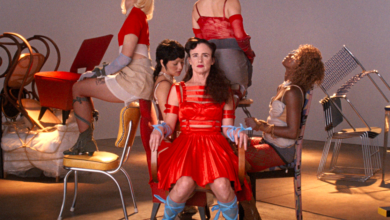

When Evelyn (Emily Alyn Lind) knocks on a stranger’s door on Christmas Day, she holds a small piece of paper in her hand. There are no words on it, but when the puzzled host asks her if she’s at the correct house, the young woman takes a glance at her note and confidently recites an address as if it had always been there. This is how we know she is a natural storyteller, and boy, does Evelyn have a story to tell.
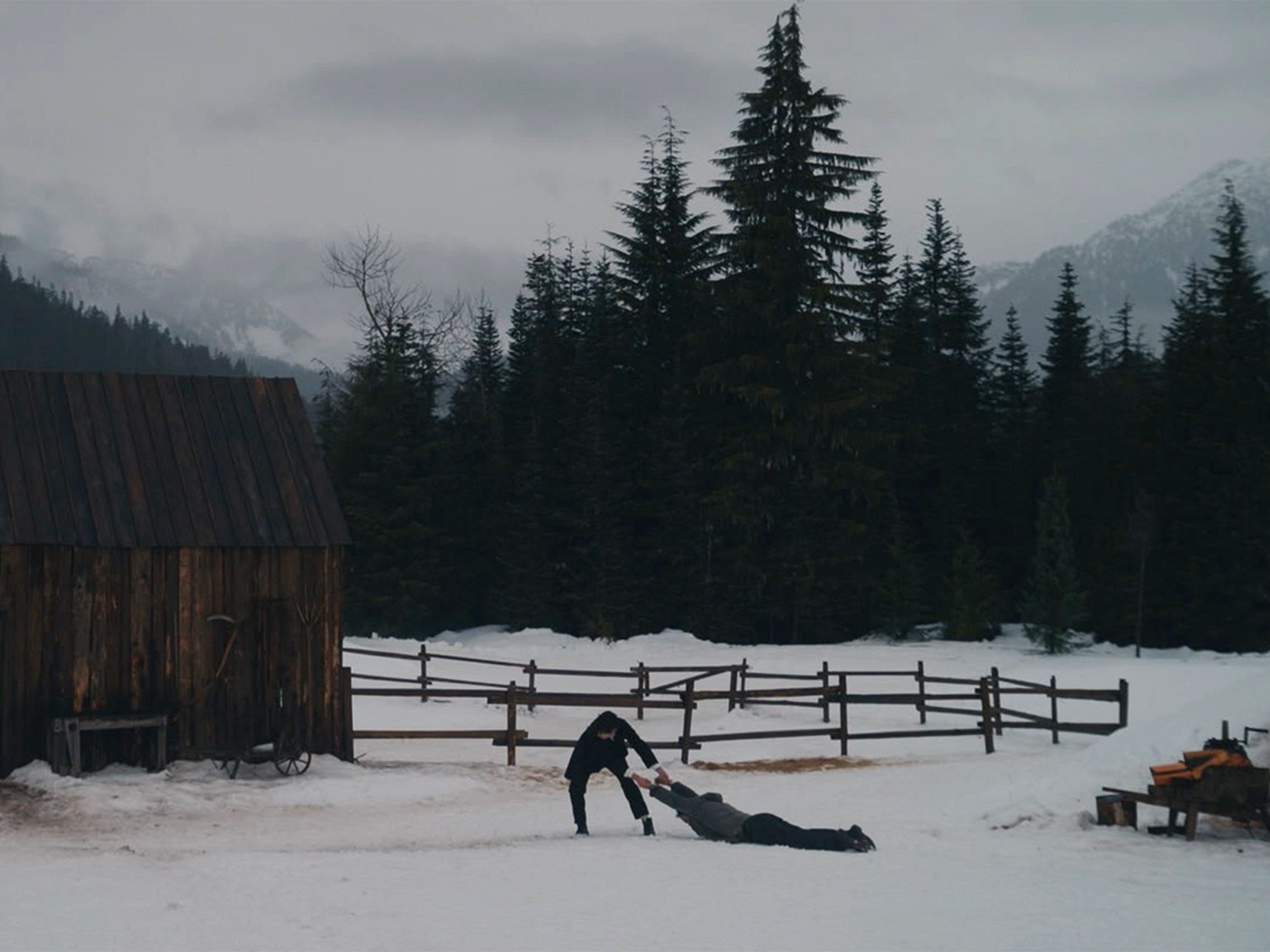
Casey Affleck’s Company is the cinematic equivalent of a Matryoshka doll, with Evelyn’s story nesting a story that nests a story that nests a story. To pull the intricate wooden dolls of this film apart would spoil the nature of its puzzling conceit, so let’s put it this way: Evelyn is in 1975, telling a room of strangers about the ageing hermit Joe (Nick Nolte) in 1953, who also welcomes a mysterious visitor (Caylee Cowan). That visitor, Alice, in turn tells the hermit yet another tale – one which involves a series of gruesome murders, Scoot McNairy’s stoic farmer Emmett, his wife Rebecca (Adelaide Clemens) and – you guessed it! – yet another mysterious visitor, the moody drifter Caleb (Atticus Affleck).
Get more Little White Lies
Affleck tries to corral this sprawling ensemble – perhaps made easier by casting his two sons, Atticus and Indiana, and girlfriend Cowan – by elucidating their interactions through a repeated use of the titular word. “If you don’t mind my company,” Alice tells Joe as she takes a cosy seat by the fire. “You don’t want my company,” Caleb morosely tells Rebecca. It is as if by repeatedly returning to this idea of togetherness the director/co-writer can begin to make sense of his muddled musing on the isolating nature of loneliness.
It is odd how far from grasping this concept Affleck is given the refined tenderness of his narrative directorial debut, Light of My Life. Like Company, the father-daughter drama zoomed into the relationship between two people asked to trust each other’s presence at times of looming danger, with the director capturing the terrifying reality of love, one inextricably tied to the possibility of loss. By contrast, Company never quite understands the depths of such stakes, relying on a sequence of convoluted parables to create the sense of dissonance that ushers in the film’s predictable twist.
Once peeved by the senseless zigzagging structure of the story, all other flaws become even more glaring. It’s quite an ask of the audience to suspend disbelief when young women with cosmetically-enhanced lips and hand-sculpted bones stumble over the foreign cadence of old accents, the illusion further weakened by shoddy costume and production design that edges Company much closer to a community theatre production than a high budget historical drama. The dialogue, frequent, lengthy and overexposed, turns risible when delivered by Atticus Affleck, whose affectations needed pruning instead of encouragement.
It’s a great shame, for when the filmmaker finally allows the viewer into the guarded arena of the film’s secret, just fifteen minutes before the end credits, there are precious moments of genuine inspiration. A kiss becomes a sentence but also a great gift, as two lovers at last grab at the rogue time-spanning threads of this modest epic. It feels ironic that this film, built upon the notion of inviting one in, is so relentlessly intent on shutting us out.