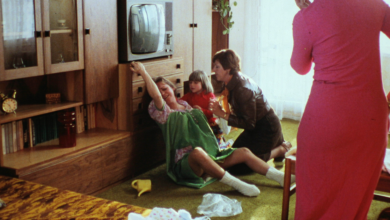

Lisa’s sexual after school activities may seem separate from Monica’s death, but they are inextricably linked. The former are brief, perfunctory affairs, while Monica’s suffering in Lisa’s arms after the accident, is as intimate as it is disturbing. The violent and prolonged death sequence in which Monica rapidly loses blood as her leg (which remains jammed under the wheel of the bus) has been torn from her body, is so purposefully explicit and traumatic that it is felt throughout the film. In her book ‘Girl on Girl: How Pop Culture Turned a Generation of Women Against Themselves’, Sophie Gilbert carefully draws comparisons between the graphic images filling the news from the Iraq War – particularly the images of Abu Graib – and the torture porn films (such as Eli Roth’s Hostel) of the same era. By the mid-noughties, porn had influenced American soldiers’ war crimes, and extreme violence had influenced mainstream media to such a degree that pop culture had reached a point of extreme exploitation, becoming all too easily digestible. Indeed, from Bonnie Blue’s brand of hypersexuality to the onslaught of memes of the assassination of Charlie Kirk, it is clear we are now at the peak of a desensitised society.
Within the context of the noughties era of extreme degradation and proliferation of violent imagery, the source of Lisa’s flippant attitude towards her body is clear. This isn’t simply the braggadocious nature of a hormonal adolescent, but behaviour influenced by an increasingly explicit media landscape. Like many young girls at the turn of the century, Lisa has unconsciously received the message from pop culture that the commodification of her sexuality is the key to her liberation. The choice to focus so much of Margaret’s runtime (even more so in the extended cut) on Lisa’s sexual forays demonstrates how she wields her sexuality in the same way she uses her quick mind: lashing out and grasping for some semblance of control over a life that suddenly seems inexplicably bleak.
Sexual anguish may not be the first thing that comes to mind for many when considering the aftermath of a terror attack, but Margaret is not alone in exploring post‑9/11 anxieties through sexual exploration. James Cameron Mitchell’s often overlooked erotic comedy Shortbus (2006) is centred on a group of New Yorkers struggling with their sexual expression, resulting in deep existential crises. Its un-simulated sex scenes reflect the graphic nature of the decade, yet the film injects meaning back into the sexually explicit. As Cameron Mitchell told Charles Bramesco, his aim was to lift the despondent characters out of George W. Bush’s era of “lockstep bloodthirsty patriotism”.
In Brady Corbet’s Vox Lux (2018), three simultaneous events help shape teenage popstar Celeste’s (Raffey Cassidy) burgeoning adult identity. The events of 9/11, Celeste’s loss of her virginity and the discovery that her sister is sleeping with her manager all occur consecutively. Corbet purposefully framing her loss of innocence with the events of 9/11 renders the whole of America a suddenly disillusioned teenage girl no longer able to square the nation’s mythmaking with the violent realities and consequences of its foreign policies.
Corbet’s Celeste and Lonergan’s Lisa are similar in age, but Lisa certainly lacks the cold composure of the teenage popstar who has a PR team to help her articulate press statements about acts of violence. Lisa casually disperses often contrarian rhetoric with the same erratic approach she has to sex, sometimes envisioning herself a voice for discriminated groups, commenting snarkily on police brutality while on the phone to an officer, or telling another not to call her “honey”. Yet, she undermines her stance constantly with her hair-trigger responses to a Syrian student Angie (Hina Abdullah), who she often comes to loggerheads with. Lisa frequently conflates all Middle Eastern countries due to limited political insight and weaponises the events of 9/11 to deflect opposition. In one of her worst moments in the film, she compares a “19 year old Palestinian to Hitler Youth,” before being kicked out of the classroom.
Although there are some stirrings of resentment towards an unjust society, Lisa’s better judgement is often clouded by the overwhelming sentimentality about protecting the “American way of life”. Pair this with her blind appropriation of grief over Monica’s death often overshadowing Emily’s own feelings, Lisa becomes the imperfect product of the era’s propaganda. In the simplest reading, the audience is invited to compare Lisa’s complicity in the bus crash with the blood on the hands of the country, although it will take more than the film’s lengthy runtime for the US to acknowledge its own fault. Delving a little deeper, through the whirling dirvish that is Anna Paquin’s Lisa, Margaret offers a girl on the brink of adulthood as challenging and cancellable as Cate Blanchett’s Lydia Tár, filled with all the conflicting anxieties, emotions and parroted American values to make her poster girl for the post‑9/11 teenager.