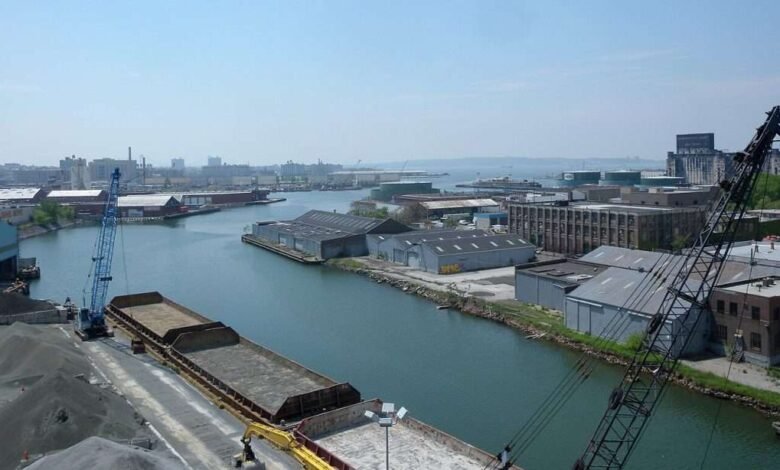
 The Gowanus Canal (originally known as Gowanus Creek) is a 1.8-mile-long waterway in Brooklyn that was once a saltwater marsh teeming with wildlife, but is now among the most polluted bodies of water in the United States.
The area’s early settlers, on the first land patents issued in Breukelen (today Brooklyn) named the waterway “Gowanes Creek” after Gouwane a sachem (chief) of the Canarsee, an indigenous Lenape tribe who exploited the waterway’s resources and farmed its shores.
Adam Brouwer, who had been a soldier with the Dutch West India Company, built and operated a tide-water gristmill here and by 1640 it was home to a tobacco plantation.
In 1699, a settler named Nicholas Vechte built a farmhouse of brick and stone now known as the Old Stone House, which still stands, although the creek itself has been rerouted away from the house.
 In 1776, during the Battle of Long Island, American troops engaged British Army troops at the house, which is often seen in drawings depicting the battle.
Gowanus Bay‘s 6-foot tides pushed brackish water into the creek, creating an environment where large bivalves thrived and this place was once a well-known supplier of mussels, clams and oysters.
By the mid-19th century, as the City of Brooklyn was became the United States’ third-largest city, the creek and surrounding farm lands began to also function as both an important transportation hub and an informal sewage and waste dumping ground.
 Between 1849 and 1860 Gowanus Creek was dredged to serve as a commercial waterway connected to Upper New York Bay.
The canal came to include stone and coal yards; flour mills; cement works, and manufactured gas plants; tanneries, factories for paint, ink, and soap; machine shops; chemical plants; sulfur producers; and fertilizer makers. All of these emitted substantial water and airborne pollutants.
In 1910 a local businessman reported that the canal was “almost solid” with sewage.
At its busiest the waterway saw as many as 100 ships, but by the mid-20th century was falling into disuse as railroads supplanted domestic shipping.
It is still used occasionally for the movement of goods, but more typically by small boats, tugs, and barges. Seven bridges or viaducts now cross the canal.
Superfund Site & Gowanus Conservancy
In 2010, the Gowanus Canal was listed as a Superfund site by the Environmental Protection Agency (EPA), a designation reserved for contaminated sites where hazardous substances pose significant risks to human health and the environment.
Efforts to delineate the extent of the contamination and to clean it up have been underway since, but until very recently the waterway remained contaminated with fecal coliforms and unhealthy pathogens.
 The waterway has also had a low concentration of oxygen, which left it generally incompatible for marine life, although a variety of extremophiles were observed in the canal. Extremophiles are organisms which can live in such extreme environments at the limits of what living things can adapt to.
At the time of the Superfund listing, the Gowanus Conservancy was created. The non-profit volunteer organization provides environmental stewardship by educating the community about environmental issues and advocating for, building, and maintaining green infrastructure projects in the area.
Their Mussel Habitat Project, in partnership with the Gowanus Dredgers Canoe Club creates and monitors artificial habitats to protect Atlantic ribbed mussels (Geukensia demissa) from habitat loss during Superfund cleanup.
Students design, build, and deploy specialized modules on new steel bulkheads to foster a thriving, resilient ecosystem. With a grant from New York State Pollution Prevention Institute this project recently engaged 89 Brooklyn Collaborative Studies high school students in constructing 30 habitats installed in bulkheads of the canal to support mussel growth.
The students designed, installed, and observed mussel habitats along the industrial shoreline of the canal. These native mussels act as filter-feeders that improve water quality and provide natural filtration by removing excess nutrients, organic matter, pollution and suspended solids from water.
The Mussel Habitat Project also included twelve community science field trips for 400 students in grades 5-12 to observe habitats and conduct water quality testing.
The students that participated in this project were encouraged to make positive environmental changes in the neighborhood and city through stewardship, education and advocacy.
 A post-installation survey revealed that 5,443 Atlantic ribbed mussels had settled on the new habitats.
Additionally, many students that participated developed a deeper interest in environmental stewardship, joined the Conservancy’s Green Team, applied for internships, or volunteered to support local environmental efforts.
According to a report this summer in Crain’s, the NYS Department of Environmental Conservation (DEC) is pushing to the waterway reclassified, hoping to escalate cleanup efforts and eventually make the canal safe for swimming.
The Canal is currently classified by DEC as a “Class SD” waterway, which could to support some fishing. DEC is hooping to change that to “Class SC” to force the city to rehabilitate the water enough to allow swimming and boating.
Until then, the Gowanus Canal is getting cleaner every day.
Illustrations, from above: Mouth of the Gowanus Canal (photo by Wikipedia user Jim Henderson); Battle of Long Island on 27th August 1776 by Alonzo Chapel, note soldiers in Gowanus Creek; “Sunset at Gowanus Bay” (1851) by Henry Gritten; A warning sign in place on August 24, 2023 (photo by Ben Fractenberg); and the Mussel Habitat Project results, 2025 (courtesy Mussel Habitat Project).
Source link