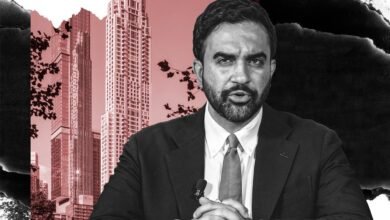

Alleged fraudster Mahender Makhijani left a trail of victims, but few more surprising than respected California landlord Gerald Marcil.
Federal agents arrested Makhijani last week for allegedly defrauding Western Alliance Bancorp out of $100 million. While national outlets focused on the Newport Beach investor’s brazen financial fraud, the alleged scheme rested on real estate plays: title policies that could be manipulated, a willing lender and a deep-pocketed investor who could back his loans
But for Makhijani’s plan to work, he needed to find a guarantor so banks would have the confidence to lend to him.
Enter Marcil, who owns thousands of multifamily units in Southern California and claims to have never defaulted on a bank loan in his 50 years in business.
Now, Marcil says he was allegedly duped by Makhijani, someone he once considered a trusted advisor. Two recent lawsuits filed by Marcil in California state and federal court lay out Makhijani’s pattern of allegedly using Marcil to sign off on loan documents on short notice and with little explanation. Marcil’s lawsuits also allege Makhijani committed elder abuse against the 73 year old.
“He gave him things at the last minute, saying ‘This deal has got to go down; if you don’t sign it now, we’re going to lose this,’” Marcil’s attorney, Albro Lundy at Baker Burton Lundy, said.
Marcil invested in Makhijani’s deals, including buying distressed properties. Marcil also provided loans to and guaranteed other loans for Makhijani. Makhijani has allegedly not paid back those loans and left Marcil to pick up the debt.
In the state court action, Marcil is suing Makhijani to collect on two personal loans he made to Makhijani totaling $9 million. Marcil alleges the loans are now in default.
According to Marcil’s lawsuit in state court, Makhijani engaged in multiple fraud schemes, including:
- Secretly placing second and third trust deed loans on at least 11 properties that Marcil had invested in
- Selling properties and pocketing sale proceeds without disbursing them to investors
- Issuing a $3 million capital call to investors for property tax payments, but keeping the money and never paying the tax authorities
- Stopping mortgage payments on properties and keeping the rental income from the properties for himself
- Refusing to pay the lawyers in a lawsuit involving himself and Marcil, leaving Marcil with a $2.4 million legal bill
Origin story
Marcil said he originally met Makhijani through Marcil’s son Jason. Makhijani hired Jason to market investment deals, which consisted of buying defaulted loans behind salvageable properties.
The elder Marcil was brought on as an unpaid consultant on certain deals to help his son’s business career and Makhijani earned Marcil’s trust and friendship.
Marcil invested in Makhijani’s deals buying foreclosed and distressed properties. The two traveled together and Makhijani “lavishly entertained” Marcil. Marcil, then in his mid 60s, felt so comfortable he even entrusted his retirement funds with Makhijani.
Makhijani acted dutifully as the trusted advisor for the first eight years, the lawsuit says. His deals produced income below Marcil’s expectations, but the returns were acceptable to Marcil because he did not have to manage the investments.
But after eight years, Marcil alleges Makhijani exploited his trust by asking him to sign loan documents without receiving the complete loan packages or giving him time to read them. Makhijani would also allegedly present false terms of the loans to Marcil, ultimately leaving Marcil responsible for massive debt.
Marcil was also dragged into high-profile civil lawsuits, including those brought by Western Alliance and Zions Bancorp last year, which allege that Makhijani’s firm took on multiple mortgages without telling the banks, leading the banks to believe they had first lien positions. Zions revealed it had $60 million in exposure to the fraud, while Western Alliance disclosed it had $100 million in exposure, tanking their stocks by more than 10 percent last October. It also came in the wake of the bankruptcies of auto parts company First Brands and auto lender Tricolor, creating broader systemic concerns about credit quality.
Nano Banc
Marcil’s lawsuit in federal court in the Central District of Southern California alleges Makhijani defrauded him by using Nano Banc, a FDIC insured bank that Marcil says Makhijani controlled. Makhijani was also responsible for sourcing about half of the owners of Nano’s equity, which included Marcil.
“Mahender was the puppeteer,” said Lundy about Makhijani’s influence over Nano Banc.
Once again Marcil alleges he was manipulated by Makhijani.
Marcil claims Nano Banc had previously engaged in a fraud involving a joint venture between Makhijani and real estate investor Mohammad Honarkar. Nano Banc agreed to lend to a joint venture between Makhijani and Honarkar. But the bank and Makhijani instead allegedly diverted about $20 million to a different Makhijani company, Continuum Analytics.
Honarkar went into arbitration in 2023 with Makhijani and Nano Banc over the diverted funds. Marcil alleges he was used as a way for Nano Banc to clear up its balance sheet and create a paper trail to make the loan look legitimate as the arbitration was pending in 2024. Marcil alleges Nano Banc hurried him into signing a $19.2 million loan, telling him that Makhijani already had too much credit with Nano Banc. Nano Banc sent the loan proceeds to Marcil’s account, but then immediately withdrew the loan proceeds on the same day.
Nano Banc also had Marcil sign an indemnity agreement, making Marcil legally responsible for the bank’s losses stemming from the arbitration award. Marcil refused to agree to those terms, and as a result, Nano Banc put Marcil into default on the $19.2 million loan and threatened to foreclose on his real estate portfolio, according to his lawsuit. An arbitrator recently awarded a $1.34 billion judgment in favor of Honarkar and against Makhijani.
Marcil is seeking a jury trial to void the indemnity agreement.
Nano Banc claims in its legal filings that Marcil read and signed the loan documents and had time to review the loan terms. Nano Banc’s lawyers declined comment for the article.
“Gerald J. Marcil – a wealthy, sophisticated real estate investor of more than four decades’ experience who owns interests in entities holding hundreds of millions of dollars in California multifamily real estate,” Nano Banc’s lawyers said in a filing.
The bank’s lawyers added, “The public interest does not support a rule under which a sophisticated investor can stop paying his loans, allege a sprawling fraud, file a 92-page complaint loaded with bare incorporation by reference to an arbitration award against a third party, and obtain an emergency order shutting down the lender. Such a rule would invite abuse and destabilize commercial lending.”
Read more

LA landlord Gerald Marcil among investors accused of bait-and-switching banks

California firm related to Zions Bancorp’s stock tumble is also in NYC real estate