
Did you know that toxic house flippers are sucking money out of neighborhoods and making them unaffordable?
Fear not. Politicians are here to save your communities from these evil-doers.
The war against house-flipping is heating up again. In Brooklyn, a state senator is renewing her push for the “End Toxic Home Flipping Act.”
A more accurate name would be the Preserve Dated Kitchens Act or the Perpetuate Neighborhood Eyesores Act. How about the Make Homes Unsellable Act? So many possibilities.
The bill, which has two dozen co-sponsors, is being carried in the Assembly by a member from Queens. Coincidentally, City Limits just ran an ominous story about house flippers “transforming neighborhoods like South Jamaica.”
Attacks on house-flipping pop up regularly across the country. It’s a perfect topic for elected officials to employ an old strategy: frighten constituents, then ride to their rescue with a new law.
State Sen. Julia Salazar, the first Democratic Socialists of America member elected to the state legislature, is using this playbook in northern Brooklyn.
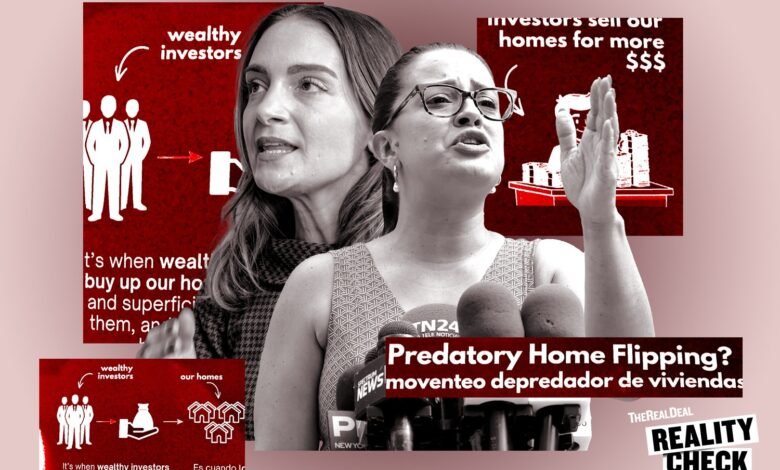
“What is Predatory Home Flipping?” a recent Salazar flier mailed to constituents asks in large print. “It’s when wealthy investors buy up our homes, quickly and superficially renovate them, and resell them for huge profits.”
A cartoon shows a smirking white guy in a suit counting stacks of money. “Investors sell our homes for more $$$,” the mailer says, with an arrow pointing to the man. At least he’s not wearing a yarmulke.
The flier says home-flipping is concentrated in communities of color. That is not surprising — they have more low-priced fixer-uppers and owners who might need to sell.

Salazar’s solution is a punitive flip tax. Let’s look at whether her bill, sponsored in the Assembly by Queens Democrat Catalina Cruz, actually targets the “predatory” actions depicted in Salazar’s mailer.
Does it focus on “wealthy investors” while protecting mom-and-pop contractors? No. It applies to all buyers except family members of the seller.
How does the bill define “predatory” buyers and “huge profits”? It doesn’t. It applies to flips that make a big profit or no profit — and even to those that lose money.
Forget taxing the rich. Let’s tax businesses that suffer losses!
Does the bill define “superficial” renovations? If you guessed no, you’re catching on.
If anything, it would encourage superficial renovations by exempting sales when the price rises by 10 percent or less. Don’t bring the plumbing and electrical up to code — just slap on a coat of paint!
Taxing losses, extending vacancies
Now let’s look at what is really in the bill.
The legislation says if a home is resold within one year of purchase for more than 10 percent more money, the gain is taxed at 65 percent. If sold in the second year, the tax would be 50 percent. (There are exceptions if the homeowner dies, can demonstrate financial hardship or sells to a relative.)
Flippers would have to wait two years to avoid the tax. Great idea — prolong vacancies in the midst of a housing crisis!
Salazar and Cruz are not trying to make flippers wait, of course; they’re trying to stop them entirely. That’s why they make the tax incredibly high and apply it to the price difference, rather than to the profit.
Say you buy a fixer-upper for $500,000, spend $500,000 on renovations and sell it within a year for $1 million. Your profit is zero. Your Salazar tax is $325,000.
That’s not a typo. For turning a neighborhood eyesore into a renovated home for a family, your reward is a $325,000 gut punch. Or you could sell during the second year and pay $250,000. But keep it off the market for 24 months and you’re home free.
Rich buyers only
Salazar and Cruz want fixer-uppers to be renovated only by people who plan to live in them. Have they thought for one second about what that entails?
At the risk of stating the obvious: A family must buy the fixer-upper and fund its renovation while also paying to live in the home they’re leaving, a hotel or an Airbnb.
Rich buyers can afford that, but most buyers can’t. They also don’t want to deal with designers, contractors and architects. They want a place in move-in condition.
Homebuyers would not be the only victims of the End Toxic Home Flipping Act. Owners of homes that need a lot of work would find it virtually impossible to sell to flippers. With a limited universe of buyers, they’d be trapped in their own homes.
Dilapidated properties would sit vacant or sell for a pittance because the flippers won’t offer much if facing a 65 percent tax or two-year wait.
New Yorkers don’t want decrepit houses on their block. They want them fixed up.
Flippers, obviously, would see their businesses suffer or die — people like the husband-and-wife team of Carlos Saavedra and Nicole Eckstrom, who turn decaying townhouses into gorgeous homes that keep high-income people in the city.
These entrepreneurs are not predators. No one is being forced to sell to them.
Most flippers are not doing $2 million upgrades like Saavedra and Eckstrom, but rather countless smaller projects that keep the city’s housing stock viable. The “End Toxic Home Flipping Act” goes after them all — except the quick and dirty sub-10 percent flips that do cosmetic work when a gut-reno is needed.
I understand the desire to keep housing costs down. But discouraging renovations is a terrible way to do that. It either extends vacancies or embraces crappiness as an affordable housing strategy, just like limiting apartment renovations to $15,000 (which Salazar voted for in 2019).
The one positive here is that various iterations of Salazar’s bill have been stuck in committee for six years. Maybe her mailer was just a public relations stunt and not a real attempt to pass something, but the City Limits article suggests otherwise.
Regardless, it’s frightening that 26 legislators have attached their names to this bill. I suggest they make it a pilot project that applies only to themselves and their families. Then they can explain to Aunt Verna, who wants to sell her run-down home and move to Florida, why nobody’s bidding.
Read more
It’s official: Rent control is about wrecking apartments

Home-flip tax would punish the good guys

House flipping: it’s harder than it looks