Stories, Journeys, and Lineages of Queer Latine and Caribbean Women and Non-binary Folks in Musical Theatre

In musical theatre, stories of identity, migration, family, love, and belonging are sung into being. But whose stories take center stage, and whose remain overlooked? For queer Latine and Caribbean women, trans, and nonbinary artists, visibility is deeply intertwined with artistic expression, cultural identity, and access to creative opportunities.
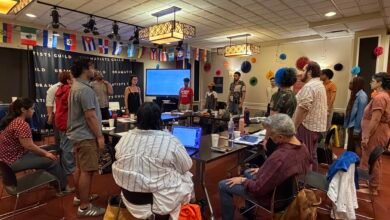
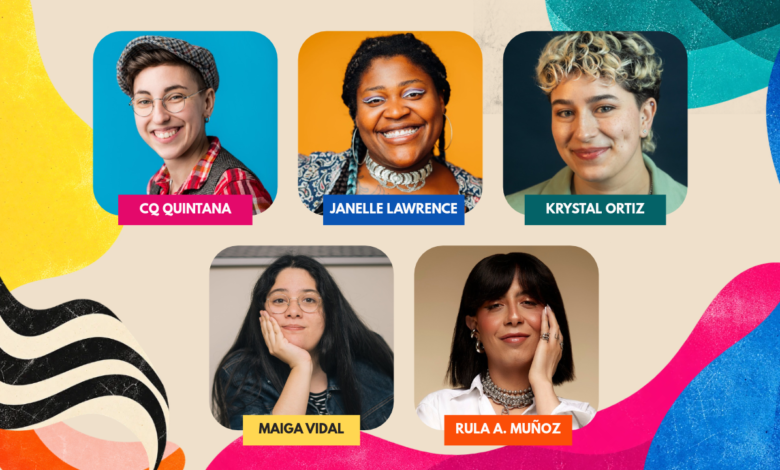
This conversation explores how CQ Quintana,Janelle Lawrence, Krystal Ortiz, and Maiga Vidal navigate and challenge the expectations of an industry that has historically centered a narrower range of voices and experiences. Moderator Rula A. Muñoz traces these artists’ pathways into musical theatre, the personal and cultural influences shaping their artistry, and their experiences of erasure, representation, and belonging. But this conversation also celebrates the ancestors, mentors, and communities that have sustained them; the stories they are determined to tell; and the possibilities they envision for future generations. Their reflections reveal musical theatre as a space of cultural memory, resistance, joy, and collective imagination. Rather than waiting for musical theatre to become more expansive, these artists are already expanding it.
Rula A. Muñoz: Let’s start from the very beginning. Was there a moment, artist, or experience that made you feel that musical theatre could belong to you?
Janelle Lawrence: I have a family who, none of them are artists or performers or musicians, but everybody sings and is really theatrical in their mannerisms. So, musical theatre sort of just felt like family in that way.
Maiga Vidal: I didn’t even know that musical theatre was a thing people did on stage. I had never even seen a musical or anything until I was a freshman in high school and they were hosting auditions for Man of La Mancha.I didn’t get cast, but I showed up to rehearsal every day, and I was like, “I will one day do this.” …And then I played the maid.My mom was not happy about the Latina playing the maid, you know what I mean? It’s just one of those things that comes around unfortunately.
CQ Quintana:I used to always say that my sensibility as an artist is something like Mel Brooks meets the TheTwilight Zone. I have this memory of my mom buying The Producers at a time when you couldn’t find it anywhere. I do think, in an interesting way, Mel Brooks was kind of a bit of my way in, in terms of thinking about musicals and what you can do and how satire can operate.
Krystal Ortiz: My parents thought I was very shy as a kid. I was very fortunate, and they decided to put me into a theatre camp to get me out of my shell. I loved it and went back to the summer camp every year at the Actors Playhouse in Miami. I was in a production of A Chorus Line at eleven years old. I remember wearing a bright green wig for a Wicked and Godspell medley, and I have such great memories of that time. That was my beginning of musical theatre just being such a joyful expression.
Rula: As people from the Latina diaspora, we are so complex and hold so many shapes and forms and identities as humans. Yet in mainstream media, we must be one-dimensional. How have your identities and intersections shaped the stories you tell or your artistry?
Janelle: My identities shape how I see everything. They are my lens to move through life. My lineage is Dominican and Haitian, and when I was younger, my aunt would say that I was a peace child. I didn’t really understand what that meant for so long. Then, I got older, and I understood the dynamics between Haitians and Dominicans, and I understood the dynamic between my mom and my dad. I was like, “Oh, they called me the peace child because I’m the thing that brings these two places together.” I find that my musicals are often about complex layers, like, “Maybe you’re not right, maybe you’re not wrong, but….” Also, I write a lot of queer stories because I’m a queer person. I see things through queer lenses—I see heterosexual moments through queer lenses, right? It’s a lens of really trying to understand where conflict lies, which is where musical thrives.
CQ Quintana: In my grad school days, I remember Chuck Mee saying to us, “Who you are is what your stories are.” Everything that I write is queer. Everything that I that I write is Cuban American. It’s just who I am. You know, our lineages, our ancestors shape like who we are and why we’re here. Coming from a very Catholic background in the South, I definitely had shame coming into myself. But I think I am in a place now that I can be proud of all the parts of me and what I am. There’s no way for that not to filter down into the characters I write.
Maiga: My work like lives in the chasm between the two versions of me that are constantly pulling at each other. I’m a chaotic bisexual. I’m bilingual. I was born in Chile but grew up in Los Angeles. I was undocumented and now I’m a citizen. There’s just like a constant thing of being two things at once and all these intersections being there. With Cafe con Leche, which is a show that I’ve been writing now for five years, there’s a lot of coming to terms with being a very queer kid but not knowing that or having language for that.In writing this show, I discovered a lot of myself.
Krystal: I’m interested in the moment of people choosing to become closer to themselves or not. For example, I played a lot of lesbian and male roles in high school, and looking back… I think I was drawn to trying on those parts of myself in a protected space. I could do that without it meaning anything.
Maiga: I think there’s a spectrum of what queerness can be presented as, and that’s what’s wonderful about there being more than one queer writer, more than one queer femme or queer non-binary writer.
I think there’s a spectrum of what queerness can be presented as, and that’s what’s wonderful about there being more than one queer writer, more than one queer femme or queer non-binary writer.
Rula: Can you speak about the moments when you experienced erasure, invisibility, or barriers within the field? How have you navigated those experiences?
Also, what are you hoping for the future generations of artists will no longer have to fight to prove or to explain?
Janelle: I am hoping that future generations of artists will no longer have to be the Brown or the Black or the ethnically ambiguous body on a stage to tell a story. I want them to just be able to like live in their stories and their experiences. I hope that in the future we can be loud. We can call things out. We can be ourselves. We have to be allowed to write messy, to have development, to be supported with resources in our development.
CQ Quintana: We’ve just lost so many spaces, even for “straight plays.” One of my great hopes is just more spaces for artists of all stripes, artists like us, artists beyond us.
I think about the difference between the commercial route and the kind non-commercial or nonprofit route for musicals. What’s possible? When I’ve been working on a book for a commercial musical project, it’s a very different world. I worked on a procedural television show where literally we could only have one gay episode per season. Thinking about those constructs, which are real, I really, really hope that we can break beyond…
I really think that we are out here, and we are pushing. I’m impatient, but I am excited for the change that is continuing to happen.
Rula: Are there artists, ancestors, mentors, or lineages inside or outside the theatre that you feel connected to in your work? Who helped make space for you, even if it was indirectly?”
CQ Quintana: I really want to shout out Diana Oh. I have been thinking about them so much. Musical theatre has this gift of accessibility, of reaching people, and I think that was just the very core of what Diana was all about. They were creating these pieces that create a community, and that’s what theatre does at its best.
I also got to go to see Buena Vista Social Club on Broadway, and that’s so visceral and of this moment. What a fucking beautiful gift that we can be part of this very human thing in this moment when our humanity is so at risk.
Maiga: The one person that I really want to shout out is my high school theatre teacher, Donald Moore. He looked at me, and he was like, “You’re an all-American girl. You will be playing Rosie in Bye Bye Birdie and Adelaide in Guys and Dolls, and you will be doing Greek tragedy.” He expanded what I could be, and then I went out into the real world, and I was put in a box that I didn’t even know existed. My goal as a writer is now to expand that box with characters written by and for us.
Krystal: I started exploring the Chicago theatre scene when I was in college and went to all these shows in people’s apartments and late-night shows at the Neo-Futurists. Checking out the experimental scene really woke up my appetite for theatre again. Chicago has mentored me a lot in my becoming the theatrical artist that I am.
Janelle: I’ve always lived in this intersection of like Black and Latine, where I’m spending so much time inside and outside of theatre trying to validate who I am so that space can be made for me.
To the part of the question that was like, “Who helped make space for me?”I felt like I made space for me. Like, I did. I really had to put myself in front of people and say, “You may not think I’m Latina, you may not think I’m Black, but I am, and I’ve lived that life.”
In that fight, I pick up great allies like all of you. People have been really great allies in this fight with me. So, we have collectively made that space. I’ve been in the act of finding my community and my allies and the people who I believe in, and we believe in each other. So, we put ourselves in these rooms.
Rula: What gives you hope right now? What possibilities do you see emerging for queer Latina and Caribbean women, trans, and non-binary artists in musical theatre?
Maiga: Janelle’s speech gives me hope. No joke. So much of what we do is alone—sitting down and writing on the page.What is within our power is our act of creation, I think. Nobody might produce it, but you know what? It’s still mine. It still belongs to me. It’s still my story.
CQ Quintana: There is so much hope in persistence. Years ago, an artistic director said to me that artists are like weeds: We just find a way. There is something just so beautiful about people persisting to write things that feel impossible in all the ways.
Krystal: Something that gives me a lot of hope is this book that Daphnie Sicre is working on, documenting all these Latino musicals post-2008. I’m so excited for the visibility that will come from all of these projects and names being written down. I’ve had this experience recently where I’m talking to non-theatre people and I say that I write musicals, and they go, “Oh my god, do you know Hamilton?” And it feels kind of like asking a chef if they’ve ever had pizza. Like, yeah, pizza’s great. It’s a fan favorite for a reason. And I’m excited to bring more attention to all the other amazing culinary dishes that are in our universe, too.
Janelle: I hope that there are so many of us that we get to be our own people and we don’t have to fall into a box or a genre all the time.
I want you to see Janelle in my work. I want you to see the stories that I want to tell, not because I’m Latina, not because I’m queer, but because you see the story.
I want you to see the stories that I want to tell, not because I’m Latina, not because I’m queer, but because you see the story.
Maiga: Let’s have a myriad of Latina stories because we’re just as American as the next person. Our own very American experience of being Latino deserves to be in the musical theatre canon, not just as like a note—you know, a hard question on the exam—but as a genuine celebration of this particular voice that’s been honed here for generations.
Rula: Thank you, everyone, so much. I’m so grateful to hear all these rich perspectives. There’s just so much—es muy rico hablar con todos ustedes.