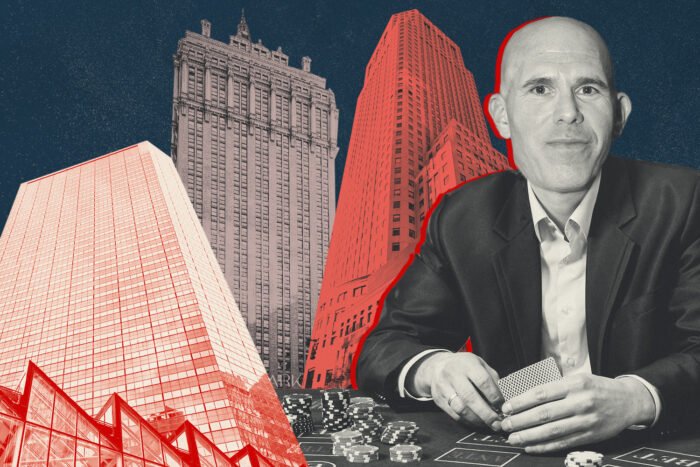
When the one-two punch of Covid and higher interest rates cratered the country’s office market, Scott Rechler was more candid about the seismic problems than most large New York City landlords.
In 2023, the 58-year-old CEO publicized that RXR, his commercial property firm, had embarked on an initiative called “Project Kodak” that would separate the viable “digital” office buildings in its mega-portfolio from the film-like properties that were now suddenly obsolete.
Three years later, that clean and simple-sounding strategy has given way to a more complex — and messy — reality.
In recent weeks, the Helmsley Building, a 35-story office property RXR owns at 230 Park Avenue near Grand Central Terminal, went on the market for about $670 million, a substantial discount from the $1.2 billion RXR paid for it roughly a decade ago.
At Worldwide Plaza, a tower at 825 Eighth Avenue in Midtown, the firm is wrangling alongside New York real estate titans Gary Barnett and SL Green to hold onto the property, whose $940 million mortgage loan is in default and whose senior lenders recently sought to foreclose. Rechler said that no foreclosure had yet taken place and that negotiations to restructure the deal were ongoing.
And, it has suffered a series of losses across its New York City portfolio that shows there’s red ink behind its Project Kodak plan.
Earlier this year, RXR sold a former office building in Brooklyn at 47 Hall Street that it had rezoned for residential development at a steep loss. Last year, it traded office properties in Brooklyn and Long Island City at deep discounts. It sold the Manhattan office tower at 340 Madison Avenue for $161 million at auction in 2025, according to Crain’s New York Business; the property had a $315 million loan from MassMutual and the buyer was Barings, a subsidiary of MassMutual. Another Midtown property at 1330 Sixth Avenue was sold in 2022 at a discount to what RXR paid for it in 2011.
Rechler said that RXR had rebounded strongly from the property downturn. It filed plans this spring for a 95-story, 3 million square foot project at 175 Park Avenue. Still, he acknowledged that the firm’s stable of institutional investors had shifted and its business had diversified and broadened beyond its New York focus.
“2023, ’24 were tough years,” Rechler said. “We were negotiating with lenders, [while there was] the least amount of clarity, the least amount of tenants in the market, [and] no debt alternatives in the market.”
The bruises are a turn from the way Rechler deftly capitalized on the peaks and valleys of past market cycles. In 2007, he sold his office REIT Reckson Associates to SL Green for $6 billion just before the Great Financial Crisis. Soon after, Rechler founded RXR and, in the years leading out of the recession, began snapping up prominent office assets at attractive values.
The market’s recent upheaval has impacted the pipeline of institutional cash that previously powered RXR’s rapid expansion. During the 2010s, the firm — behind the salesmanship of Rechler — was one of the most prodigious fundraisers in the city’s commercial real estate industry, raising a series of large property investment funds, including a roughly $820 million vehicle in 2017.
Rechler said that “institutions across the country and the world lost so much money on office in this Covid dislocation that it’s hard for them to have conviction to want to go back to investment companies and say, I want to start buying office again.”
Large institutional investors have generally understood that marketwide dislocations were to blame for swamping their office investments, according to Robert Ivanhoe, vice chairman of the law firm Greenberg Traurig and the senior chairman of its global real estate practice. But some investors are also fickle, he added, turning away from sponsors who had underperformed even due to the difficult overarching conditions – or more closely monitoring them.
“I hear that a lot from large institutional investors,” Ivanhoe said. “They invested with a particular sponsor, the investment went poorly, and they say: ‘We’re not going to invest with them again, at least not without retaining discretion.”
RXR has developed a new roster of funding sources in response.
Last year, it acquired a high-rise office building at 590 Madison Avenue for almost $1.1 billion — the highest priced post-pandemic office acquisition in the city. Rather than reach into the typical pot of cash it might have received in the past from insurance companies or pension funds, the firm took on the opportunistic investment firms Elliott Management and Baupost as partners.
“We’ve had to go to special situation funds that are willing to be contrarians,” Rechler said.
“They’re very nimble for a large organization, and that’s a testament to Scott’s leadership,” said Andrew Scandalios, co-head of JLL’s capital markets practice in New York who has worked on deals with RXR.
An appetite for risk
In 2022, the Federal Reserve began to sharply lift interest rates, which diminished commercial property values and stymied refinancings. Lasting pandemic-era shifts in working habits accelerated the obsolescence of older office assets, pushing down rents and forcing owners to confront spending large sums speculatively on upgrades in the face of uncertain demand.
“Like literally every investment made before three years ago is at risk of being a bad investment, right?” one New York City investment sales executive put it.
While Rechler and several real estate experts interviewed by TRD attributed RXR’s problem assets to those macroeconomic issues, some observers also noted instances where the firm showed a tolerance for riskier deals that stood a chance of going sideways even without “black swan” events.
In 2013, for instance, as the firm shopped for financing to purchase a leasehold interest in 75 Rockefeller Plaza, one banking executive remembered feeling uneasy at the high leasehold costs and the rental rates that RXR had projected to make the deal profitable.
“If things didn’t go as planned, you had an enormous ticking leasehold cost that reduced the margin for error,” said the executive, who asked not to be identified because he didn’t want to impact his business relationship with the firm.
Late last year, RXR restructured the building’s ownership and debt, bringing a new equity partner into an interest that valued the building’s leasehold at about $200 million, according to reports, less than half of what RXR spent buying it and renovating the tower.
Rechler pushed back on the assertion that the 75 Rockefeller deal had been optimistic or foolhardy.
“It was clearly a Covid casualty,” he said.
A spokesperson for RXR said that the building is presently “approximately 98 percent leased” and is “achieving rents exceeding $100 per square foot.”
Rechler also pointed to RXR’s sale in 2015 of a 50 percent stake in six office properties to Blackstone that allowed its investors to cash out and receive “two times a return on equity,” according to Rechler, protecting them from future losses at those assets. RXR’s investors at 1330 Sixth Avenue, for instance, had been profitably bought out of the majority of the tower’s ownership structure in the Blackstone deal, Rechler said, years before its ultimate discounted sale.
A spokesperson for Blackstone declined to comment.
But Rechler admitted that RXR had made mistakes. It acquired the stake in Worldwide Plaza, the 2-million-square-foot building, in a deal that valued the building at around $1.7 billion in 2017. Rechler said that, by then, RXR had noticed that property pricing was rising without commensurate rental gains in the market, a red flag that suggested values were overinflating.
“We probably should have totally stopped at that point,” Rechler said. “It’s the last deals that hurt.”
One tenant at the property said he has noticed fewer and fewer floors available to select on the digital touchscreens at the elevator banks as tenants have left and vacant floors were taken out of service. He said the dwindling number of occupants and lack of investment in sprucing up the 1980s-era building gave the tower the feel of a “zombie” property.
“Breaking ground this year.”
Rechler insists that, on balance, RXR is in a stronger place.
He suggested the firm is close to a breakthrough at 175 Park Avenue, a nearly 1,600-foot-tall office and hotel tower it is planning next to Grand Central. The building is anticipated to cost a staggering $6.5 billion, and RXR has applied for $4.8 billion of federal loans that it could qualify for because the project includes plans for upgrades to the surrounding transit infrastructure at the site.
Rechler said he had met with President Trump who had “taken an interest in” the project and claimed that RXR will be “breaking ground this year” on the development.
“Across all of our investment strategies, we’re raising more money now,“ Rechler said, explaining that his firm had increasingly broadened past its previous focus on office into other lucrative areas of the commercial property market, including multifamily apartment development, warehouse logistics spaces and lending. It has also spread its investing activities to markets across the country.
A spokesperson for the North Carolina Investment Authority, an investment manager for state pensions, said that it had invested in a $3 billion mixed use development outside of Raleigh that is being led by RXR. It is also participating in a separate venture with RXR that plans to provide preferred equity funding for apartment development projects in high-growth markets across the country.
“Both ventures are in the early stages, but they have met or exceeded projections to date, and we expect them to be successful over the long term,” the spokesperson said. “Given RXR’s broad expertise and our partnership’s success to date, we would certainly consider expanding the relationship for other investment opportunities.”