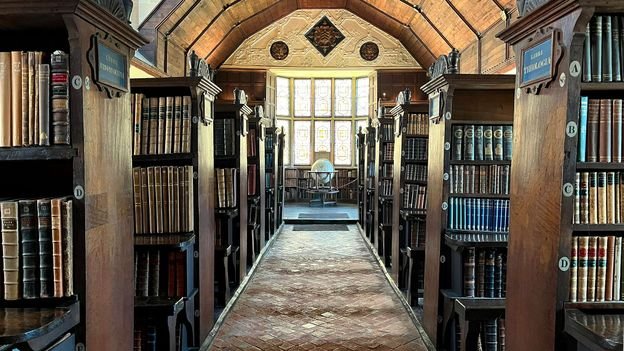
Today, just a few volumes in the library are chained – purely for display purposes. And the remaining books are now placed in the modern fashion with their spines out. But otherwise, the medieval room remains a remarkable time capsule of the library’s history. Near the entrance, visitors can even see the 13th-Century chest, which Walworth believes is the original. During term time, the historic library room is still used by students. And this ongoing use is a major factor in the superlatives that are often applied to the age of Merton’s library. “It’s hard to think of an earlier library room that’s been in continuous use,” Webber says.
The library is mythologised
Claims about Merton’s longevity first gained traction in the Victorian era, as it became more of a tourist destination. Visitors would marvel at its stained-glass windows, as well as rare books like its 15th-Century edition of The Canterbury Tales. “It’s one of the earliest books printed in England,” Walworth explains. “What’s unique about Merton’s copy is the hand-illuminated borders.” Among those who visited the library was American writer Ralph Waldo Emerson, who mentioned it in his 1856 travelogue English Traits. In 1884, a young Beatrix Potter visited, describing the library’s “beautiful oak roof” and “ancient, dusty smell” in her diary.
By this time, books and magazines were increasingly describing the library in record-breaking terms. An 1878 guide to Oxford called Merton’s library “the most ancient now in England”. The 1885 edition of the Encyclopaedia Britannica described it as “the oldest existing library in England”. Gradually, these claims were inflated. A 1928 article in The Times recounted an event held by the Oxford Preservation Trust in which it was declared “the oldest library in the world”.

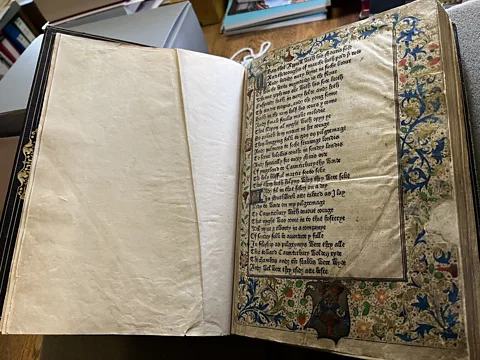 Courtesy of the Warden and Fellows of Merton College Oxford
This growing perception of Merton’s longevity was even referenced in F Scott Fitzgerald’s classic novel The Great Gatsby. In the book, the multi-millionaire title character fills his mansion with imitations of history’s most prestigious rooms. So, it’s only natural that his books live in a recreation he refers to as “the Merton College Library”. As Walworth puts it, “Merton’s library had become a byword for the ‘best’ ancient library” by that time. She even points out that Fitzgerald’s fictional scenario had roots in reality. “The dining clubs at Princeton University have historical imitation rooms. One of them is based on the Merton College Library.”
Source link