Theatre can bring us close to experiences we might otherwise encounter only from a distance. Few contemporary works accomplish this as clearly as The Gaza Monologues. Emerging from Gaza, the project has continued across different times and places, asking urgent questions about witnessing, ethical listening, and what happens when testimony is carried beyond the moment in which it was first spoken.
Palestinian theatre has long carried stories of exile, displacement, and political life. Emile Habibi’s The Secret Life of Saeed: The Pessoptimist, adapted for the stage and first performed as a one-man show by Mohammad Bakri in 1986, is one important example. The Gaza Monologues has had a different journey. It was never identified with one performer or production. I have seen the monologues performed by different people, in different languages and places, and what has always struck me is that the words remain those of the young people from Gaza. This is what makes the work a living archive: The testimonies continue to travel, while the reality that gave birth to them has never really ended.
From Psychosocial Practice to Transnational Testimony
The project originated in 2010 through ASHTAR Theatre in Ramallah as a psychosocial and artistic intervention following the 2008–2009 war on Gaza. Thirty-one young people, aged fourteen to eighteen, wrote first-person accounts of bombardment, fear, loss, and everyday survival that were later developed into monologues. Led by ASHTAR co-founder and artistic director Iman Aoun, the process centered collective authorship, ethical listening, and performance as a space where young people could speak in their own voices. What began as a local intervention evolved into a transnational performance practice. The work circulated internationally not as a fixed script, but as a repertoire of testimony activated through performance.
Diana Taylor’s distinction between archive and repertoire helps explain this journey. While the archive preserves memory through texts and documents, the repertoire carries memory through bodies, voices, gestures, and performance. The Gaza Monologues exists on the page, but it has never lived only there. Each new performer carries the testimony into another place and moment.
Voice, Naming, and the Politics of Presence
In The Gaza Monologues, there is specific attention given to names and places. The speakers are not simply young people “from Gaza.” They speak from particular streets and neighborhoods:
Tamer Najem, Ash Sheikh Radwan: Gaza is a matchbox… and we’re the matches inside it.
Ahmad El Ruzzi, Al Wehda Street: Before the war, I used to feel that Gaza was my second mother… but today I feel it’s an exile.
Amanee A. Shorafa, Al Remal: It was like a hand was extended to me… a rubber ring that pulled me out.
Gaza is so often encountered from a distance through numbers, images of destruction, and political language. Naming the speakers reminds us that behind a collective experience are individual lives that cannot be reduced to one story. No single voice is asked to represent Gaza. The thirty-one young people who composed the monologues speak from distinct experiences that do not become one story simply because they lived through the same war and siege. Together, their voices create a collective testimony without losing the individuality of the young people behind it.
Institutional Circulation from Gaza to New York
The international journey of The Gaza Monologues began early. In November 2010, twenty-two young performers from different countries came together in New York to carry the testimonies of young people from Gaza who could not be there themselves due to the siege on Gaza. Following a performance in English on 28 November, the monologues were presented the next day at the United Nations as part of the International Day of Solidarity with the Palestinian People.
Tasmin, a participant from Sri Lanka, remembers something Iman Aoun told the group on their first day of rehearsals: “Don’t assume. Take the initiative.” She describes learning to be independent while finding support among performers from different countries and backgrounds. The testimonies were not simply travelling as written texts; they were being entrusted to other voices and bodies. This became especially significant at the United Nations, where Gaza and Palestine are usually discussed through diplomacy, resolutions, and political language. That day, the words of young people from Gaza entered the room as testimony.
Touring Through Germany and Austria With KinderKulturKarawane
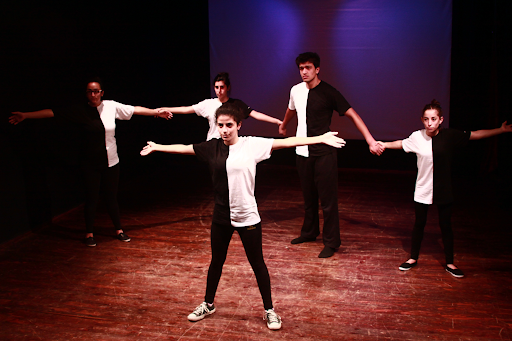
In 2014, I directed ASHTAR Theatre’s English-language production of The Gaza Monologues, which toured Germany and Austria for forty days with KinderKulturKarawane. We gave around twenty performances in fifteen cities, in theatres, schools, universities, and youth spaces. Almost every performance was followed by a discussion, and these conversations became part of the journey of the monologues themselves.
In Germany, students repeatedly connected what they had seen onstage to what they had learned about the Holocaust and the Second World War. They spoke about people becoming numbers and casualties. Theatre had confronted them with individual lives: young people remembering their dead, their homes and schools, but also speaking about their hopes and dreams. Some began questioning the distance between encountering war through the news and listening to one person tell you what happened to them.
The conversations became more difficult when German students spoke about the historical responsibility they had inherited from previous generations. We had not introduced this comparison; it came from the audiences themselves. For the Palestinian performers, it opened another question: How could these young Germans carry the history of Jewish persecution in Europe while listening to Palestinians describe their own lives under occupation, displacement, and restriction? We were not equating these histories. Young Germans and Palestinians were suddenly sitting in the same room, bringing different inherited memories into the conversation, and trying to understand how those histories continued to shape the present.
One of the most powerful encounters came when Tamer Najem, one of the original writers of The Gaza Monologues, finally joined us. Leaving Gaza had itself been difficult. He travelled through Rafah and Cairo before reaching Germany and could not join the company at the beginning of the tour. Until then, our performers from the West Bank and Jerusalem had been carrying the words of young people from Gaza. Suddenly, one of those original voices was standing in front of the audience.
After the performances, students repeatedly asked him: What can we do for Gaza? What should we give? How can we help? I remember one discussion when Tamer became very emotional and burst into tears. I cannot claim his exact words after all these years, but I remember clearly what he wanted them to understand: We are not here to ask for your money. What is the point of sending us aid, books, and food while we are under missiles? We need this war to end. We need our borders to open. We need to travel, study, and feel safe, like you.
He was asking them to understand solidarity differently—not simply as giving something to Palestinians, but as recognizing that their voices and political choices also mattered. He spoke about European governments and boycott as a form of solidarity. The response was mixed. Some felt he was accusing them personally; others heard the pain of someone speaking about a reality they had previously known mostly through the media. What stayed with me was that the conversation did not end with the Q and A session. People were still talking in the theatre corridors as we left. There was no neat conclusion.
In Frankfurt, an audience member asked me why The Gaza Monologues presented only the testimonies of young people from Gaza. Why were we not also hearing Israeli children? Could there one day be a play in which Palestinian and Israeli young people stood together on the same stage?
The question placed me in two positions at once: as a Palestinian and as the director. As a Palestinian, I felt it assumed a symmetry that did not match the reality these young people were describing. The Gaza Monologues gave them a space of their own—not as politicians or representatives, but as young people who wanted to study, play, love, travel, and imagine a future. The project had begun as a psychosocial intervention after war. In that space, I could not ask them to also carry the voices of those they associated with the military power behind their fear and loss.
But as a director, I understood the desire behind the question. I can imagine, and even dream of, a play in which Palestinian and Israeli young people stand together and speak about what this conflict has done to their lives. But that dream cannot be separated from the reality outside the theatre. A shared stage cannot perform equality and reconciliation while occupation, restrictions on movement, and unequal conditions continue. For such an encounter to have honest meaning, occupation must end, and Palestinians must be able to live with rights, safety, dignity, and freedom of movement.
I was speaking from inside that reality. I could direct this work in Germany and then return to a life in the West Bank shaped by checkpoints, permits, and restricted movement. This dictates what I can make as an artist. My responsibility is to narrate the reality I know and challenge representations that reduce Palestinian lives or allow others to speak for us. This does not cancel the dream of another kind of theatre. It means I cannot perform a reconciliation that has not yet become possible in life.
Questions about peace followed the performers throughout the tour: When can peace happen? How do you imagine the conflict ending? Sasha Al Asbah resisted the expectation behind them. As I remember her words: We are not politicians. We are Palestinian youth and theatre students, not diplomats or spokespersons for negotiations. We feel an obligation to tell the stories of our people in Gaza.
The performers came from Ramallah and Jerusalem. They were not experiencing the bombardment that young people in Gaza had, but their lives were shaped by checkpoints, permits, and restrictions on movement. Sasha turned the question back to the audience: How can you continually ask us to imagine peace when our daily lives are connected to restriction, fear, loss, and occupation? For her, imagining peace had to begin with what freedom meant in everyday life: movement, equality, access to land and sea, and living without occupation.
At the end of the tour, everything we had been discussing about borders and freedom of movement became painfully concrete. We were one Palestinian theatre company, but we could not travel home together. The performers from Ramallah and Jerusalem returned through Jordan. Tamer had to travel through Cairo and Rafah because Gaza required another route entirely.
I remember receiving the news that Tamer had been denied entry to Egypt and sent back to Germany. After forty days of performing testimonies about siege, borders, and freedom of movement, one of the original writers of these testimonies was again unable to reach home. ASHTAR responded publicly, calling attention to his situation and the movement of artists. The image stayed with me: We had stood together on stages across Germany and Austria, yet we could not take the same route home, and one of us could not make it home at all. The fragmentation we had discussed with audiences was now shaping our own journey.
Theatre could not open the border for Tamer, but it could make visible what a border means in a person’s life: who can leave, who can return, and who is left waiting in between.
The Gaza Monologues remains unfinished because many of the conditions that gave birth to it have not ended: war, displacement, destroyed homes and schools, siege, restrictions on movement, separation, and the interruption of ordinary life. The young people who wrote these testimonies in 2010 were trying to make sense of what they had survived. More than a decade later, their words have not become simply a record of the past.
This became painfully clear after 7 October 2023 and the war that followed in Gaza. Thirteen years after the original monologues were written, ASHTAR called on theatremakers around the world to perform them again. New monologues from Gaza were also written and presented alongside the originals. Voices separated by more than a decade now sit beside one another. This is what makes the idea of a living archive so tangible: New testimonies are added, while the present changes how we hear the old ones. A sentence written by a teenager in Gaza in 2010 cannot be heard in exactly the same way after 2023.
I have known this work as a Palestinian theatremaker, as its director in Germany and Austria, and later as a researcher. What remains at its center is simple: young people telling us what happened to them in their own words.
Theatre cannot end a war, open a border, or rebuild a home. But it can keep a name attached to a life and resist reducing a person to a number or an image on a screen. This is what the work has taught me about witnessing: What matters is what remains with us after we leave the theatre.
A play should be able to become history. The Gaza Monologues should have told us what young people in Gaza once survived, rather than continue to speak so closely to what another generation is living through. Yet these young people never speak only about suffering. They speak about school, friendship, love, humor, dreams, and the future. They refuse to let violence define the whole of who they are.
The Gaza Monologues continue whenever another person carries these words and another audience chooses to listen. But there is a more painful reason: the reality that keeps calling these testimonies back to the stage has not ended either.
I hope there will come a time when we hear The Gaza Monologues differently—not because we have forgotten what these young people lived through, but because their words finally belong to a history that is no longer being repeated in the present.