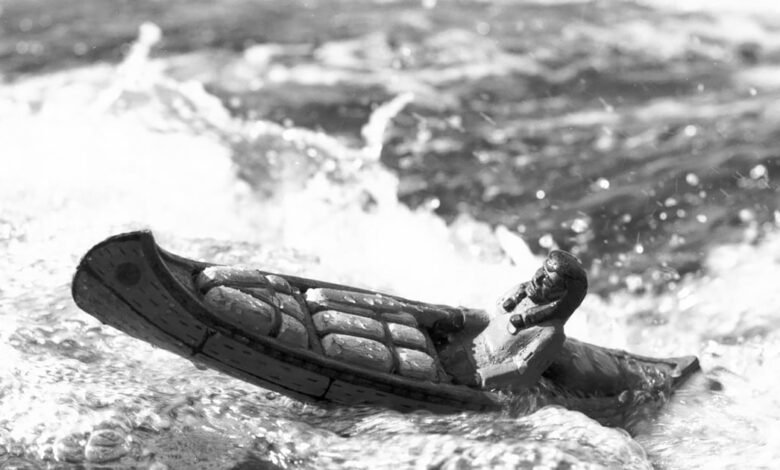
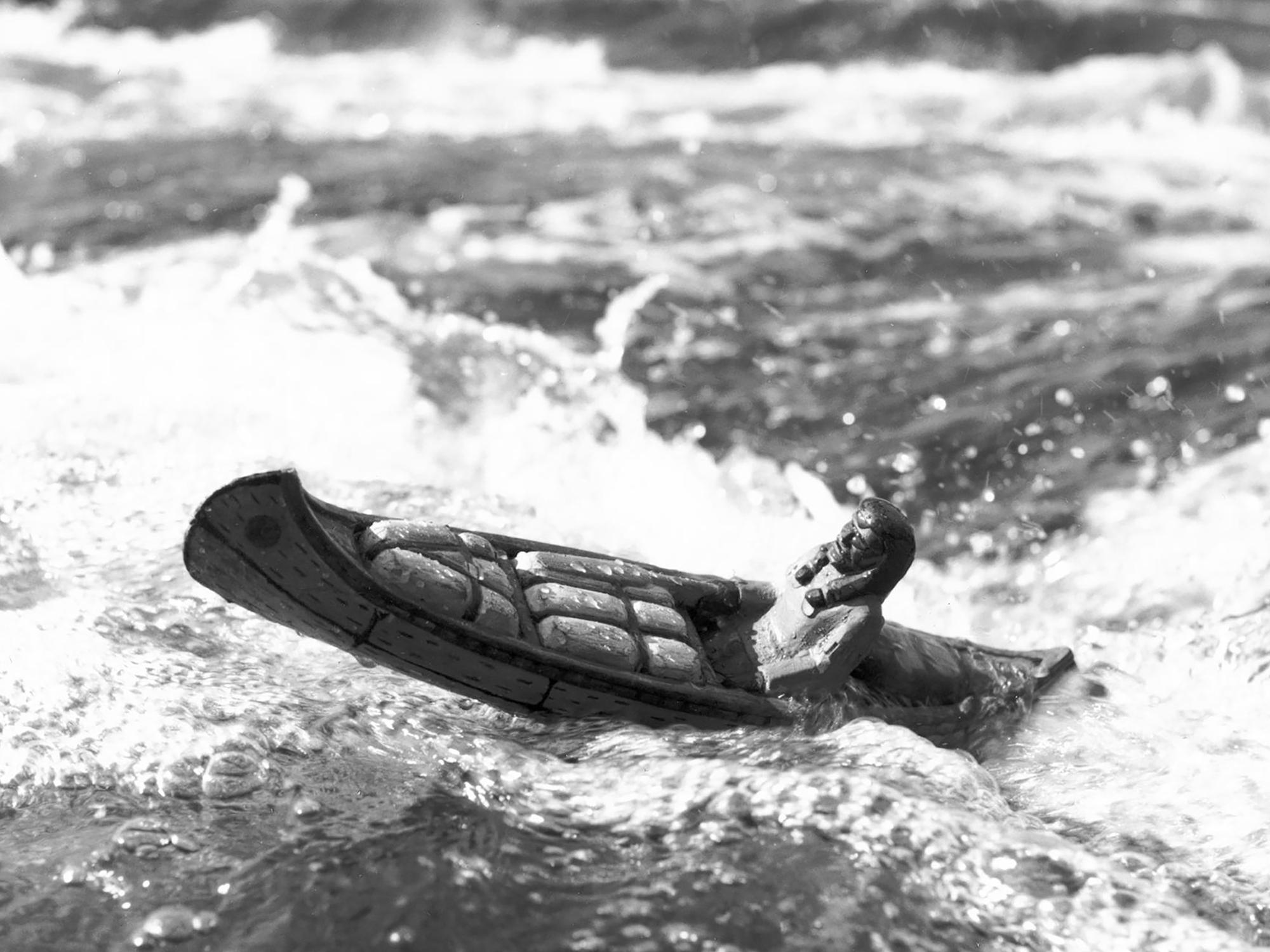
Mason’s interpretation of Paddle to the Sea cleverly twists this simple lesson to incorporate modern concerns about water pollution and forest fires, resulting in an ominous narrated statement unique to the short film. The biggest distinction between the two is that Holling’s work, published in the 1940s, doesn’t have the modern insights to address these dangers. Yet in Mason’s vision, a lone seagull flies frantically into the smog caused by wildfires while the narrator solemnly states, “Paddle did float for he was made of wood, but he could also burn”.
In both the literary and cinematic iterations, Paddle to the Sea starts by telling the story of a young First Nations boy lovingly carving a piece of wood into the figure of a canoeist he names Paddle. With a whimsical, childlike desire to traverse the entire Great Lakes, the boy decides to send this wooden toy on a journey to fulfill his dream. Under the toy canoe is the message “Please put me back in the water. I am Paddle-to-the-Sea”, read by all humans who pick up Paddle on his journey.
Mason majestically brings Holling C. Holling’s natural world to life as his first project with creative control. With direction, cinematography, and editing all performed by Mason, he could depict the great outdoors as he saw fit. Seagulls, squirrels and water snakes engage curiously with the wooden figure through naturalistic interactions shot in real time, often unplanned, with narration courtesy of NFBC veteran Stanley Jackson providing additional insight. Considering Mason’s commitment to wolf conservation (his 1972 doc Cry of the Wild would become the NFBC’s most financially successful feature at the time of release), even in his filmmaking infancy, Bill Mason had a singular artistic power of presenting the ecosystem before him purely, with minimal manufactured interference.
With an Academy Award nomination for Best Live Action Short Film, Bill Mason’s new accolades would embolden him to push this earnest display of environmentalism with The Rise and Fall of the Great Lakes. Continuing his cooperation with the NFBC and marking his first intensive partnership with prolific collaborator Blake James, a stable foundation of resources enabled Mason to experiment with new, intricate techniques. This 1968 short is a classic case of bait and switch – opening as a quirky educational tour of the Great Lakes, only to subversively morph into a work of slapstick satire with match cuts and canoe-oriented stunts that result in nothing short of “movie magic”.
Like Paddle to the Sea before it, The Rise and Fall of the Great Lakes opens with the roar of waves crashing on the lakes, leading into a pastoral folk song by Canadian singer-songwriter Bruce MacKay describing the lakes as “five jewels beneath the sun”. Tracing their genesis during the Ice Age, the balladry narration provided by MacKay, paired with Blake James’ comic acting and Mason’s keen eye for assembling the strongest images of the great outdoors, presents a fully cohesive thesis on how humans have impacted this region, for better or worse. In a final effective match cut, James – in a moment of respite as the canoeing figure – takes a drink from the lake only to make the shocking discovery that the water has been replaced with polluted liquid. He paddles through the sludge as MacKay’s crooning assures us these changes keep the world going round, a bittersweet statement that continues to ring true as the proliferation of AI data centers built across the country creates new ecological and health concerns.