On the centenary of his silent masterpiece and the release of ‘The Faust Bible’, we examine FW Murnau’s mastery of supernatural cinema and its lasting cultural impact.
Mystery is something that remains thoroughly connected to the influential German director FW Murnau – both in terms of his work and their fate, as well as to his mythology. It is devilishly tempting to view this air of mystery in connection to Murnau’s singular ability to capture the supernatural. Several Murnau pictures are lost in their entirety, including Satan and 4 Devils, while others – 1922’s Phantom, The Burning Soil, Nosferatu: A Symphony of Horror, and 1930’s City Girl – have been reinstated in various degrees, accompanied by intriguing stories of near-loss and resurrection: fires, government orders for destruction, and a print discovered in an Italian asylum.
In her study of German Expressionism, ‘The Haunted Screen’, Lotte Eisner wrote that “no other director, not even [Fritz] Lang, ever succeeded in conjuring up the supernatural as masterfully as [Murnau].” Although this reputation has somewhat overshadowed an entire filmography, which also includes great works of mystery, romance and drama, it is nonetheless accurate and seductive to consider the director’s exquisite gift for phantasmagorical conjurings.
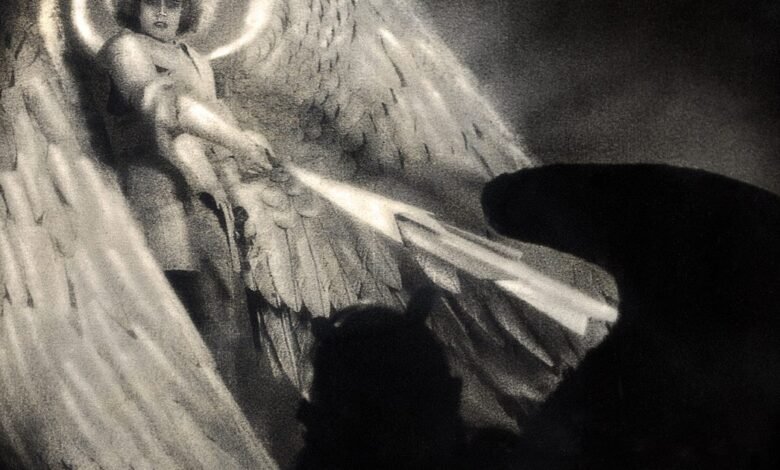
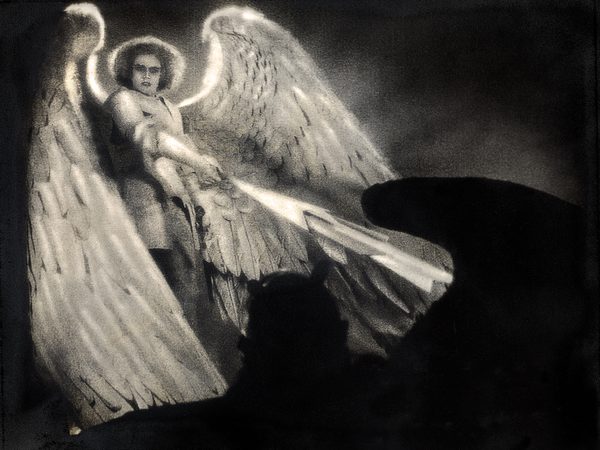
Murnau’s final German film, 1926’s Faust, proclaims to depict the opening of the gates of hell, – a grand infernal spectacle that cements his reputation for cinematic darkness. Adapting Johann Wolfgang von Goethe’s play with meticulous detail and bringing forth its eschatological themes, the film opens with a wager between Heaven and Hell via the Archangel and Mephisto. Mephisto bets that he can wrest the soul of alchemist Faust away from God, and if successful, he shall claim Earth. The demon unleashes a plague, and as Faust looks for a cure, the ensuing deaths and chaos inspire a crisis of faith in the townsfolk. Disillusioned, Faust swears an oath to the lord of darkness and makes a blood-pledged deal with the devil for a day’s trial of power, but is soon tricked into the temptations of hedonism and regained youth. When the trial ends, Faust agrees to surrender his soul to continue his pleasures, and having exhausted all delights, he falls in love with the virtuous Gretchen. Eventually, Faust and Gretchen die together, the union of their tragic love bringing an end to Mephisto’s claim to the Earth.
Murnau’s on-screen conjurings would intriguingly intertwine with his off-screen life, retroactively adding to their allure through lore and legend. Directly following the production of Faust, he left for Hollywood, having been signed by studio head William Fox, who subsequently gave Murnau creative freedom to make his ambitious American debut, Sunrise: A Song of Two Humans. In May 1929, the film took home the special Academy Award for Best Unique and Artistic Picture – the only one of its kind in Oscars history.
However, the sweet smell of success would soon sour. Soon after the ceremony, Fox was in a serious automobile accident and by October of that year, he had lost a large part of his fortune during the Wall Street Crash. By 1930, he’d lost control of the studio and was later jailed on bankruptcy related charges of conspiring to obstruct justice and defraud the United States. The following year, Murnau died tragically in an automobile accident. In a strange parallel to Fox’s accident – where Fox had survived but his chauffeur was killed – Murnau, alone in the back seat, was the sole fatality. The signing of a creative genius by a wealthy studio head who would together make Hollywood’s only Unique and Artistic Picture before falling into ruin has, at the very least, a tinge of the Faustian bargain to it, at least in the way it is often told.
Salacious myths persisted around Murnau’s death, including a scandalous rumour perpetuated in a short passage of Kenneth Anger’s infamous book ‘Hollywood Babylon’. Anger’s apocryphal assertion that Murnau had been performing a sexual act on an underage boy at the wheel at the time of his death continues to circulate, even if only in telling of his chauffeur’s efforts to dispel the rumour. In relation to Faust, this mythical version of events places Murnau as the cursed genius meeting his fate amidst the moral corruption of a scandal-ridden hedonistic pre-Hays Code Hollywood. Viewed through a century of a seemingly “cursed” legacy, these events seem significant and tantalising. Even the master negative for Sunrise would perish in the 1937 Fox Vault Fire, with the film still the subject of restoration efforts in 2026.
In the 100 years since Faust, Murnau’s life, works, reputation, legacy and even his body have been violated in unfortunate, bizarre and tragic circumstances. These events, though strange yarns to spin, are disparate and easily rationalised: a global economic depression; the swerving of a car into the wrong lane; the flammability of nitrate film stored improperly. Yet they continue to capture our imagination.
Murnau had a direct connection to the occult from early on in his career via Albin Grau – the co-founder and occultist producer behind the short-lived German silent-era film studio Prana Film, and the artist behind Nosferatu’s unique visual style. Their relationship has since been dramatised in 2000’s Shadow of the Vampire, E Elias Merhige’s film centred around the urban legend that the film’s star, Max Schreck, was an actual vampire. Now a cult classic, Udo Kier and John Malkovich play Grau and Murnau opposite Willem Dafoe’s brilliant depiction of Schreck. The film is a very effective example of “printing the legend”, only adding to Murnau’s posthumous reputation.
The director’s remains have also been subject to strange happenings. On hearing of his death, Greta Garbo commissioned Murnau’s death mask, which she would keep on her desk for the rest of her life. In a sickeningly dark twist on this posthumous collection, Murnau’s skull was reported stolen in 2015. Cemetery caretaker Olaf Ihlefelt reported that candle wax was present at the site of the desecrated tomb, indicating that occult connections to the theft couldn’t be ruled out. To date, it remains missing, only adding fuel to the fire.
In a development befitting of the strange path of Murnau’s work, a 400-page book documenting the production of Faust – made up of sketches and designs by set designers Robert Herlth and Walter Roehrig which would be developed into detailed storyboards – was gifted to the director, compiled by Herlth as a “Bible”. Available publicly for the first time since being rediscovered and restored by la Cinémathèque française, ‘The Faust Bible’ displays side-by-side comparisons of the detailed sketches against stills from the film, evidencing the accuracy with which these visions were replicated, and marks an important development in shedding light on a filmmaker’s legacy amidst the dark tales.
With the 100 years of cinema that has followed, how is it that Faust and Murnau’s work still remain unsurpassed in conjuring the supernatural through the medium of film?
In developing his craft prior, Murnau had pioneered “the unchained camera” on 1924’s The Last Laugh, making cumbersome cameras newly mobile and fluid. For Faust, these techniques were combined with scale models, practical effects, forced perspective, double exposures and clever editing to create a new height of visual spectacle.
A student of art history, before directing Murnau was an aspiring painter himself. The visual mastery of Faust came from his painterly eye and its inspirations were many: Wilhelm von Kaulbach, Franz Stassen, August von Kreling and Franz von Stuck – their works would inform the look and style of the film, including its precise compositions and the masterful use of light and shadow. Indeed, Murnau’s tireless collaborations are what made the visuals of Faust so arresting and timeless. His personal interpretation of the text itself has also been continually read as ahead of its time – analyses have pointed to veiled themes of homosexual suppression and a desire for equality throughout his work.
As with the sexual themes of Nosferatu and the anti-militaristic themes of The Last Laugh, Murnau was a master of metaphor and of critical storytelling. A closeted homosexual at a time when it was forbidden under Paragraph 175 of the German criminal code, the exploration of the themes of love torn by moral forces in Faust are explored implicitly. The pact of Mephistopheles is undone by “the eternal word,” love, which transcends all forces which seek to stop it – a seemingly happy end, were it not for the gruesome fates of Gretchen and Faust, who are persecuted nonetheless.
Although his core belief was that love of any kind should conquer all, external powers and institutions would ultimately still unfairly punish those that crossed its boundaries. The abolition of Paragraph 175 would not happen until almost 70 years later in 1994, emphasising again just how prescient Murnau’s film was in all elements of its execution. The homophobic attitudes that surrounded Murnau’s passing only five years later, only underline this further.
Today, Faust is frequently overlooked compared to Murnau’s other major works including Nosferatu, The Last Laugh and Sunrise, despite being one of the great works of the silent period. His mastery in bringing together the forces of good and evil, alongside the star casting of Germany’s highest paid star at the time, Emil Jannings, calls to mind the formula of popular franchise films today, particularly the big-budget superhero films that have dominated the early 21st century. Perhaps it is the simplicity of its narrative that sees Faust overlooked against his other works, although viewed as ‘pure cinema’ in its execution of composition, lighting, visual effects, and meticulous editing, it is undoubtedly complex and sophisticated.
Murnau’s place in cinema history has been lovingly nurtured over several decades and the influence of his work has continued to consistently inspire artists and filmmakers alike. When director Michael Mann added Faust to his 2002 Sight and Sound ballot, he noted that the film had “invented what had never been done before and delivered magic in both its human pathos and visual effects.” At the very least, it’s an effective summary of what Murnau’s masterpiece achieved through the creative gifts of its director and the ensemble of talents that created it. Despite a posthumous legacy characterised by rumour, tragedy, and myth, the truth lies simpler: FW Murnau was an intellectual, a philosopher, an aesthete, a perfectionist, and a creative genius, and Faust is one of his great masterpieces.