
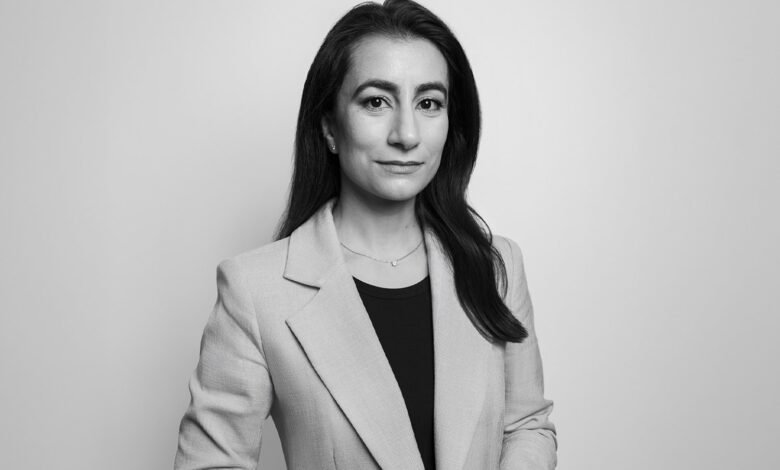
Neda Navab has shot up the residential real estate totem pole in less than a decade to become the leader of the largest brokerage in the country by sales volume.
Navab’s resume is blue chip all the way: a bachelor’s degree from Columbia, a stint at McKinsey and an MBA from Harvard Business School.
After graduating HBS, she worked at tech startups for a few years before joining Compass in 2018 as the chief of staff to Compass co-founder Robert Reffkin, whom Navab has known since undergrad.
Within six months, she was leading the brokerage’s Eastern region operations, which functioned as its own mini-brokerage for which Navab drove agent growth and market expansion.
She became president this year. Her job entails managing Compass’ more than 30,000 agents across the country, all while Reffkin finds ways to successfully integrate the brands like Corcoran, Coldwell Banker and Century 21 that came over in the $1.6 billion merger with Anywhere that closed earlier this year.
This spring, Navab has been on a whirlwind tour of the country marketed as “100 events in 100 days.” True to her status as an overachiever, she accomplished the task in just 80.
Navab’s mother and father, both Iranian immigrants, met in the Boston area before moving to Jericho, New York, where Navab grew up. Like Reffkin, Navab credited her mother’s job as a real estate agent as the spark for her journey into the business of brokerage. Her father practices pediatric dentistry and used to teach at New York University’s Dental School.
Navab and her husband, a healthcare investor, live in Bronxville, where they’re raising their two children. They bought their home there two years ago through an off-market listing.
This interview has been condensed and edited for clarity.
Born: April 28, 1986
Hometown: Jericho, New York
Lives: Bronxville, New York
Family: Husband, two children, ages five & two
You’ve talked about how your mom immigrated during the Iranian Revolution. Is that also the case for your dad?
He came just before the revolution. She came during.
Had they met there or did they meet here?
They both immigrated to Boston, and my mom was calling a phone number for an apartment that her friend had lived in, and my dad answered. She’s like, “I’m looking for Susan,” and he’s like, “Oh, Susan doesn’t live here anymore,” and my mom goes, “Are you Iranian?,” and he goes, “Wow, how did you know?”
And she says, “Because you have a terrible American accent, you can’t speak English properly. I’ll introduce you to some people, meet me outside at 6 p.m. Friday night. I have a bunch of Iranian friends,” and hung up.
That’s so assertive of your mom. Do you feel like you get any of that from her?
She’s the ultimate role model for me growing up. Strong, decisive Middle Eastern woman.
Your mom has a real estate background. How did that inform your relationship with real estate?
It gave me a real appreciation that you don’t have to have a certain fancy degree or have parents who belong to a certain country club in order to build a career in real estate.
“I always knew that I wanted to be really financially independent, and so it was never a choice that I wanted to pursue a professional path.”
It’s funny because you do have some fancy degrees. So, how did you end up wanting to pursue this very prestigious path?
Growing up I always knew that I wanted to be really financially independent, and so it was never a choice that I wanted to pursue a professional path. But also being the child of immigrants, I think that achievement in a traditional way is actually the norm.
You were featured in a New York Times story about how Harvard Business School was trying to foster gender equity during your time there. Do you still talk about that with former classmates?
No, never.
Did anything stick?
All we knew was the experience we had. In hindsight, the intentional interventions that the program had peppered in, I think probably did make a difference in how involved women were in the classroom and in conversations.
What do you do to nurture talent for women seeking to advance in this profession or other professions?
One of the things that’s been most surprising to me is the symbolism of a woman running the No. 1 brokerage in the country.
Beyond the symbolism, are there things that you also try and do specifically?
I gravitate towards a more stereotypically female leadership style. I do a lot more listening in the room, a lot more digesting and patterning.
What was the process of you [taking on the role of president of Compass]?
I was actually leading our integration with Anywhere, so I stepped out of a day-to-day role at Compass for a few months to play the chief integration officer role, and once we were into early February and Robert was taking on this mantle of running Compass International Holdings, it became clear that we needed, you know, a singular leader waking up every day thinking about Compass and Compass agents and their business.
I’m curious about the 100 events in 100 days. Where was the place you visited that you would most like to spend a night out?
The place I was most charmed by unexpectedly is where I was last week, New Hope, Pennsylvania. Have you ever been?
I haven’t.
So idyllic, really green. I think the Hadids, and oh gosh, who’s that fabulous actor from Pennsylvania? The Eagles fan, his name is escaping me — Bradley Cooper! They’ve all started to buy homes there.
I wouldn’t say gaffe. The team knows I’m very honest. I’m unfiltered.

With so many events, you’re getting photographed all the time. How did you manage your wardrobe?
Oh my god, I really appreciate that [question]. Just a lot of black, brown and beige. On repeat. Capsule wardrobe.
If someone was taking photos of me every day, they’d be like, he has one suit.
When I was in Philadelphia a couple of weeks ago, I was standing in front of the room about to give a keynote, and behind me was a slide that had a headshot and my title and I was wearing the exact same thing in person as the headshot. I made a joke of it.
That can be your gaffe.
That can be the gaffe.
Do you feel like you have a sense of personal style? If you do, where does it come from?
I don’t want it to be the red blazer, red lipstick, you know. I’m pretty neutral and uncontroversial. I actually think, as a woman, sometimes how you appear can distract from what you’re saying, or how you make people feel.
You’ve talked about how you don’t really believe in work-life integration. When you’re at home, you’re at home, and when you’re at work, you’re at work. How do you accomplish that?
A lot of self control.
I was at an event with one of our agents in Brooklyn a couple of weeks ago, and I got some really bad news, personal news. In that moment I said, “I just have to compartmentalize, because this agent has come all the way from D.C. to Brooklyn to spend time with me.”
What do you do for family time?
I love being out of the house, so we’ll go to a playground, or a park, or the library, or just running errands.
There’s something really fun about doing your normal activities, but with a kid. Like the things at a grocery store that attract their attention, or the things they see walking down the street. I think it’s just like doing those normal things, but trying to be really present when you’re with them.
What’s the last trip you’ve taken as a family?
We went just in March down to Florida. It was my two kids, my husband, and we went with another couple and their kid, who’s my son’s best friend.
What time do you wake up in the morning?
Between 6 a.m. and 7 a.m.
What’s your morning routine?
At least one or two mornings a week, I’m trying to get a little workout in my basement. And then we’re getting the kids ready for school: making them breakfast and packing lunch, getting them dressed, getting their hair done, while making my own breakfast, getting myself dressed. When I’m in New York, I always drive my son to school. I love being in the car with him for those five minutes.
Is exercise important to you?
Movement is important to me. The bar for what you can do in this chapter of life has to change. I try to do one personal training session a week, and then I try to do one fitness class with girlfriends.
What’s your class?
I’m a masochist, and I really enjoy Barry’s Boot Camp.
Me too.
Do you have a go-to instructor?

No, it’s new for me.
I now go to the one in Scarsdale, but I used to go to the one at Park Avenue South all the time. Keoni, if you ever come across him on the schedule, is amazing.
How did you get into Barry’s?
I’ve been doing it since I moved to San Francisco in 2013. I love the music, the intensity. When I lived in New York City, I would see the same people at the 5:40 a.m. class every day.
How did you meet your husband?
We met in business school. He was doing surgical residency at the Brigham, which is the hospital in Boston. The surgical residency program he was in requires you to do research. Instead of doing traditional research, he got his MBA, and so we overlapped at business school.
What was your first date?
We met on a group blind date, where they invite one gentleman, and he brings two single friends, and one woman is invited, and she brings two single friends. He and I were both the friends.
Did you hit it off?
A group blind date is maybe the most awkward way to meet a potential partner. I don’t think anyone in the group really hit it off, but our paths crossed again a month or two later at another sort of group setting where you were supposed to swap seats every couple of minutes to meet someone new at the table, and we just sat next to each other the whole time.
You were married in France. Would you consider yourself a Francophile?
I’ve never said that, but yes, I probably would.
What led to your decision to get married there?
The venue. It had this traditional Renaissance-era building, and then also had a Moroccan riyadh on the property as well, so we did a more Middle Eastern theme night, and then a more traditional sort of European-themed night. It was like a nice blend of the cultures and aesthetics and traditions we gravitate towards.
In your Instagram caption about your child, you have the evil eye emoji in there. Talking about traditions, is that something that’s important for you?
It’s definitely a Middle Eastern thing, the evil eye. I’m definitely a little superstitious. I believe in the evil eye. I pinned a little evil eye gem to my baby’s bassinet. It’s hard to stay connected and rooted to your heritage when it’s a country that’s really complex and hard to travel back to.
Do you have family in Iran?
A lot.
What have the last few months been like for you with the war?
Talk about compartmentalization. It’s been really hard to watch what’s unfolding there. It reminds me of the stories my mom would talk about around the time of the revolution.
Are you able to be in touch with them?
Pretty inconsistently. The internet blackout has covered the majority of the time since the initial bombings happened. On occasion, my family can make outbound landline calls, but they’re at $20 a minute or something crazy. So we just know that they’re alive, and then we’re like, “Okay, we’re gonna hang up, this is a very expensive call.”