Jacques Rivette occupies a distinctive place within the French New Wave. His films are characterised by the patience afforded to their duration, not to mention their philosophical ambition. In a late interview with Hélène Frappat, Rivette made this dimension explicit, claiming that there was “nothing more important than what we call metaphysics”, and citing philosophical heavyweights such as Spinoza, Kant and Hegel. Elsewhere in the same conversation, he spoke of a specifically cinematic truth, a vérité de film, akin to what Paul Cézanne called the “truth of painting”. Questions of metaphysical and artistic truth are privileged throughout Rivette’s work, but nowhere are they more powerfully realised than in La Belle Noiseuse. His 1991 art drama remains one of cinema’s most penetrating studies of artistic creation, yet its significance extends beyond its cinematic achievements: in an era dominated by digital self-representation, La Belle Noiseuse appears increasingly prophetic, anticipating contemporary anxieties about what images reveal.
Loosely adapted from Honoré de Balzac’s short story ‘The Unknown Masterpiece’, Rivette’s 1991 adaptation unfolds as a prolonged confrontation between artist and muse on the sprawling grounds of a country estate near Montpellier. Young artist Nicolas (David Bursztein) and his girlfriend Marianne (Emmanuelle Beárt) are visiting the area, and are brought to meet the renowned, ageing painter Frenhofer (Michel Piccoli) by art-dealer Porbus (Gilles Arbona). Over the course of the evening we learn that Frenhofer had originally begun a work called La Belle Noiseuse, with his wife as his model; however, driven to the brink of mutual destruction by the creative process, and facing the collapse of their marriage, he abandoned the painting – and with it, his whole artistic career. Ten years later, Porbus suggests that Marianne could serve as the model for a renewed attempt at La Belle Noiseuse, and Nicolas eagerly assents.
Get more Little White Lies
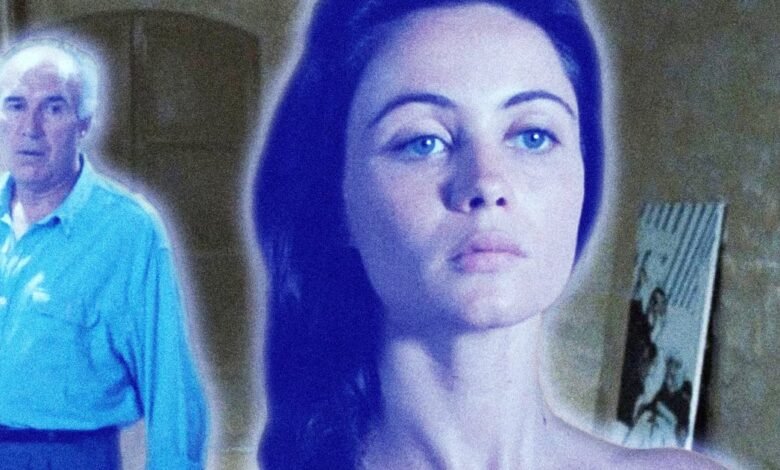
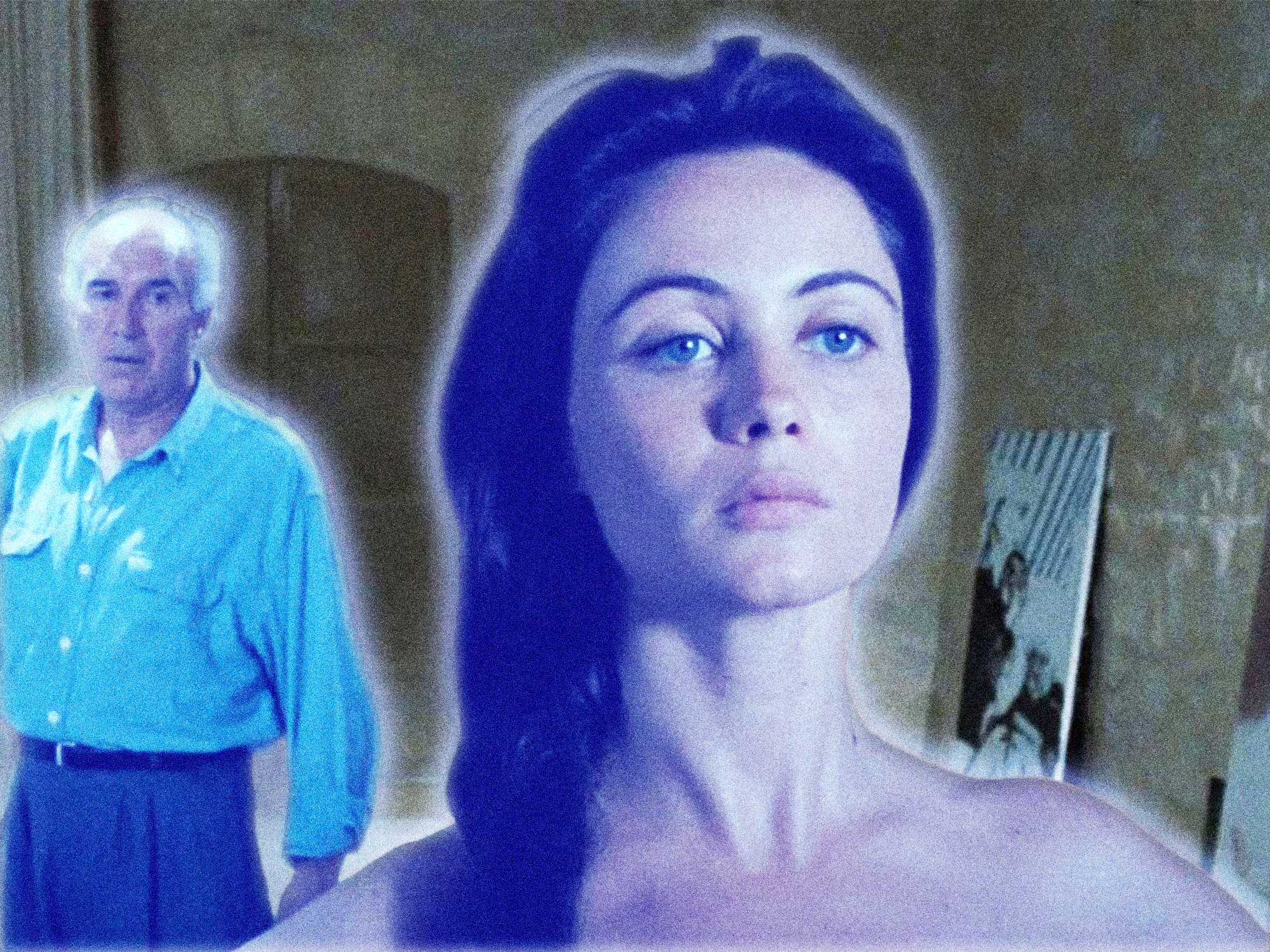
Emmanuelle Béart’s Marianne is strong-willed and self-possessed, while Piccoli’s Frenhofer initially comes across as a forgetful, introspective figure. When they start working, however, he hardens, and becomes forceful, impatient, gracelessly repositioning Marianne with his hands. These early scenes encourage us to anticipate a collapse of acceptable boundaries, threatening a descent into predatory desire. We see the disparity in their ages and their professional status, her nudity, and our antennae prick up. Yet this is smoke-and-mirrors – a strategic ploy to smuggle in something far stranger. Frenhofer’s obsession belongs to another order entirely. “I don’t care about your breasts, legs, your lips. I want something more.” What he wants, he struggles to name: “Whirlwinds. Galaxies, the ebb and flow.” Later, he rejects even the notion that he wants something: “I want nothing. I told you, it’s the painting… You and I, we’re just involved.”
At first, Marianne is dubious, finding the old man’s lofty talk of truth and surrender faintly ridiculous. Yet as the work progresses, she begins to recognise both the difficulty and the exhilaration of what they are attempting together. In a crucial reversal, it is Marianne who insists they continue once the painter’s own conviction begins to falter, compelling him into the very condition he had theorised but failed to achieve: an egoless passivity in which artistic creation feels less like mastery than letting be.
Of course, one might suspect that Rivette is having his cake and eating it: cloaking voyeurism in art. After all, whatever the characters say or do, the audience spends long periods observing Emmanuelle Béart’s naked body. Yet this is precisely where the film’s duration becomes crucial. The sustained, meditative camerawork Rivette employs is fundamentally ill-suited to erotic excitement, while his treatment of the artworks allows us the pleasure of watching several iterations emerge in real time.
In the language of classical aesthetics, desire is an activated form of attention: it seeks fulfilment, it aims to realise a goal. The experience of beauty, by contrast, is disinterested. It takes pleasure in form without seeking to possess or appropriate the beautiful object. Marianne – and through her, the audience – gradually ceases to experience her body as something charged by erotic tension because, within the strange discipline of the studio, a transformation is taking place. She is becoming the site of an authentic artistic creation.