Chorus of Voices: Gender euphoria is bliss. Freedom to experience masculinity, femininity, and everything in between. Getting to show up as your own self. Gender euphoria is opening the door to your body and being home. Unabashed bliss. You can feel it. You can feel the relief. Feel safe. And the sense of validation and actualization. Or sometimes it means being confident in who you are. But also to see yourself reflected back. Or maybe not, but being excited to find out.
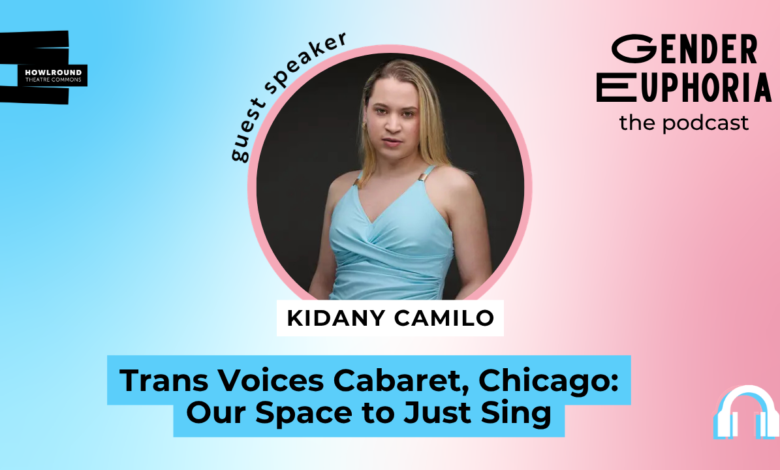
Nicolas Shannon Savard: Hello and welcome to Gender Euphoria: The Podcast, a series produced for HowlRound Theatre Commons, a free and open platform for theatremakers worldwide. I’m your host, Nicolas Shannon Savard. My pronouns are they, them, and theirs. Today I am here with Kidany Camilo, lead producer of Trans Voices Cabaret in Chicago. And before I talk too much about that, Kidany, I’d like to give you a chance to introduce yourself. Could you tell us a little bit about who you are as an artist?
Kidany Camilo: Hello, folks. I’m Kidany Camilo. Any and all pronouns. And I’m originally from Puerto Rico, back in Bayamón. And I am a multi-hyphenate theatre artist. So I’m mostly known as an actor, a playwright, and producer and director. Most of my art comes from my own culture, Latinidad, and how queerness kind of dabbles with that intersection.
Nicolas: All right. We’re talking about Trans Voices Cabaret today. So could you tell me a little bit about that program and what y’all are up to?
Kidany: Yeah. So Trans Voices Cabaret (TVC) is a cabaret-style showcase that showcases trans and nonbinary performers. And each year we do about like two or three shows where a small cast of like three or four singers can join us, and they can showcase their talents with us. And with me specifically, as a producer, every single show that I do is themed, just because who doesn’t like a good theme?
Nicolas: Of course.
Kidany: I always try to let my artists, I guess like, interpret my theme however it is that they want to do it. Because I feel like what better freedom with your art than for me to give you like, hey, like, you know, here’s the rules of the game and, you know, do as you please.
Nicolas: What are some of the themes that you’ve done in past shows?
Kidany: So the first show that I did, it was last November, and I was still on the Producer Mentorship Program, which is a program that runs for about six months or so, where you train under a lead producer. And basically, you learn the ropes of what is it exactly that you do as a producer. My first theme was like, kind of like, kind of punk rock, revolutionary.
My second show, I was still in that mentorship. And it was a sexy Christmas kind of vibe. I’ve never been a fan of Christmas. Like, you know, no shade, it’s just, it’s not my thing. So much, so much joy. I’m just like, do you know how many wrinkles are formed during the holidays? Not with me. Not with me. So I’m like, no, babe, like, we’re gonna make it sexy. And it was inspired, actually, by my love for this artist called Sabrina Claudio. She’s an R and B artist. And she did this album about like three years ago, called Warm December. And it was her first ever Christmas album. And I was like, really, you have to make a Christmas album like every other artist?
But then I heard it. And I was like, hold on. Hold on. I was like, you did not. How did you make Christmas sexy? Like, you know, not everyone can do that. But she did. She did. And it was beautiful. It was wonderful. The aesthetic and just like, you know, the music production of that album was just gorgeous. And I was like, I think I want to, I want to use that as an inspiration for my artists. And it was, it was fantastic.
And then my most recent one, which was in honor of Pride Month, was actually June twenty-third, twenty-fourth, I think. It’s a Monday. Twenty-second, close enough. And basically, the title of that show was Still/Here. And it was inspired by my love of Bill T. Jones, because he choreographed a dance called Still/Here back in the nineties, which tells like the story of like, you know, his experience dealing with friends, with friends, with lovers who had AIDS and just like, you know, their lives during that time. And I took that inspiration and I did a show that actually had also a literary component to it. So in between each song, each singer got the chance to read a section from a book that I chose called The Faggots and their Friends between Revolutions.
Nicolas: That’s a great title.
Kidany: No, it’s fantastic. And it is a cult book that came out back in like the 1970s. And it was about, it’s like short stories and poems and like, just about like queer life and community and revolutions and, and the violence that we suffer, but also that we were never taught to lose. So we always get back up and we keep going. And each singer had to read some selection from that book. Because I know that the audience for sure, it’s not going to know that book because, you know, it’s such a, you know, it’s not modern. And they loved it. They loved it. They felt, you know, they feel touched by it. It’s also my, it’s also my own way of reclaiming that book. Because the book kind of centers gay men as the, you know, as the core of that movement. So this was my way of being like, well, no, that’s not true. There’s more, there’s more people in the community than just you. So that was my way to like, incorporate each passage being read by a trans person and how that changes the perspective of some of those passages.
Nicolas: Love that. Did the performers get to choose which passage they read? Or was that more curated by you?
Kidany: No, I picked some for them. I picked them based on the songs that they had, just to create something that kind of, that kind of went hand in hand with their songs. They didn’t know which ones I picked until the day of, because I’m also that girl that I’m like, you know, if I could just give you one, one little surprise, I hope it’s this. And so they found out that day what it was. And when they read it before their songs, I can see in their eyes that they’re like, this hits really close to home. And I’m like, I know, that’s why I picked it. But then when they sang, it was just like that… it’s that push that they needed. It was that push that they needed to know that, you know, you’re, you’re making history. You know, every day that you’re alive and that you try to, you know, push the boundaries of like, what we can do.
Nicolas: Love that. So you touched a little bit on community and revolution and all of these things. So I know that Trans Voices Cabaret, in Chicago anyway, is part of a larger collective that is Gender Fucked Productions. And it seems those things are in line with what you all do. So how does the Cabaret fit within the broader scope of that organization? What else does Gender Fucked do?
Kidany: Gender Fucked Productions has a myriad of like projects that cater to like trans people. And it kind of, I guess like our mission is to, is to support trans folks and just giving them the chance to create: to create art and just create equity and that balance that we don’t have in the artistic world that often we so long for. Like we, we long to just do like a, like a normal thing. But then we get put into a box that, “wait, but you’re, you’re too niche.” Like that’ll change the whole part. And I’m like, well, no, actually this’ll just be the same. It’s just a different perspective. But I digress.
Nicolas: We could go on about that all day.
Kidany: We could, we could go on about that all day, all day. And trust me, I could go on about that. But basically with Gender Fucked, we have different projects such as meetups, a T4T Open Mic, Trans Scribe: A New Works Festival, TVC, Metamorphosis, which is also a new playwright residency and trying to help early career trans playwrights.
And yeah, and we, we just, we just create different programming just to help folks. And there’s, there’s different producers for like each project. And my focus right now is TVC, just because that’s, I’ve, I was a singer back in the past for these shows and now I’m just, you know, the mother hen. So I just produce the show. So, so it feels like a, like a correct rite of passage that now I can, I can be mother to my babies. And I feel very, I feel very happy, actually. I feel very happy and very honored to just like give them the space to sing because we don’t, we don’t often get that. And if we do, it’s, it’s tied to something bigger where it kind of uses our identity as a, like, oh, we have a trans person doing this. So you have to come see us. It’s brand new, but there are times we’ll be kind of, I, we just want to be, we just want to be, we just want to do a little, do a little songs and then go home.
And I really hope that, you know, all my artists who I’ve hired and future ones as well know that I do this for them. And my goal is their joy. If they’re happy to share their art and their music with an audience, then I’m happy.
Nicolas: You started to touch on it a little bit, but I think this might be a good time to talk about how would you describe the role that TVC is kind of aiming to play in the queer art scene and generally in the musical theatre scene in Chicago?
Kidany: Yeah. So musical theatre scene here in Chicago is, it’s, it’s big, but it’s very, it’s very specific to a certain kind of people who want to do musicals. It’s not that often that I get to see like a, like a cast where there is actually quite a lot of like trans folks doing that show. There’s only like maybe like just one person and the rest, they’re all just cis and white and straight, which that, which that to me is kind of, it’s kind of weird. I’m like, wow. I’m like, you know, I used to think that like, you know, queers would like take over musical theatre and then here we are being colonized by the straight people. So I’m kind of shook. But, you know, nevertheless,
Nicolas: Straight people and the white people, it sounds like.
Kidany: Yes. Yes.
Nicolas: You either get the token trans person, or the token person of color. And it’s just still a cis white cast.
Kidany: And I’m kind of shook because there’s so many, there’s so many amazing trans talent here in Chicago that, that I’m like, damn, if you’re not being hired to do a musical, I’m for sure not going to be hired to do a musical. So this is—so something’s not right here. Something’s not right here. And to be honest, it’s lack of, it’s lack of equity and, but also lack of, lack of imagination.
We, we give other people such grace to imagine other people and being something else. Like, you know, someone can play Irish, someone can play some other job, you know, but God forbid that, you know, I can play a seductress. And it’s like, whoa, I’m like, that changes the whole story. I’m like, no, babe, I’m like, the story is quite the same. It’s kind of the same, to be honest, like it’s the same insult that I feel whenever way back, I think like last year, I think there was a campaign that on Twitter that people wanted Keke Palmer to play Rogue on X-Men.
I was really happy. I was like, oh my God, if Keke Palmer gets to play rogue because she’s perfect, like she’s perfect. But then we had the pushback from people being like, no, she can’t play her because like, you know, she’s not white. Like she doesn’t, she doesn’t fit it. And I’m like, okay, but like, how does being white change the story of Rogue?
Nicolas: Is it really necessary for the character?
Kidany: Is it, is it necessary? And also like, like, let’s be honest, she came out from Mystique. She came out from someone who shapeshifts. So babe, I don’t, I don’t think it matters. I don’t think it really matters. It doesn’t change the story. Actually, otherwise it makes it more complex and makes it more nuanced. And, and that you actually have to think now that how does, you know, how does it now inform the story of Rogue that, you know, it’s not just like, you know, this Southern belle who like, you know, kicks ass.
So, yeah. So that’s kind of like the insult that I feel whenever people are like, well, but like, you know, but you’re trans, like, I gotta see you in a role. And I’m like, okay, what, and what can you see me? Like, um, please, um, that’s not just like a sex worker. Um, please.
Nicolas: We do so many other things!
Kidany: So many other things! So yeah. So that’s the scene. And I, I guess like in contrast, with TVC is that like… No, we don’t do like full musicals, but this is a chance to also kind of be a bit more personal because, um, a cabaret is way more personal than a show. In a show, you just have your script, you have your part and babes that’s it. With a cabaret, now you have to involve your artistry into it and also your own self that this is, this is your song that you’re singing, but how do you connect to it? How are you going to interpret it? And what do you want the audience to take away by you doing this song? So it adds, um, a more personal touch that I think you can’t do with just a role because, in a show, most likely that focus is going to go with how does that make sense with the story? You know, with a broader picture.
Nicolas: Now I want to know, you tell me about a couple of performances that have really stuck with you where that personal connection like really, really came through that you’re still thinking about months later.
Kidany: Uh, yeah, yeah. I have, I have a few actually. I have a few that, that have stuck with me. The first one that I want to give a huge shout out is Crystal Claros. They are an amazing, amazing performer. And, you know, if you’re hearing this, I think, I think you’re amazing, babe. They did such an amazing opening song for our last cabaret. But the song that really, that really hit me that I’m like, this is haunting me is they sang “The Subway” by Chappell Roan. And that was heartbreaking. That was heartbreaking. And that still haunts me. And, um, yeah, I just think that if like, you know, the level of artistry that they bring to the stage, I’m like, that’s, that, that is what I want. That is what I want to see in every musical um, that, that I, that I don’t get to see, you know.
I think also of John-Payne. John-Payne, a few years ago, sang “The Man That Got Away” by Judy Garland. That was… Okay, that was, that was amazing. That was amazing. Their technique and their storytelling with their voice is really something so unique and so powerful. Um, that I think about that very often.
Yeah. And, oh my God. So, Brave Space Alliance, they hired TVC to be an opening act. And I got three singers to, you know, go on, go and give a little show. So I hired Ri Desta, Marcela Ossa, and KT. And all three of them sang amazing songs. But I think their closing song, which was “Linger” by The Cranberries, that was like, that was such, that was such a scene stealer. Like they, like, they really, they really rocked it, rocked it.
And also shout out to, to KT because I gave them the song, “Pink and White” by Frank Ocean. They sent me a text later, after I told them, hey, this is your song, that I picked for you. And they were like, no one has ever given me a Frank Ocean song. And you’re the first one to ever give me that. And I, and I want to know why, you know, it’s not bad. It’s just that I like, why? And I’m like, you always get the chance to sing, to like, you know, sing R and B. But you always sing it from the point of view that it’s going to be a torch song. And I’m like, what if you sing it out of, you know, out of joy? Like, you know, I, I want to know how that sounds in your voice. And it was gorgeous and it was gorgeous. So if anyone, if anyone wants to hear, KT, their Instagram is KT underscore K-A-Y-T-E-A 94. They’re, they’re, yeah, they’re just, a great artist and, you know, I’m surrounded by like great artists 24/7. But those are the few performances that I’m like, oh, oh yeah. Oh yeah.
Nicolas: So the cabaret, it sounds like it’s not like necessarily like a specifically musical theatre cabaret. It sounds like you’ve got a blend of different genres going on, which is cool.
Kidany: Yeah. Like, originally, I mean, in the, you know, with Lorena, she also tells, she always tells me, she’s like, “Kidany, you have to do at least one musical song for cabaret. You know, that the mission of TVC is to do musicals.” And I’m like, Lorena, I get it, girl. I get it.
But, unfortunately most people who come to our shows, they aren’t musical people. So we need to also cater to those people who don’t know musicals. So this is the perfect balance of like, yes, we’re going to have some musical songs, but we’re also going to have, some popular songs that people might know and be like, oh, I was like, so what’s, so it’s not just, you know, theatre, you know, and, and jazz squares. I’m like, yeah, I know we could do more. We can do more than theatre. I know, right? Shocking.
Nicolas: Jazz squares are only a small little portion of what we do.
Kidany: It’s just a small little portion of what we do. And you know, there’s more, there’s, there’s also jazz hands.
Nicolas: Occasionally grapevines.
Kidany: Occasionally grapevines. But we don’t, we don’t want to get too crazy. We don’t want to get too crazy.
Nicolas: Oh, tell me a little bit about the audience at the cabaret. What is show night like?
Kidany: It’s a mix. It’s all like, it’s always a toss up. There have been performances where it’s mostly, like straight people coming to like, you know, support the queers. And then there are times for like, you know, it’s all the queers, all the, you know, all the elders and the youth coming to like see our shows. Our last show actually, was a mix of that. It was a mix of like, you know, queer youth, and the elders who came to see the show. And it was beautiful. It was beautiful to just entertain them and to witness them also seeing themselves on stage. You know, it’s not that often that we get, that we get to see, you know, our community see themselves on stage and be like, Oh my God, like, you know, that’s a trans person, you know, who’s belting the fuck out of like that song, you know, something that, that I would never expect. I finally got to say, and it’s life changing. It’s life changing.
I still remember one cabaret that I did—this was like a Halloween one. I always tend, when I do sing, I always tend to sing at least one song in Spanish just because, you know, I never know if there’s, if, if like there might be, you know, a Latina in the audience that I’m like, “okay, this one’s for you.” But when I do, it’s, it makes me really happy to know where they are in the audience and for them to get to hear me. It’s not that often that I sing in cabarets. I make sure that as a producer, I just, I just produce, I don’t sing, you know, this is for them, not for me. But there have been times that, you know, things happen and I just, I, I have to step in.
This last show, when one of my babies had to step out because they were hired to do an improv show, they were like, “Hey, I have to leave”. And I’m like, “But the group number.” And they’re like, “I know, but I have to go.” And I was like, “It’s okay, baby. I’ll step in.” And as a closing number, you know, I talked with the audience about like, you know, you know, thank you for coming, whatever. One of my singers had to step out because, you know, they’re booked and busy and I want them to like get their coin. So I’m going to sing their part and do a soprano. So trust me, I’ll be fine.
And those people have never heard me sing and like, you know, ever, cause I’m like, you know, that’s, that’s not what I do. And when I did sing, they were like, you were hiding that. And I’m like, I know, I know I was hiding that. Isn’t it like, you know, a good surprise? But also to like, it was really, it was really gay because I, I was the opening verse to the song of “Purple Summer” from Spring Awakening. So yeah. So that was like, you know, much, much more gayer you cannot get. And the opening intro is just really beautiful.
So yeah. The audience is really, you know, they really feed life to us and I’m, I’m super grateful for whenever they come to see us because people be really busy and especially they, they be busy because, you know, some, no shade, they want to, they want to go support other queer art that doesn’t center trans people. So when, so when we do, you know, I’m, um, I’m, I’m super happy to like have anyone that is like, so you remember, you remembered there’s more letters, you know, in our, in our mafia. Okay. That’s good. That’s good.
Nicolas: I’ve got to ask: any other numbers or performances that made you see a song or an entire show in a new and fabulously queer way?
Kidany: One of my singers in this last show, they sang “I Will Survive”, but they did it like they did like a funk version of it. And, you know, my life, my life was changed, you know, for the better. It was changed for the better. You know, Ri Desta sang that song and they, yeah, they rocked the shit out of that song. And I’m, and I’m so happy because I needed, I needed some soul like in that, you know, in that set list and they brought it and they brought it and it sounded really, it sounded really good. And I know that they’ve been, you know—they were kind of scared that the song was not going to come out great because they’ve been going through changes with their voice.
And I told them like, you know, wherever your voice is that day, that is what you’re doing. Like, you know, your body’s going through changes that you can’t control. So whatever comes out, that’s what comes out. But just know that whatever is going to come out, it’s going to be good. Regardless of what your body does, it’s going to be good. Just trust, trust. And babe, did I trust? Did I trust? That was gorgeous. That, that, that was gorgeous. That, yeah, that, that was such a highlight to see them be comfortable and also not care, you know, what their body does. Cause they, they know. And I, and I taught them like, just, just know babe, that you have power. Like, you know, once you’re in that mic, you own this room. So whatever comes out your mouth, babe, it’s going to be gold. So just trust, just trust.
Nicolas: And I know we are running close to time, so I will wrap this up asking you two questions that I ask all guests of Gender Euphoria: The Podcast. And the first one is, would you like to give a shout out to a member of your queer trans artistic family tree who has helped you along the way, guided you, showed you a path to becoming the fabulous queer artist you are today?
Kidany: Okay. So there’s three people that come to mind that I adore. And the first one is Lorena. Lorena [Torres-García], she’s the co-artistic director of Gender Fucked. They were my, my mentor when I was still in the program, you know, you know, trying to learn how to, how to be a producer and their support has always been such a breath of fresh air and their trust. And yeah, their trust in me like really made me so happy because I’m, I’m such a hands-off person and I’m like, just tell me what you need done and I will do it. And, and, you know, they gave me their trust without any questions asked and, you know, I delivered, you know, and I delivered and I’m very happy that they gave me the chance to like do this now.
And the other person, is Esteban Andres Cruz. They are currently on Broadway. They are doing Dog Day Afternoon and they’ve been my close friend. They’ve also been a person to also like, to, to like push me and to, and to also like, they’ve pushed me to like not be afraid of conflict because conflict means that we care. Conflict means that there is, that there is love. If we just let things go by and we don’t, and we just like, you know, don’t address it, then we’ve given up. We’ve given up. And, you know, they’ve taught me that and that strength and I’m really happy that they’re in my life.
And the third person is one of my close friends and best friends who’s like, he’s my brother. It’s Nelson Aod Rodriguez. He, he is also a part of like my crew with Esteban. And he’s always, he’s always been like a sibling to me in the best way possible. He’s given me the support and he’s also given me a hand when I needed someone the most. He just knows how to, how to build community with people that he loves. But he’s taught me that like, you know, there’s, you know, there’s always good people. He’s very giving. So like, you know, as much as he gives to me, then I give to him. So it kinda is a brother that I never had or that I wish I had.
So I’m very grateful for like these three people that have shaped me into who I am and to being such a, such an ambitious person that I am. My God, my God. Sometimes I just wonder, I’m like, darling, like, do you, do you want to like breathe or like sit or like, just like stare at a wall? And I’m like, uh, no, cause there’s work to do. So, you know, they taught me to be ambitious and to dream big and, and, but also I’m, I’m very much that girl that I’m like, that I’m like, okay, so I’ve been told that like, you know, you know, trans people can’t get, can’t like dream to like be this and that. And I’m like, perfect. I’m going to get to that, you know, you know, and you’ll watch. And that’s, that’s definitely what I’ve been doing.
I, I set my eyes on that and I get it and, you know, I pray for anyone who wants to stop me. I pray. I pray because it’s, no, it’s just, that’s not in my plans. So, you know, good luck for them. And I just really hope that any trans person who is hearing this, and just wants like someone to push them and to, to like dream bigger.
And if you want something, babe, just get it. Trust me, there are many ways to get something. And we have a lot of obstacles to, to overcome. Cause we have to be twice as good and twice as better as the rest, which shouldn’t be too hard. So, you know, why not just get it?
Nicolas: I love that. Shouldn’t be too hard to be just twice as good.
Kidany: It shouldn’t be too hard to be twice as good. We’re fine. We’re more than fine.
Nicolas: Have you seen the talent in this community?
Kidany: I’m like, okay, I see, I see the challenges, but have you seen us? Like, we’re fine. We’re fine, babe.
Nicolas: And finally, would you leave us with a snapshot of a moment of gender euphoria in performance or everyday life?
Kidany: I one time went clubbing and this was back in during grad school. So like four years ago. And I went clubbing during spring break with some friends and we were, we were up in Buffalo. I go clubbing and I give my ID to like this guy, to, you know, to the bouncer. Should I go in? And the guy just stares at, he just stares at my ID and he’s like, “Do you have any other?” And I’m like, and also me being who I am, I’m like, “Do I look like I have another?” So I go in and I’m like, this fucking dude. I’m like, couldn’t give me a fucking break? Anyways, I’m on the dance floor and that same bouncer goes to find me on the dance floor and he’s like, “Hey, I’m sorry. I didn’t mean to like come off that rude. It’s just that I don’t, I don’t know what the hell you are. You look so androgynous that I, I’m just fascinated. Yeah. You’re beautiful. I, you know, I was just, you know, very confused.” That moment, even though very annoying, brought me so much joy and euphoria because that’s what I’ve always wanted to be and to feel. I just want to be a walking confusion to someone. I think their curiosity to like, you know, what are the possibilities of what you can be?
Nicolas: To walk through the world, wave of confusion in your wake.
Kidany: You know, yeah. Like, I guess my, my gender euphoria is causing chaos.
Nicolas: That is the secret third gender: chaos.
Kidany: That is, that is actually. Yeah.
Nicolas: This has been Gender Euphoria: The Podcast. Hosted and edited by me, Nicolas Shannon Savard. The voices you heard in the intro poem were Rebecca Kling, Dillon Yruegas, Siri Gurudev, Azure D. Osborne-Lee, and Joshua Bastian Cole. The show art was designed by Yaşam Gülseven. This podcast is produced as a contribution to HowlRound Theatre Commons. You can find more episodes of this show and other HowlRound shows wherever you find podcasts, including on noncommercial open source apps like Anytime Podcast Player for iPhone and AntennaPod for Android. If you loved this podcast, please share it with your friends, your colleagues, your students. You can find a transcript for this episode along with lots of other progressive and disruptive content on howlround.com. Have an idea for a meaningful podcast, essay, or TV event that the theatre community needs to hear? Visit howlround.com and submit your ideas to the knowledge commons.