
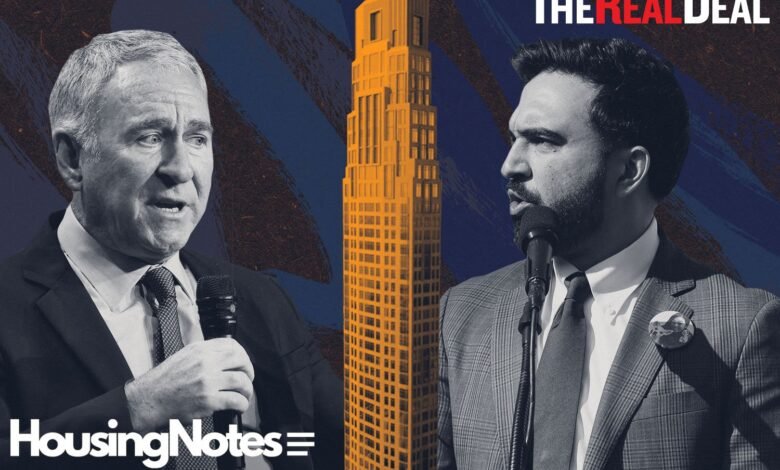
We are excited to announce that Jonathan Miller, who has long authored the most authoritative report on the residential real estate market, is partnering with The Real Deal. Below, you’ll find his Housing Notes column, which will now run on our site several times a week. In addition, Miller’s quarterly report for New York City, which he published through Douglas Elliman for more than three decades, will now be “The Real Deal report, prepared by Jonathan Miller.” Miller’s data venture, Streetmatrix, which provides hyperlocal data, will provide statistics to TRD Data subscribers.
— TRD editors
The social media post that started it
About three weeks ago, the NYC mayor announced, in conjunction with New York Governor Kathy Hochul, another attempt at a pied-à-terre tax to shore up the budget deficit. I wrote a critical piece about this tax, focusing on its unlikely implementation rather than its underlying concept. In the NYC mayor’s video announcing the pied-a-terre tax, he mentions Ken Griffin’s all-time record US home purchase price of $238,000,000 at 220 Central Park South, while standing in front of the building. That’s where the real estate industry’s harsh criticism of the pied-a-terre tax really began. The governor has already announced the new budget, with the proposed pied-a-terre tax embedded, even though we literally have no idea how it is being implemented.
Incidentally, Griffin’s 4-story condo is not a penthouse, nor is it on top of the building as the mayor and most people assume. The building is a 70-story tower, and Griffin is located about 20 floors below the top. The best park views tend to be mid-building, like his, capturing views of Central Park’s greenery from inside the unit.
A whiny response to criticism born from a K-shaped recovery
There’s an excellent Bloomberg article, “U.S. wage growth is increasingly K-shaped with largest divide since 2015,” which helps us understand the frustration building up on the disproportionate income growth the wealthy have over the remainder. It’s quite pronounced.

Being insulated from the day-to-day stress of nominal wage growth over an extended period of time, any criticism of the fruits of that success, combined with decades of being served with maximum adulation (a byproduct of society’s current excessive billionaire worship), I can understand the personal affront one might feel owning the most expensive home in the U.S. and being criticized for it. As a result, Ken Griffin showed that he can whine as much as mere mortals rather than be above it. That is his right, but I do not think the NYC mayor used good judgment of getting personal in his social media effort. But the degree of Griffin’s whining was unexpected. While I very much admire what Griffin has achieved and that he should be rewarded for being innovative, smart and clever (I listen closely to his economic insights), his reaction to the mayor’s video clearly wasn’t about the pied-à-terre tax. It was about being singled out for buying the most expensive home in U.S. history, which has been exhaustively explored since he closed in 2019. I thought it was a bad look for him to talk about pivoting to Miami, which he already did the last time the pied-à-terre tax came up in 2019. However, I have no doubt he meant it when he said it.
I’m willing to bet that if Mandami hadn’t made a video with Griffin’s apartment as the centerpiece, there wouldn’t have been the backlash from the real estate industry, inaccurately assuming the rich are going to flee the city, just like the silly arguments made during the mayor’s election run. However, I can understand the industry’s point of concern. NYC is currently the real estate performance outlier in the U.S., and the wealthy as a market segment has made the clear difference in this market, something about the golden goose. Going forward, the mayor has to be more conscious of where the money is coming from for tax revenue, something about biting the hand that feeds you.
Griffin subsequently suggested he might withdraw from a planned $6 billion office project at 350 Park Avenue in response to that one-minute YouTube video that identified him as the buyer of the most expensive home in U.S. history. As a financial industry leader, this decision seems strange, almost brand-damaging to him as a titan of his industry. Buying the most expensive home in U.S. history is an attention magnet, good or bad. He’s been in the headlines for years over his record-setting full-retail residential real estate purchases.
While both historically low, the murder rate in Miami is double NYC
Griffin is already leaving his Chicago business roots, after criticizing Illinois and Chicago leaders for years over crime policy, taxes, pensions and governance, saying these policies were unwinding prior progress and making it “ever more difficult” to maintain Chicago as Citadel’s HQ. The murder rate per capita in Chicago is more than 4X the rate of NYC, but Miami’s rate is more than double NYC. The latest threat to move is not about safety.
Griffin said he was concerned about his safety in NYC, referring to the murder of a United Healthcare CEO in Midtown in 2024. I get it. But I suggest those safety concerns should have begun on the day he bought the most expensive home in U.S. history. The mega sale seems to be mentioned nearly every day ever since, so it’s probably had more eyeballs on his $238 million home, more than any home in U.S. history before the mayor’s one-minute video.
Griffin has framed Miami and Florida as offering “traditional values,” better governance and a more optimistic environment for entrepreneurs. Incidentally, the NYC financial services talent pool is 6x that of Miami. I suspect the talent pool is the reason why Griffin has been bullish on NYC based on his actions despite his recent threat to leave.
I thought I’d mention that the murder rate per capita in New York City was 1.6 in the first half of 2025 while Miami* was more than double at 3.4. Both rates are historically low, so safety doesn’t seem like a rational reason for a serious NYC exit decision either. For additional reference, the murder rate per capita calculation in Chicago was 7 during the same period.
*Miami murder rate per 100,000≈(16 homicides /0.45–0.50 million people)×100,000rate≈0.45–0.50 million people16 homicides×100,000.
No, it’s not as bad as systematic racism
Steven Roth, the once-billionaire (based on his stock value) behind Vornado Realty Trust, developed 220 Central Park South, the development where Ken Griffin bought the most expensive second or primary home in U.S. history. On his company’s May 6, 2026, earnings call, Roth compared the phrase “tax the rich,” the message of the NYC mayor’s one-minute YouTube video, to racial slurs and antisemitic language. His comparison was highly criticized because it really trivialized the weight of racial discrimination by equating economic policy rhetoric with systemic oppression. How insulated from the real world can you be? I suspect Roth felt the need to stand up for his key investor at 350 Park Avenue. Steven Roth’s Vornado and Ken Griffin’s Citadel are partners in the large joint venture redevelopment (with the Rudin family) that I mentioned earlier. But this more recent Bisnow headline is interesting: Ken Griffin: Citadel NYC Tower ‘Probably’ Going Ahead Despite Mamdani Video.
The billionaire class doesn’t care about taxes as much as you think
On the property side, the very wealthy often benefit from New York’s skewed property tax system: luxury condos in new towers can be assessed at a fraction of market value, and programs like 421a historically let some nine‑figure apartments carry surprisingly low annual tax bills. That means a billionaire in a $200 million+ Midtown penthouse pays a tiny effective property tax rate, while renters in ordinary buildings indirectly shoulder a larger share of the property tax burden through their rent.
A friend told me recently they had a meeting with a billionaire embedded in NYC, and, on the topic of the pied-a-terre tax, indicated that they don’t care as much about those types of taxes as the media coverage suggests. I’ve heard this over and over again from the wealthy in private sittings over my career. The reason is the abundant resources such as talent, that NYC provides to help titans of industry thrive to build their businesses.
Richard Florida, the father of new urbanism, recently wrote an excellent piece on this very topic for The Atlantic: The One Tax The Rich Can’t Escape: New York’s proposed pied-à-terre tax is unlikely to chase anyone away.
Here’s his key message:

The very loud stories about a handful of tech bros fleeing California for Florida over the proposed wealth tax describe a small, unusually vocal slice of the billionaire class, not the whole group. Only six of the 246 billionaires in California left to avoid the proposed wealth tax. I’m sure the actual number is a bit higher and the loss is clearly damaging to the state’s coffers. The repetitive coverage of the usual cast of billionaire bros, such as Musk, Brin and Zuckerberg, diverts attention from what is actually happening.

Final thoughts
NYC’s revived pied-à-terre tax on $5 million+ second homes has become a flashpoint less for its mechanics than for Mayor Mamdani’s decision to spotlight Ken Griffin’s $238 million condo in a social media video, triggering an emotional backlash from Griffin and the real estate industry despite NYC’s comparatively strong safety metrics and economic fundamentals. It was personal. The episode underscores a broader K‑shaped recovery in which the wealthy have seen outsized gains while still benefiting from New York’s skewed property tax system and legacy abatements, even as many billionaires remain anchored in the city for its deep talent pool, suggesting a narrowly targeted pied-à-terre levy is unlikely to unleash a mass exodus.
While the zeitgeist is slowly shifting against years of billionaire worship, they are still desperately needed as NYC taxpayers. I hope the NYC mayor remembers that.
The actual final thought — Here’s how the NYC pied-à-terre tax looks to those who continue to attack the city.
Read more Housing Notes columns and sign up for email newsletters here.
Read more

Housing Notes: Breaking down the billionaire halo effect

Housing Notes: Nothing makes sense — but local versus macro explains it