
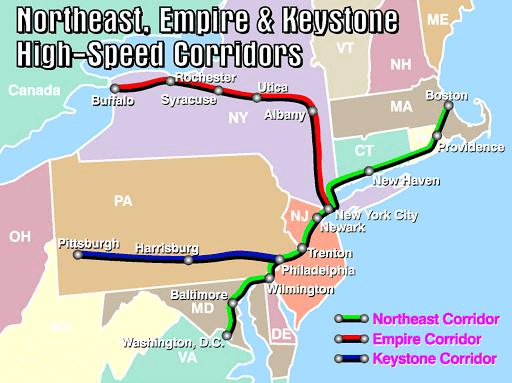
 In recent years, there’s been growing interest in high-speed rail (HSR) as a way to address long-standing transportation challenges in Upstate New York. With increasing investments in technology, higher education, and infrastructure, the region stands at a pivotal moment to capitalize on the opportunities HSR could offer.
But while the potential benefits of high-speed rail are clear, it’s essential to recognize both the challenges and opportunities associated with such a transformative project.
Upstate New York is emerging as a significant player in the technology sector. One of the most notable developments is the planned $100 billion investment in semiconductor manufacturing by Micron Technology in Syracuse. This investment is expected to bring thousands of jobs to the region and make Upstate a critical hub for microchip production.
High-speed rail could serve as the lifeblood of this technological corridor, linking the emerging microchip manufacturing hubs in Syracuse, Rochester, and Buffalo with other innovation centers across the Northeast. By reducing travel times between these cities, HSR would not only improve connectivity but also ensure that this tech hub thrives.
However, the claim that high-speed rail could reduce travel time between Buffalo and Rochester to just 30 minutes may require further verification. In similar cases, such as the 75-mile stretch from Washington, D.C., to Baltimore, high-speed rail typically reduces travel times to around 30 to 40 minutes.
While it’s plausible that high-speed rail could dramatically reduce travel time between Buffalo and Rochester, actual distances and speeds must be carefully considered.
Another key area where high-speed rail can make a difference is higher education. In cities like Buffalo, Rochester, and Syracuse, universities are the largest employers, and these institutions are essential to the region’s economic future.
Universities like the University of Rochester and Syracuse University drive local economies, attracting students and faculty from across the country and the world.
To remain competitive, these institutions must continue to attract top talent year after year. High-speed rail can play a critical role in this by improving access to universities for students from major metropolitan areas like New York City, Boston, Washington, D.C., and Philadelphia.
By reducing travel time between these cities, high-speed rail could make Upstate universities more attractive to students, boosting enrollment and ensuring that these institutions remain vital to the region’s growth.
This claim is supported by similar initiatives in Europe, where high-speed rail has been used to improve access to universities, driving both enrollment and economic growth. While this is a promising strategy, it remains to be seen how such a system would be implemented in the U.S., where the scale of high-speed rail projects varies widely.
High-speed rail is often lauded for its environmental benefits. It can reduce dependence on cars, ease congestion, and decrease the carbon footprint of travel. High-speed rail projects in countries like Japan and France have contributed significantly to environmental sustainability by providing an alternative to automobile and air travel.
In Upstate New York, the expansion of high-speed rail could further support efforts to reduce carbon emissions while providing a cleaner, more efficient mode of transport.
From an economic standpoint, the potential return on investment for high-speed rail is substantial. Some estimates suggest that high-speed rail could generate $1 billion to $2 billion annually in ticket sales, freight services, and related revenues. While these figures are optimistic, they align with successful high-speed rail systems elsewhere in the world.
For example, Japan’s Shinkansen and France’s TGV systems have been key drivers of economic growth, particularly in regions outside of major urban centers. However, the specifics of ridership and revenue generation for a New York-based system would depend on several factors, including the population served, fare structures, and integration with other modes of transport.
Tourism is another sector that could benefit from high-speed rail. With attractions like Niagara Falls, the Finger Lakes, and the Adirondacks, Upstate New York is a prime tourist destination. High-speed rail could make it easier for tourists from major metropolitan areas to visit these sites, contributing to the local economy and increasing tourism revenue.
In fact, studies have shown that regions with access to high-speed rail systems experience increased tourism. For example, the implementation of high-speed rail between London and Paris resulted in a significant rise in tourism for both cities. Similar outcomes could be expected for Upstate New York, particularly as travel times are reduced and accessibility is improved.
The claim that Niagara Falls would become more accessible through high-speed rail is plausible, but further studies would be needed to understand the exact impact on tourist numbers and revenue. By connecting Upstate’s major tourist attractions with major cities in the Northeast, high-speed rail could also foster regional development by attracting new businesses and investments.
High-speed rail in Upstate New York presents a promising vision for the region’s future. It can support the growth of high-tech industries, provide universities with an additional tool to attract talent and promote regional tourism and environmental sustainability.
However, it is important to recognize that such a project would require careful planning and coordination. A balanced, evidence-based approach is crucial for ensuring that the promises of high-speed rail are realized while addressing challenges related to funding, ridership projections, and environmental impacts.
For example, while high-speed rail is projected to reduce travel times significantly, claims about specific time reductions — such as the 30-minute travel time between Buffalo and Rochester — must be based on realistic assessments of distance and speed capabilities. Similarly, the revenue potential of high-speed rail will depend on factors such as ridership demand, fare structures, and the integration of rail with other transportation systems.
Nevertheless, the benefits of high-speed rail in Upstate New York are clear. As the region continues to develop as a hub for technological innovation and higher education, high-speed rail will play a key role in connecting the cities and driving economic growth. It’s time for Upstate New York to seize this opportunity, with a forward-thinking vision that balances ambition with practicality.
George Cassidy Payne is a staunch advocate for High-Speed Rail, Payne actively supports efforts to improve and modernize transportation systems in upstate New York, believing that high-speed rail offers a transformative opportunity for regional growth and sustainability.
Illustration: Map of Northeast, Keystone, and Empire corridors, federally designated high-speed rail corridors.

Source link