
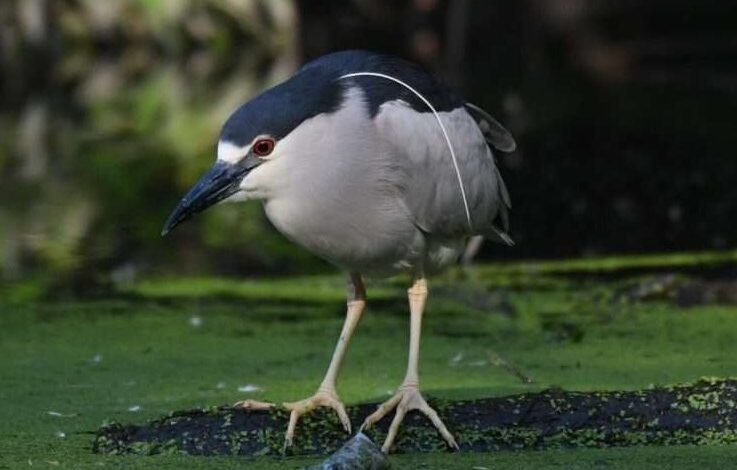
 The Black-Crowned Night Heron, historically the most abundant wading bird in New York Harbor and an important environmental indicator, is vanishing fast, according to new research led by NYC Bird Alliance and published today the scientific journal Conservation Science and Practice. The study confirms that local Black-Crowned Night Heron populations have declined by 55% in just 22 years.
Urban estuaries can support thriving ecosystems despite bustling human activity. Noting that bird populations can serve as a key indicator of environmental health, researchers recently investigated trends in the New York–New Jersey Harbor, home to the largest breeding population of colonial nesting wading birds (herons, egrets, ibises) in the northeastern United States.
Every night at dusk the Black-Crowned Night Heron leaves its harbor island, spreading out across the New York City to hunt – standing motionless at the water’s edge until a fish or a crab delivers itself to this patient nocturnal hunter.
By morning it has returned to one of a handful of small wild islands where it nests alongside nine other wading bird species, including Great Blue Herons and Great Egrets.
For over four decades, NYC Bird Alliance scientists and more than 100 trained volunteers have counted every wading bird nest on every island in New York–New Jersey Harbor, the longest continuous wading bird dataset in the Northeast.
In NYC Bird Alliance’s study data spanning 22 years showed that the overall population of these wading birds has declined by 27%, faster than average declines across North American birds. Though populations of Great Egret and Snowy Egret increased over time, Black-Crowned Night Heron declined by 55%.
Alarmingly, the researchers estimated that the Night Heron could be lost from the region as soon as 2037 if no conservation action is taken.
“Conservation action works, and our discovery of this decline while this bird is still plentiful will allow us to prevent their local extinction. As a top predator that connects to every corner of the harbor ecosystem, the Black-Crowned Night Heron is a modern day ‘canary in the coal mine’ telling us something important about the health of our estuary,” said corresponding study author Dustin Partridge, PhD, of the NYC Bird Alliance.
“Healthier waterways brought nesting wading birds back to our city 50 years ago, and the same investment can keep the Black-crowned Night Heron here too—while improving the lives of all New Yorkers connected to our harbor.”
The Bird Alliance told supporters in a recent email that local extinction could end up “putting the entire northeastern population at risk.”
The organization is counting on early detection of the decline to help stave of their disappearance. The Alliance’s scientists are hoping to uncover what is causing this decline by researching predation, human disturbance, water quality, and more in the harbor.
They’re also calling on New York policymakers to support more research and institute better protections for Black-Crowned Night Heron. The Herons are listed as endangered in Maine and Pennsylvania and threatened in New Jersey. New York, where the Northeast’s largest population persists, has no listing.
You can learn more about their efforts, and what you can do to help, at their website.
Photo of a Black-Crowned Night Heron hunting in Central Park by David Ringer.
Source link