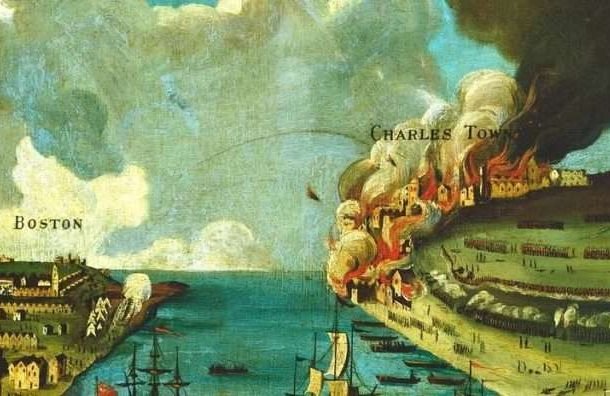
 June 17, 2025, marked the 250th anniversary of the Battle of Bunker Hill. New England militiamen inflicted 1,054 casualties on the British, 50 percent of the British force.
The Bostonians and their allies sustained 411 casualties that day, including the man who stood at the heart of the battle, Dr. Joseph Warren, the namesake of Warren County, NY, who was brutally killed and mutilated by the British at the end of the battle.
A few days before, Warren was made a Major General of the Continental Army the day after George Washington was made Commander in Chief. He had been serving President of the revolutionary Massachusetts Provincial Congress, the highest position in that colony’s revolutionary government.
He wore an conspicuous officer’s uniform, but when he arrived in Charlestown, Warren refused command offered by the more experienced Israel Putnam and took a place among the volunteers.
There, he also refused command from Colonel William Prescott (1726-1795), and was greeted by the cheers of the soldiers he joined in the redoubt on Breed’s Hill, a hastily-built square-shaped earthen fortification built overnight. Despite the name Bunker Hill name, this was the actual location of most of the fighting.
Warren’s believed to have been one of the last Patriots in redoubt as the Patriots retreated under fire.
Redoubt Rediscovered
A previous ground-penetrating radar survey on the hill in the 1990s had promising results suggesting an oval-shaped trench. Technology has significantly improved since this original survey and the City Archaeology Program working with the National Park Service and other partners has re-surveyed the redoubt, confirming its location.
 An archaeological excavation led by City of Boston Archaeologist Joe Bagley with support from American Veterans Archaeological Recovery has also uncovered numerous military and domestic artifacts.
The effort has confirmed the geometry Henry Pelham’s Map of the Siege of Boston. Among the other finds were eight marble-sized lead musket balls with visible ramrod and molding marks; three gun flints, two gray English flints and one beige French flint; scattered metal pieces from colonial and British firearms.
The also found items from the post-Battle British occupation of the site, including a ceramic wig curler; parts of glass bottle, teacups and porcelain and earthenware; sleeve buttons lost from military and personal clothing; and fragments of clay tobacco pipes.
In addition to the redoubt, the team is also hoping remote sensing techniques will identify areas of potential burials for the more than 300 individuals who lost their lives during the battle, including both colonial and British forces.
The colonial forces included people of color and Native individuals from multiple Native nations. No burials will be disturbed as part of this work, but radar and documentary surveys may help to better protect these locations. The City Archaeology Program is coordinating with the National Park Service on Native consultation.
Read more about New York’s connections to the Siege of Boston & the Battle of Bunker Hill.
Illustration: Detail of “View of the attack on Bunker’s Hill, with the burning of Charles Town, June 17, 1775” by an unknown artist (ca. 1783); and “The Death of General Warren at the Battle of Bunker Hill” by John Trumbull (1786).
Source link