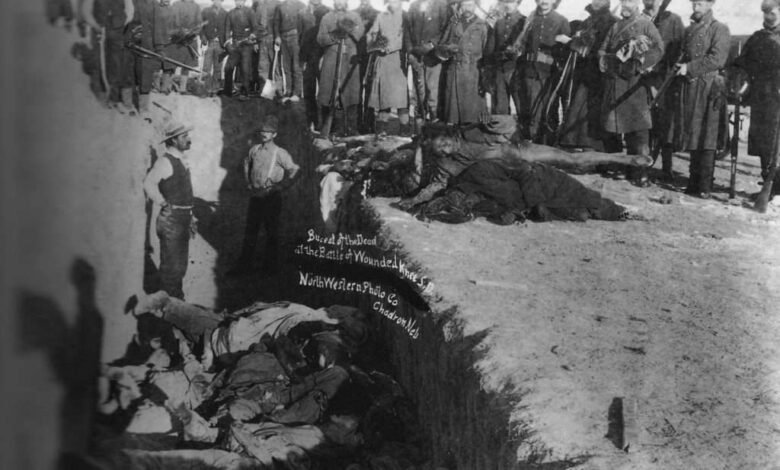
 On December 29, 1890, the deadliest mass shooting in American history took place at near Wounded Knee Creek (Čhaŋkpé Ópi Wakpála in Lakota) on the Lakota Pine Ridge Indian Reservation in South Dakota. During what is now known as the Wounded Knee Massacre, hundreds of U.S. troops, including many recently arrived German and Irish immigrants, surrounded a Lakota camp and opened fire killing an estimated 250 to 300 Lakota women, men, and children.
Over half of those killed were women, children, and elderly tribal members, and most of the dead were unarmed. Twenty-five soldiers also were killed and 39 wounded, many being the result of friendly fire (six of the wounded later died).
In his book The Plains Sioux and U.S. Colonialism from Lewis and Clark to Wounded Knee (Cambridge University Press, 2004), historian Jeffrey Ostler said “Wounded Knee was not made up of a series of discrete unconnected events. Instead, from the disarming to the burial of the dead, it consisted of a series of acts held together by an underlying logic of racist domination.”
Two days after the massacre, Nelson A. Miles, a major general then serving as commander of the Military Division of the Missouri, wrote to his wife, describing the events at Wounded Knee as “the most abominable criminal military blunder and a horrible massacre of women and children.”
Although he continued to oppose indigenous sovereignty, Nelson Miles would later fight to compensate the survivors of the massacre.
Miles blamed the massacre on Colonel James W. Forsyth (1833-1906), the commander in the field of 7th Cavalry, which committed the massacre. Officially nicknamed “Garryowen” after the Irish air adopted as its march tune, the 7th Cavalry was the same unit wiped-out at Custer’s Last Stand by combined Lakota Sioux, Northern Cheyenne, and Arapaho forces in June of 1876.
Miles removed Forsyth from command but he was reinstated by Secretary of War Russell A. Alger and later promoted.
(Among other roles, Nelson Miles had served as a colonel in 61st New York Infantry during the Civil War. He later became an opponent of the Philippine–American War and supported an inquiry into the brutality of American troops in the Philippines, releasing his own report on US atrocities during that war. He condemned the use of concentration camps in the Philippines and said that the use of torture was widespread and was undertaken with the knowledge of some senior officers.)
Despite the brutality, 20 soldiers were awarded the Medal of Honor specifically for actions at Wounded Knee, including at least four New Yorkers, among them:
John E. Clancy (ca. 1868 – 1932), born in New York and serving as a musician at the time of the massacre, he was cited “for bravery in twice voluntarily rescuing wounded comrades from under fire of the enemy.”
Frederick Ernest Toy (ca. 1863 – 1933) was born in Buffalo to German-American immigrants. He was initially to be cited for “bravery displayed while shooting hostile Indians.” This was changed on the final citation by the War Department to “bravery.” Captain Winfield Scott Edgerly said Sergeant Toy did “deliberately aim at and hit two Indians who had run into the ravine.”
Bernhard Jetter (1862 – 1927) was born in the Kingdom of Württemberg and immigrated to New York City in 1881 (he was naturalized in 1896). Jetter and several other soldiers took part in search-and-destroy missions and was cited for “distinguished bravery.” Jetter returned to Brooklyn after leaving military service and died in Brooklyn.
Herman Ziegner (1864 – 1898), born in the German state of Saxe-Weimar-Eisenach, cited for “conspicuous bravery.” After eight years Ziegner was discharged from the Army and settled in New York City, where he married and worked as a night watchman at the Equitable Building.
At the start of the Spanish–American War, Ziegner was one of the first to join the 71st New York Volunteer Infantry Regiment and led troops at San Juan Hill. He died from malnourishment and malaria after returning to New York and is buried in Brooklyn.
Although perhaps not technically a “New Yorker,” John Chowning Gresham (1851 – 1926) attended West Point and was a First Lieutenant at Wounded Knee (his older brother had served with the Confederate States of America). His citation said he “voluntarily led a party into a ravine to dislodge Sioux Indians concealed therein.”
A number of the citations on the medals awarded to soldiers at Wounded Knee say they were pursuing Lakota trying to escape or hide. One citation was for “conspicuous bravery in rounding up and bringing to the skirmish line a stampeded pack mule.” Another was awarded in part for extending an enlistment.
In 1990, both houses of the U.S. Congress passed a resolution on the historical centennial formally expressing “deep regret” for the Massacre at Wounded Knee.
In 2001, the National Congress of American Indians passed two resolutions condemning the military awards and called on the federal government to rescind them.
In February 2021, the South Dakota Senate unanimously called on Congress to investigate the 20 medals of honor. Although Congress has failed to act, in July 2024, the Secretary of Defense Lloyd J. Austin III announced a joint Department of Defense / Department of the Interior review to consider revoking the Wounded Knee Medals of Honor.
In all, more than 50 New Yorkers have been awarded the Medal of Honor for what is now known as the American Indian Wars (1609-1890), which is considered to have ended with the Massacre at Wounded Knee.
Illustration:

Source link