 A cemetery for free and enslaved Africans from the mid-1600s to the mid-1800s, the Harlem African Burial Ground is an early sacred site in New York City’s history, and yet for decades the site was disrespected and forgotten. Nieuw Haarlem‘s Black cemetery has been paved over for a city bus garage.
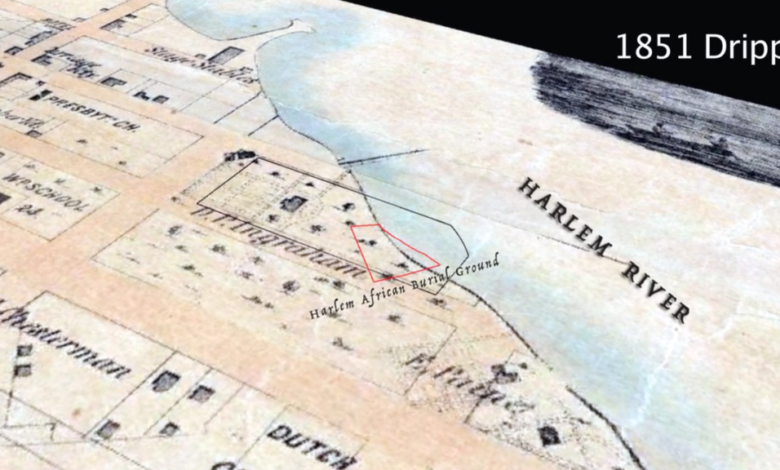
The historic footprint of the Burial Ground is an almost half-acre spot in what was once Nieuw Haarlem, established by Dutch royal charter on August, 15 1660 as an outpost of New Amsterdam. The Low Dutch Reformed Church which established the Burial Ground was the community’s founding place of worship.
It is now located on a city block at 126th Street and 2nd Avenue (2460 Second Avenue) in East Harlem, most recently occupied by the 1947 decommissioned MTA 126th Street Bus Depot.
 From the beginning, the church maintained two cemeteries: one for people of European descent, and another for people of African descent.
“Early settlers profited from the rich soils and acres of timber, and the town flourished with an influx of immigrants that included Danes, Swedes, Hollanders, French Huguenots, and Germans,” according to a recent archaeological survey. “Despite the diversity of ethnic backgrounds, Dutch was the language used for civic affairs in the early years.”
The road to Nieuw Haarlem, later known as the “Old Harlem Road,” was improved to New Amsterdam by the Dutch West India Company‘s enslaved Africans. It ran to the Harlem River near East 125th Street just south of burial sites.
The segregated cemeteries were maintained until 1858 by the Elmendorf Reformed Church, successor of the Low Dutch Reformed.
The Burial Ground has been referred to over time by a variety of names, including the Reformed Low Dutch Church of Harlem and Negro Burying Ground. The site has been significantly disturbed by development from the early-1800s, when the land was first subdivided into city lots.
In the early 20th century a recreational park (complete with a dance pavilion, shooting gallery, carousel, and other structures) was built on the site, and later a movie studio.
Most recently it was the decommissioned East 126th Street Bus Depot, built by the Third Avenue Railway in 1947 to house the new bus fleet operated by its subsidiary Surface Transportation System (later Fifth Avenue Coach).
The structure was inherited by the City of New York as part of the condemnation process for Fifth Avenue Coach in 1962, when it was taken over by the NYC Transit Authority (now MTA), and used to operate several Bronx and Manhattan bus lines.
 Early History & Missing Records
According to the a recent archaeological study:
“The Native American name “Rechgawanes” was given to a section of land south of 109th Street west of the confluence of the East and Harlem Rivers, and to the stream that once ran along the route of East 107th Street about twenty blocks south of the project site (Grumet 1981). Planting areas and old fields once characterized the upland along the shoreline.
“The project site lies in an area near former flatlands called Muscoota by Native Americans, which once stretched between the Harlem River and Morningside Heights, northwest of what were formerly the Harlem Creek and its bordering wetlands.
“A Native American trail known as “Wickquasgeck” was reported in northern Manhattan west of the project site through what is now Central Park. A second Indian Path veered off this trail at East 110th Street near Fifth Avenue, and headed northeast toward a habitation site on the Harlem River near East 124th Street, just about two blocks southwest of the project site (Grumet 1981).
“This Amerindian Trail was incorporated into the first road system of the village of Harlem. Passing through the meadows of Muscoota to a place called Conykeekst, the trail crossed First Avenue at East 124th Street and terminated at a camp or village site near the shoreline about two blocks south of the Depot site (Bolton 1922)…
“New Amsterdam had been settled for 13 years before the first efforts were made to settle at what is now Harlem. Early attempts to establish a European presence in 1637 were unsuccessful due to lack of manpower, poor health, political conflicts, and clashes with the Native American community.
“Isaac De Forest was the first documented landowner in what eventually became the village of New Harlem (a.k.a. Nieuw Haerlem, Harlaem, or Haarlem), and in the 1630s he was granted a tract of about 100 acres which formed a narrow strip from the Harlem Creek to the Harlem River (Riker 1904).
“Following De Forest’s tenure, the tract passed through ownership by William Beeckman and Claesen Swits. Swits’ farm was later destroyed in an skirmish with local Native American groups, and his abandoned land eventually became the site of the first successful settlement of the village of New Harlem.”
Upcoming Event, Ongoing Research
Part of the problem for researchers has been missing “Harlem Records.” As early as 1902 it was reported that many of the original records from the earliest years of the Town of Harlem, dating between 1666 and 1686, were missing from the City Register’s Office.
Roughly 20 volumes of conveyances as well as “fifty-six valuable city maps of city lands” were reportedly absent from the repository. A New York American newspaper article from 1916 reported that the real estate records, which were then in possession of the Title Guarantee and Trust Company, had been missing for over a century.
Two years later, the New York Times reported that they had been found and had been donated by historian James Riker to the New York Public Library. Most of the early records of Harlem are now public, but gaps still remain in the recordation of early deeds.
 The Reformed Church Archives in New Jersey says they do not hold any materials specific to the Low Dutch or Elmendorf Reformed Churches.
Ongoing research by the Harlem African Burial Ground Task Force and other community members interested in the site’s preservation and memorial is contributing new knowledge and plans are being considered to redevelop the site into a memorial park.
The site was “rediscovered” by the public in the late 1990s when reconstruction of the nearby Willis Avenue Bridge revealed a colonial site and historic burial ground under the old Bus Depot.
Per New York State law, the NYC Department of Transportation conducted a Phase I-A historical and archeological survey, which verified the existence of the burial ground.
Through research and advocacy, community advocates are now bringing this history to light, and now the New York City Economic Development Corporation (NYCEDC) is leading the memorial efforts.
The next phase of archaeological work hopes to establish the complete distribution of human remains across the bus depot site.
It will be led by Michael Pappalardo and Dr. Elizabeth Meade from AKRF Inc., who managed the 2015 archaeological work at the site, collaborating with Dr. Rachel Watkins, biocultural anthropologist, and Dr. Aja Lans, bioarcheologist, both well-established experts specializing in the discovery and analysis of human remains of African descent.
Free Online Event
The Harlem African Burial Ground Initiative and NYCEDC will host an online conversation about the Burial Ground’s history, the role of urban planning in historic preservation, and the vision for the future memorial, cultural education center, and mixed-use project planned for the site.
This free online event will be held via Zoom on February 12, 2025, beginning at noon, ET. Register here.
This program is supported by the Ministry of Education, Culture and Science of the Kingdom of the Netherlands, through the DutchCulture USA FUTURE 400 program of the Consulate General of the Netherlands in New York.
Much of this essay was drawn from the 2013 survey report prepared for the MTA by Cece Saunders and Faline Schneiderman-Fox. Read more about the history of Nieuw Haarlem in this essay by The New Netherland Institute.
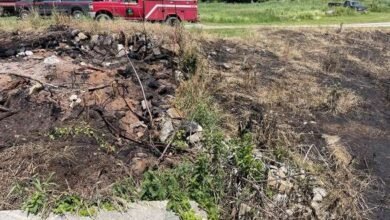
Illustrations, from above: the 126th St NYCTA Bus Depot, on the site of the Harlem African Burial Ground in 2021 (courtesy ); Harlem African Burial Ground excavation site inside the Bus Depot (AKRF); 1851 Harlem African Burial Ground map illustration (NYCEDC); Elmendorf Reformed Church, the successor of the Low Dutch Reformed Church of Harlem (wikimedia user Smallbones).

Source link