 A major educational development of the early twentieth century was the rise of high schools. Public high schools gradually replaced the academies in the late 1800s. This change arose partly from the changing notion of “public,” with independent schools no longer seen as completely fulfilling public education responsibilities.
The rising cost of first-rate secondary education and the emerging urban middle class that desired it, also contributed to the move toward high schools. In city after city, academies were transformed into public secondary schools and architecturally impressive public high schools opened.
By 1910, a dramatic expansion of secondary school attendance had begun. School districts raced to build new high schools to meet the demand, adapting the high school program to the varying perceived needs and interests of a diverse student body.
Typically, high schools offered separate courses of study for students planning for college, for those seeking to enter industry, and for those preparing for white-collar commercial occupations. The role of schools in sorting pupils and in defining their future status in society became a controversial one, especially as aptitude testing and guidance programs proliferated.
From one perspective, the schools were helping pupils by providing an education adapted to their abilities and future needs. In another view, the schools were narrowing the opportunities available to students, often on a basis reflective of social class and ethnic origins.
Nonetheless, high schools grew ever more popular. By 1940, high school attendance had come to be the normal occupation of the teenager, and the most general culmination of formal education.
 If you were an elementary school pupil in 1930, you would have much in common with pupils of one hundred years before. Reading, writing, and arithmetic would still be core subjects. But much would be changed.
The schools of New York not only kept up with modern curricular innovations, but were often the testing grounds for them. Progressive ideas about how children learn and about the nature of the classroom as a social setting were reflected in the work of pupils in many schools — in activity programs and group projects, in social studies, and in the encouragement of artistic expression.
The trend to recognition of a need to educate “the whole child” was spurred by publication, in 1929, of the State Education Department‘s “Cardinal Objectives of Elementary Education,” which declared:
“It is the function of the public elementary school to help every child: (1) to understand and practice desirable social relationships; (2) to discover and develop his own desirable individual aptitudes; (3) to cultivate the habit of critical thinking; (4) to appreciate and desire worth-while activities; (5) to gain command of the common integrating knowledge and skills; and (6) to develop a sound body and normal mental attitudes.”
Similarly, the concerns of citizens and educators through succeeding decades permeated the school curriculum. Economic concerns of the Great Depression, patriotic and democratic preoccupations during World War II, issues of war and peace, race and ethnicity, world survival and environmental survival, have all had their impacts.
The early twentieth-century school teacher, as well as his or her students, could have recognized similarities and differences compared to his or her nineteenth-century counterpart. Most concrete, perhaps, was the progress towards equal rights for women teachers.
Equalization of pay scales for women and men began in New York City in 1911 and was extended statewide in 1924. During the same years, women teachers generally gained the right to retain their jobs after marriage.
Teachers’ status rose, also, through their increased organizational efforts. The New York State Teachers Association, which had been founded in the mid-nineteenth century, affiliated with the National Education Association and expanded its role as an advocate for the professional status of teachers.
Teachers’ unions, including the New York City Teachers Union, founded in 1916, and its successor in the American Federation of Teachers, worked not only to improve wages and benefits, but also to promote measures they believed would benefit schools and pupils.
It was not until the 1960s, however, that teacher unions generally attained the status of collective bargaining agents. (In 1972, the State’s teachers organizations merged to form the New York State United Teachers.)
Controversy and Change
The inherent tension involved in attempting to provide a universal system of education in a society based on religious, ethnic, political, and economic diversity and freedom, has produced recurrent controversy throughout the State’s history. Recent decades have seen new forms of controversy and new efforts to resolve long-standing problems.
From the earliest years of public education, the question of the proper relationship between schooling and religion occupied educators. The schools of the Public School Society, in New York City, and the district schools upstate, were all, theoretically, nondenominational. But since the “principles of morality” were part of the core curriculum, the potential for controversy was unavoidable.
In many schools, the Bible was made assigned reading; but which version of the Bible, Protestant or Catholic, was to be used? The intractability of such problems contributed to the decision of the Catholic church leaders, in the 1840s, to begin the development of a separate church-sponsored parochial school system.
 For the public schools, the State Superintendent of Common Schools ruled in 1853 that Bible-reading could not be required in violation of a pupil’s conscience, but a kind of non-denominational Protestantism nonetheless became the norm, reflected in school prayers as well as holiday celebrations and the like.
While public interest in this issue waxed and waned over the years, it remained unresolved. In 1951, during a period of increased interest in school prayers, the Board of Regents tried to find a solution by adopting an official State-written nondenominational prayer and recommending its use by all school districts.
It was this Regents prayer which was found unconstitutional by the United States Supreme Court in a historic 1962 ruling.
Educational equality also has been high among the issues of educational concern and controversy in this century. While generally accepted as a goal, equality has proven difficult to achieve.
In the early years of the century, the most noticed inequality was between students in the prosperous cities and those in the poorer rural districts – exactly the inequality noted by the State’s leaders in the early 1800s. As late as 1920, the State had over 10,000 school districts, of which over 8,000 had only a one-room elementary school. Many communities could not afford more elaborate schools.
Educators argued that such schools could not meet modern standards, and that rural youngsters were therefore deprived of full educational opportunities. School consolidation was part of the solution proposed, along with increased financial support.
In 1925, with the support of Governor Alfred E. Smith, the State adopted a landmark Equalization Law, basing State aid on a formula that recognized the disparities in school district wealth. This principle has remained a fundamental element of all State aid programs since that time.
In recent decades, however, the wealth disparity has tended to reverse itself, with cities having inadequate resources, while some suburban districts are relatively wealthy. In the case of Levittown v. Nyquist (1982), the State’s Court of Appeals ruled that equality of school finance was not mandated by the State Constitution.
 Equal educational opportunity for pupils of varying racial and ethnic backgrounds has been one of the fundamental challenges of the post-World War II decades. While official segregation of Black pupils was virtually ended in New York before 1900, the “unofficial” segregation of the schools became extremely apparent, especially with the growth of the Black community in many of the State’s cities.
Especially after the Supreme Court’s historic ruling in Brown v. Board of Education (1954) that racially segregated schools are inherently unequal, Black parents and civil rights supporters sought to persuade or compel school districts to accomplish actual desegregation. Supporting this effort was the Board of Regents, which made progress towards desegregation one of its leading statewide priorities.
Sometimes under pressure of court orders, many of the State’s cities have taken action to desegregate some or all of their schools, but this process is far from complete. The 1960s and 1970s also brought a broad-based expansion of the rights of students.
For handicapped children, these years saw the recognition of the fundamental right to education, from which many had been previously excluded. For children whose native language was not English, the rise of bilingual and multicultural programs was a virtual educational enfranchisement.
For all pupils, the extension of civil liberties to the school setting, including freedom of expression, access to and privacy for pupil records, and due process in disciplinary matters, gave hope that the democratic rhetoric of education would be made reality.
Conclusion
The history of education in New York State has been, in part, the evolution of a school system. Over time, a network of schools was built up, reaching communities throughout the State, and supported and supervised by central educational authorities.
But this history has been, as well, the story of the interrelation between changing educational patterns and the larger social forces shaping the lives of the people of the State. Both of these aspects of our history have made their mark on each of our schools and communities.
The story of schools, education, and community impact, awaits those who would venture to rediscover it.
This is part four of four-part series on the history of education in New York State drawn from Consider the Source New York’s Researching the History of Your School an online collection of resources from the New York State Archives and the Archives Partnership Trust. The resources include history, historical resources and how to access them, and activities to use when teaching school history or researching a local school.
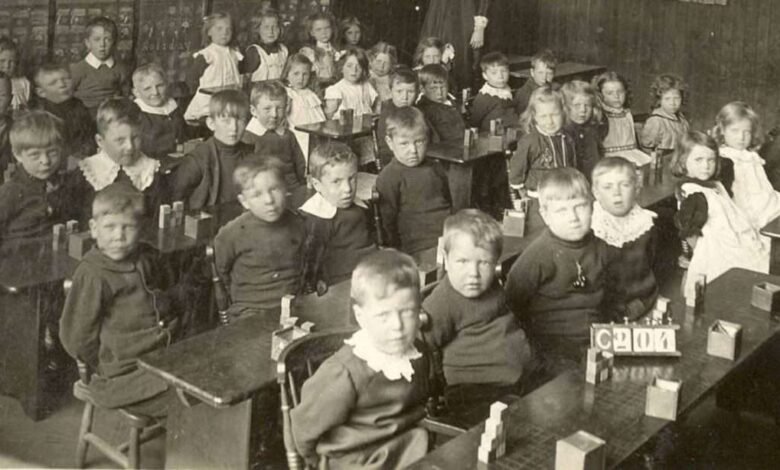
Illustrations, from above: Gothic-style Eastern District School at 227 Marcy Avenue in Brooklyn, built in 1907; Garden City, NY’s Stratford School which opened September 1930; A 19th century classroom; and a segregated black school classroom in ca. 1960.
Source link