 During the United States Supreme Court’s 1944-1945 term, the Justices heard three final days of oral arguments in the week that began on Monday, April 30, 1945. Justice Robert H. Jackson (1892 – 1954) missed some of these arguments. He might not have been fully prepared for those that he did attend. In that week, the Supreme Court work was not his primary concern.
Beginning on April 25, 1945, President Harry S. Truman had recruited Justice Jackson to represent the U.S. as its chief prosecutor, with allies, of the Nazi German leaders who were on the brink of being defeated militarily and captured.
Since then, Jackson had been reading secret executive branch planning documents, meeting privately with the President and other executive branch officials, assembling staff, editing the President’s coming order and announcement of Jackson’s appointment, drafting his own statement, confiding in and getting advice from family and selected close friends, and having other meetings and conversations on this topic.
On Monday, April 30, Justice Jackson traveled from his rural home (Hickory Hill in McLean, Virginia – he had been raised however, in Chautauqua County and attended Albany Law School) to the Supreme Court. He had morning telephone calls with President Truman and with White House Counsel Samuel I. Rosenman. At noon, Jackson, with all of his fellow Justices, took the bench. The Court announced a decision and then heard oral arguments in three cases.
On Tuesday, May 1, Justice Jackson did not go to the Court. He worked from home, reading documents, writing a memorandum on an executive branch prosecution plan, and speaking by telephone to the Secretary of War, Henry L. Stimson. In the afternoon, Jackson hosted a meeting of senior Department of Justice and War Department officials, which Judge Rosenman joined in the late afternoon. Jackson missed Supreme Court oral arguments that day in four cases.
Justice Jackson did attend on Wednesday, May 2, 1945. The Justices took the bench at noon. Chief Justice Harlan Fiske Stone admitted attorneys to practice before the Court. Then the Justices heard oral arguments, the final ones of the term, in two pairs of consolidated cases.
In each argument, one of the advocates was William Dwight Whitney, partner in the New York City law firm of Cravath, Swaine & Moore. Justice Jackson had seen Bill Whitney argue before the Court earlier in the term. Whitney impressed Jackson. The next day, he recruited Bill Whitney to join his Nazi war crimes prosecution team, where he became a significant contributor.
One of Whitney’s oral argument co-counsel on that day was another New York City lawyer, John M. Harlan II. He and Jackson also came to be acquainted, including after President Dwight D. Eisenhower appointed Harlan in early 1954 to be a Judge of the U.S. Court of Appeals for the Second Circuit. (Following Justice Jackson’s death in late 1954, Judge Harlan was appointed to succeed him on the Supreme Court.)
At some point on May 2, 1945, Chief Justice Stone and the seven other Associate Justices learned that Justice Jackson would be working for President Truman as U.S. prosecutor of Nazi criminals. Jackson had not confided in or consulted any Justice when he was recruited. Nor had Jackson disclosed to any of them in advance that he had accepted the appointment, even though some could see it— Jackson did, and we do — as in tension with the separation of executive and judicial powers, and as risking leaving the Court short-handed for some period of time.
I believe that Jackson told his “Nazi prosecutor job” news to his fellow Justices on the morning of May 2. Maybe he did so in the Court’s robing room, just before they took the bench that noontime. Jackson’s news might have distracted some Justices during that afternoon’s oral arguments.
At the White House, President Truman held a press conference in his office just after 4 pm. He read a statement announcing his appointment of Justice Jackson:
“At my request, Mr. Justice Robert H. Jackson, in addition to his duties as Justice of the Supreme Court, has accepted designation as Chief of Counsel for the United States in preparing and prosecuting the charges of atrocities and war crimes against such of the leaders of the European Axis powers and their principal agents and accessories as the United State may agree with any of the United Nations to bring to trial before an international military tribunal.
“Pursuant to the Moscow Declaration of Nov. 1, 1943, all war criminals, against whom there is sufficient proof of personal participation in specific atrocities, are to be returned to the countries where there crimes were committed, to be judged and punished by those countries themselves. These cases are not involved in this assignment.
“There are left, however, the cases of other war criminals, particularly the major war criminals and their principal agents and accessories, whose offenses have no particular geographical localization.
“I hope and expect that an international military tribunal will soon be organized to try this second category of war criminals. It will bee Justice Jackson’s responsibility to represent the United States in preparing and presenting the case against these criminals before such military tribunal.
“Justice Jackson has assembled a staff from within the War, Navy and other departments concerned which has already begun work, so there will be no delay on the part of the United States. It is desirable that preparation begin at once, even though details of the military court are not yet determined.
“I have just signed an Executive Order designating Justice Jackson to this post. He and his staff will examine the evidence already gathered and being gathered by the United Nations War Crimes Commission in London and by the various Allied Armies and other agencies; he will arrange for assembling the necessary additional evidence and he will begin preparations for trial.
“It is our objective to establish as soon as possible an international military tribunal, and to provide a trial procedure which will be expeditious in nature which will permit no evasion or delay – but one which is in keeping with our tradition of fairness toward those accused of crime. Steps to carry6 this out are actively underway.
“Arguments in the Supreme Court for the current term will conclude this week and the court has ordered adjournment on May 28. It is hoped that the trial of these war crimes cases will have been completed next October when the court reconvenes.”
(President Truman also signed Executive Order 9547 that formalized his appointment of Justice Jackson.)
Back at the Supreme Court, the Justices had adjourned until the following Monday, May 7, when they would return to the bench and announce decisions. On that day, Justice Jackson was present for the first part of the session, but then he left the bench to attend to other matters.
 On May 2, after President Truman had announced Justice Jackson’s appointment, Jackson released his own statement to the public (and he circulated a copy of it to each member of the Court):
“The difficult task which I have undertaken at President Truman’s request is that of a lawyer and advocate. It is to prepare and present to an International Military Commission, the case against the principal war criminals on behalf of the United States.
“The President and I have exchanged views and fully agree on the general methods to be pursued. We recognize the magnitude of the task and the heavy responsibility on one who undertakes it. It is a labor I would not have sought, but I accept the assignment by the Commander in Chief with a sense of my inadequacy and with complete dedication I shall see it through.
“I have already selected staff, and it is at work. Fortunately I was able to obtain personnel familiar with the problems and with the materials which have been assembled in the various departments. This staff has been working for some time on the cases under the direction of far-sighted leadership.
“An impressive amount of original and authentic evidence is now in Allied possession and more is being obtained daily in the European theatres of action. There will be no delay on the part of the United States, and we think undue delay itself is a failure. Proper respect for the tribunal that will hear these cases, as as the deference due to representatives who may present the cases of other Governments, will make it impossible publicly to disclose our case until it is presented to the commission.
“All I can say at this time is that I have fully canvassed the difficulties and obstacles and hazards which may cause concern to some people and would not have taken this burden upon myself if I were not convinced that materials available and procedures possible afford an opportunity to do something toward bringing to a just judgement those who have heretofore thought it safe to wage aggressive and ruthless war; and to do it in a way that will be consistent with our traditional insistence upon a fair trial for any accused. Our degree of success will largely be measured by the strength of our support among the American people.”
Late that afternoon, Justice Jackson sat beneath the portrait of Chief Justice William Howard Taft in the Court’s West Conference Room and posed for press photographs.
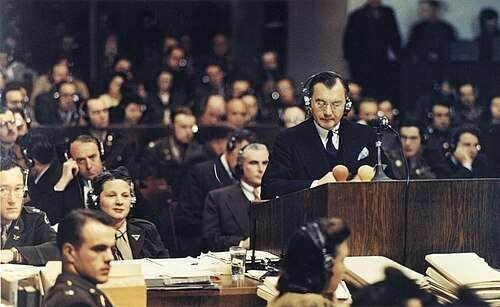
But Jackson was no longer, principally, on the job of being a Justice of the Court. He now was U.S. Chief of Counsel; he would be, soon, in Nuremberg, the U.S. chief prosecutor of Nazi war criminals. Working, as he had said, “to do something toward bringing to a just judgment those who have heretofore thought it safe to wage aggressive and ruthless war; and to do it in a way that will be consistent with our traditional insistence upon a fair trial for any accused.”
John Q. Barrett is the Benjamin N. Cardozo Professor of Law, St. John’s University and the Elizabeth S. Lenna Fellow at the Robert H. Jackson Center in Jamestown, NY. He published a regular newsletter about Justice Jackson, “The Jackson List.”
Illustration: Justice Jackson beneath the portrait of Chief Justice William Howard Taft in the Court’s West Conference Room, May 2, 1945; and Jackson as Chief U.S. Prosecutor at the International Military Tribunal in Nuremberg, Germany, 1945–46.
Source link