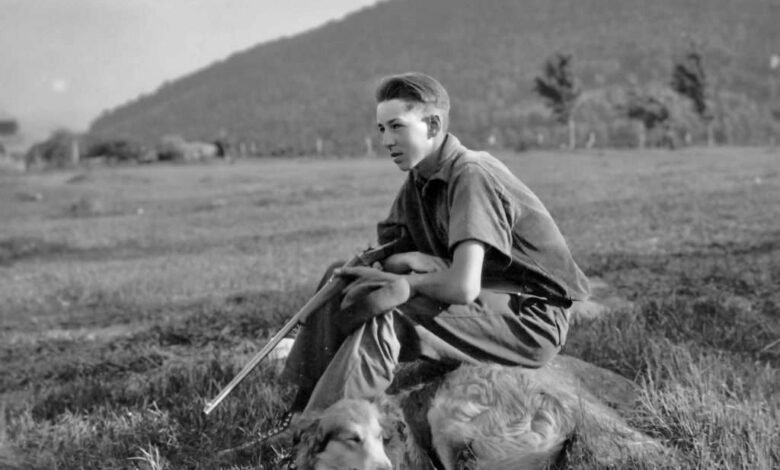
 Paul Schaefer’s life in the Adirondacks began in 1921 on account of his mother, Rose. Gertrude Fogarty and Peggy Mearns Allen, Paul’s sisters, described their arrival in the small Adirondack hamlet of Bakers Mills in northern Warren County. The family had heard of this area of the Adirondacks from Rose Schaefer’s brother, their Uncle Frank Holtslag.
Rose Schaefer was an accomplished musician, but she “had hayfever and asthma and she was this time in such poor health that her doctor said she would not live through another year unless she left the Schenectady area during the hay fever season…until a hard frost killed the ragweed in town.”
Paul Schaefer’s father, Peter Schaefer, worked as an accountant for General Electric Company in Schenectady, New York. At one time he had been a classical scholar and traveled in Europe. He was an excellent writer, a trait passed on to Paul, as well as a fine downhill skier, a skill passed on to his children, especially youngest son Carl.
Professor Carl J. George of Union College, a colleague of Paul Schaefer’s, wrote: “His parents, Rose and Peter Schaefer, must have been proud of their five offspring, Vincent, Paul, Gertrude, Carl, and Margaret (Peggy), all achieving significant careers.
“The family, in an effort to free Mrs. Schaefer from her heavy burden of rag-weed allergy and tuberculosis found Camp Cragorehol near Bakers Mills, well away from the offensive weed and also closer to her therapy for tuberculosis at Ray Brook. Recovered from TB and allergy, Rose and Peter gave much mentoring in the wonders of nature, great books, religion, and the importance of wild places, resulting in the dedication of Paul and siblings to informed conservation. Rose lived to the age of 87 and Peter, long a clerk at GE and retiring in 1930, lived to be 92.”
Many visit the Adirondack Park today to seek scenery, spiritual nourishment, and recreation amidst mountains, rivers, lakes, towns, and villages. For the Schaefer family one hundred years ago, as with many others, the Adirondack mountains were a place to escape the urban landscape, regain lung function and, in their case, preserve their mother’s life.
Before widespread use of penicillin, breathing Adirondack “balsamic air” was thought necessary for the slow recovery from tuberculosis and other lung ailments. Paul Schaefer’s youngest sister, Peggy Mearns Allen, served as an Army nurse in Europe during World War II. In a 2008 letter, she wrote:
“The family all had influenza during the 1918 pandemic after World War I. Our mother had always been in frail health and would get hayfever and asthma during ragweed season. She contracted tuberculosis before I was born and took the cure at Raybrook (near Lake Placid). When I arrived, the doctor told her she probably would not survive the following winter unless she got away from the ragweed in Schenectady that summer.
“Her brother Frank knew it (ragweed) did not grow in Bakers Mills then, as he used to go up there fishing at Second Pond. There were dirt roads from Chestertown up in those days and ragweed didn’t invade until paved roads encouraged it. By then, antihistamines helped her.”
In spring of 1921, the family left for the Adirondacks. Paul Schaefer was twelve, with two brothers and two sisters. “We were in a rather difficult situation, since we didn’t own a car and we felt like pioneers heading for parts unknown,” recalled sisters Gertrude and Peggy.
 “It took all day to come from Schenectady. At that time, you just expected to have numerous blowouts of the tires on the car … The roads, at that time were dirt roads from Warrensburg north. When we reached Wevertown that first trip it was raining quite hard and the Ford (a Model T) was not able to get up Washer Hill, just before Johnsburg, because the gas did not feed properly.
“The car stalled in the middle of the hill. The men had to lift the car bodily and turn it around, and it was possible to back up the hill…At that point we began to wonder if we would ever get to our destination. However, we did, and the two month’s stay in the Adirondacks was quite an experience. And only the beginning of a wonderful new way of life for all of us.”
Paul wrote that his Uncle Frank had made arrangements for the Schaefer family to occupy the wing of a house that belonged to a guide Frank knew.
“The house was at an elevation of 2,000 feet, close to a towering mountain and the edge of wilderness… All of us found that the lives we had been living were dramatically changed. The people living in the few houses … were refreshingly different from those we knew in the city.”
“The Morehouse place was a working farm,” wrote Gertrude, “and we enjoyed haying it, with Georgie (George Morehouse, John’s son), watching him milk the cows, jumping in the hay mow, gathering eggs and picking blackberries…
“Our nearest neighbor was George’s father, Johnny Morehouse. He shared his scanty fare with our family. Milk, eggs, rutabagas (called ‘beggies’), maple syrup, and berries were lifesavers for us. We had trout once in a while, an occasional woodchuck, and sometimes deer and bear.”
Two miles down the road, Bakers Mills had a general store, church, the remains of a mill, and a few houses. The hamlet was on the historic dirt road from North Creek to Wells, twenty-miles distant through the woods and along the East Branch of the Sacandaga River. Johnny Morehouse drove the Schaefers to the catholic church at North Creek on Sunday morning for two dollars.
According to Paul’s sisters, John pitched a tent in his field for a neighbor who was dying of cancer, and he took care of her until she died. John’s farm included cows and horses. His wife Maude separated cream from the milk and made butter in a churn. John managed the vegetable garden and his fields of potatoes, beans, squash, carrots, lettuce, radishes.
As for brother Paul Schaefer, the sisters wrote that he closely followed either George or John Morehouse wherever they went or whatever they were doing. The Morehouse family truly introduced him to the Adirondacks. Later on, he learned to catch trout and hunt woodchucks, both of which became part of family fare for the Schaefers.
Schaefer recalled the great influence Adirondack natives and their rural life had on his growth and experience as an outdoorsman and conservationist.
“My first summer there was a dream. The surrounding forest was so vast, so ominous as to make me fear it, and at the same time, eager to explore it. My first impressions of the country were mostly ones of awe. Tales of the great forest that lay unbroken westerly for miles, of men who got lost there, intrigued me.
“The natives were a breed I had never met before. They were hunters, trappers, fishermen, loggers and guides. They led what seemed to me to be a carefree life despite an almost total lack of money and undeniable hardscrabble conditions. I especially enjoyed the nights they fiddled and had square dances in the house we lived in.
“I was seldom idle. I helped cut wood, drove cows to pasture, and was involved in all the other things that were part of a frugal mountain life. The natives responded to my interest in their activities, and soon they would take me into the bordering wilderness, to lakes and streams and beaver ponds. At the end of the first ten weeks, a genuine appreciation of their life was so embedded in me that I hated to go home to school.”
This is has been an excerpt from long-time New York Almanack contributor David Gibson’s new book A Force for Nature: Paul Schaefer’s Adirondack Coalitions (Syracuse University Press, 2025). Paul Schaefer grew to become a highly influential Adirondack wilderness conservationist.
Gibson’s book reveals how families often discover the healing and teaching properties of Adirondack landscapes and Adirondack people together. In the case of the Schaefer family, Adirondack experiences which shaped the generations of the family one hundred years ago greatly influence the different branches of the family living today in or near the Adirondacks, people still making important contributions to the region.
David will be speaking about the book at Historic Saranac Lake on April 23, 2026 at 6 pm. For more information visit www.historicsaranaclake.org.
Photo: Paul Schaefer in Bakers Mills, age 15 in 1923, with dog Lion, open fields, and Eleventh Mountain in background (courtesy of the Adirondack Research Library, Kelly Adirondack Center of Union College).
Source link