 Just after sunset on a toasty evening in May 1903, a two-year-old trotting horse named Princewell, startled by “a noisy automobile,” bolted for freedom in the Bronx.
Trainer Frank Ferris was leading the young colt across the tracks of the Putnam Division of the New York Central Railroad, turning onto the Boston Post Road at King’s Bridge, when the motorcar “rushed past,” according to a New York Times report.
“Princewell arose on his hind legs,” the story went, “shook his head, and was free.” Galloping back to the tracks of a very active rail line, Princewell – aided by a policeman and several bystanders – evaded two trains, including a “Buffalo express” coming up behind him on the northbound tracks, and was eventually caught after an apparent four-mile north-south back-and-forth chase.
“Princewell was taken to King’s Bridge police stable for a rest and examination,” the Times reported, “and later he was led back to his former quarters on the Speedway.”
 (The Speedway was the Harlem River Speedway in Upper Manhattan, which stretched from 155th Street in Washington Heights to Dyckman Street in Inwood. Opened in 1898, it was restricted to equestrians and carriage drivers until 1919; part of it was later incorporated into Robert Moses’ Harlem River Drive.)
Princewell’s mad dash brings to mind the history of the rail line he traversed and its origins in a more equine era. Beginning service in 1881 as the New-York and Northern Railroad Company, the 50-plus-mile Put lasted under various guises until 1958 as a passenger line and into the 1980s as a freight line. It ran from the Bronx through Westchester County to Brewster in Putnam County.
The mighty New York Central acquired the property in 1894, and travelers to Manhattan could make a connection to a West Side elevated line beginning in 1918.
The line coursed through southern Westchester County hard by the Saw Mill River, then snaked through the 8,000-acre Rockefeller estate in Pocantico Hills, hard by the village of North Tarrytown (now Sleepy Hollow).
In the late 1920s, John D. Rockefeller Jr. aimed to remove the thunderous steaming Put from his family’s bucolic spread. His solution: buy an entire hamlet, East View, which 46 families called home, for what was variously reported by the Times as $700,000 to $825,000 (about $13 million to $16 million in today’s dollars) to provide a new right-of-way for the railroad.
The Times reported that the Standard Oil heir would contribute about $1 million to build the new straighter and flatter roadbed several miles to the east.
 “Moving the railroad off of his property became of paramount importance to John D. Rockefeller Jr. and he began negotiations with The New York Central for the removal of the railroad,” Tarrytown Village Historian Richard Miller wrote in 2014.
“Mr. Rockefeller found the Board of Directors in ready agreement, because the proposed alternate route not only eliminated the sharp horseshoe curve around the Tarrytown Lakes and into Pocantico Hills, but also eliminated a 230-foot climb between East View and Pocantico Hills.”
In all, the Times estimated that John D. Jr. spent about $5 million – or close to $100 million in 2026 dollars – to rid his land of the Put.
Unlike its larger sister Hudson and Harlem lines, the little railroad never converted to electric power. “The Diesel locomotive recently has been operated over the Putnam division in hauling heavy freight and has functioned so satisfactorily that New York Central officials believe that its adoption will entirely obviate the necessity for electrification of that line,” the Times wrote in 1929.
And despite various civic nudges over the years, Putnam line commuters – who had to slog through as many as 30 station stops – also never had a direct connection to Grand Central.
Ridership steadily declined. In 1955, for example, a Yorktown Heights lawyer named David J. Nelson wrote to Westchester County Executive James D. Hopkins saying that the terminus of the Put in the Bronx caused “so much inconvenience that commuters avoided the line.”
A year later, the supervisors of the towns of Greenburgh and Harrison appeared on WOR radio with Thomas Deegan, a New York Central vice president and chief of staff to Chairman Robert R. Young, urging a direct connection. But Deegan shot down such an idea.
“He said operating complications would make it impossible to add to the number of trains using the terminal,” the Times reported. He added that the line was being operated at a “staggering loss” and that it was “one of the lines he would like to give up.”
(Deegan later chaired the organizing committee for New York’s 1964 World’s Fair).
 The end was foreordained. The railroad was losing an estimated $400,000 a year (close to $5 million today) and carrying only 300 passengers daily. The finale to more than 75 years of Putnam division passenger service came two years later.
A final train ran north on the evening of Thursday, May 29, 1958, carrying 400 passengers, including a former mayor of Brewster born in the 1870s, and the current mayor, who carried a 1903 pass for his youthful work on the line. The journey – which ran 27 minutes late – took nearly three hours.
The Old Put’s right of way remains as more than 50 miles of paved rail trail enjoyed by walkers, joggers, and bicyclists, with scattered traces of the railroad infrastructure visible along the way, including bridges and wooden ties.
As for the spirited Princewell? He reappeared in the Times in 1905, two years after his breakaway journey, at the annual Speedway parade featuring 200 rigs.
Princewell and a partner horse finished in second place in the “Team to Runabouts” category. His harnessed collaborator? A horse named Scotsman. No apparent relationship to the famed Flying Scotsman of British railway lore.
Read more about New York’s Railroads.
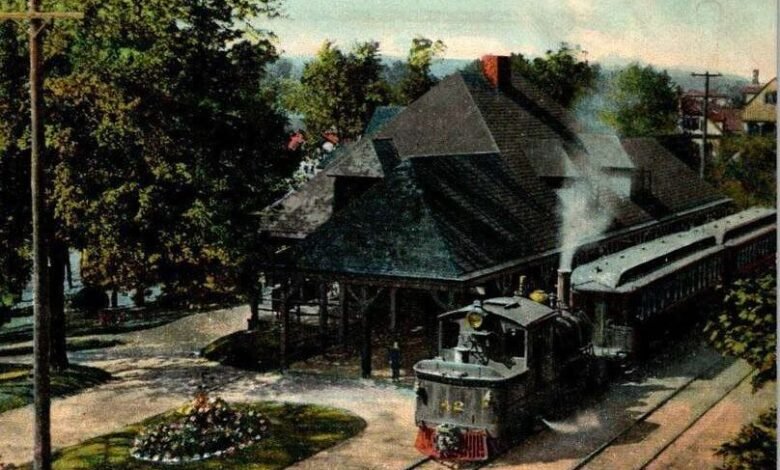
Illustrations, from above: Postcard showing the Putnam Division’s Park Hill Station in Yonkers, ca. 1907-1915; map showing relocation of the Old Put rail line; trotting horses on the Harlem River Speedway, ca. 1900; and the last train at Briarcliff Manor Station on the Putnam Division Line, May 29, 1958 (New York Transit Museum).
Source link