
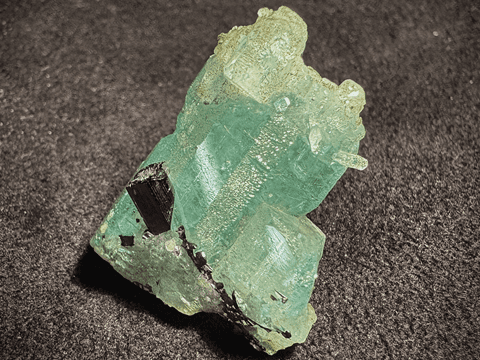
![Beryl (/ˈbɛrəl/ BERR-əl) is a mineral composed of beryllium aluminium silicate with the chemical formula Be3Al2(SiO3)6.[6] Well-known varieties of beryl include emerald and aquamarine.](https://www.newyorkalmanack.com/wp-content/uploads/2026/03/Mineral-Beryl-e1774449180809.png) Wiley, which calls itself “a global leader in authoritative content and research intelligence for the advancement of scientific discovery, innovation and learning,” has announced a new collaborative project with the American Museum of Natural History to extend access to the Museum’s renowned mineral collection to scientists around the world.
Wiley, which calls itself “a global leader in authoritative content and research intelligence for the advancement of scientific discovery, innovation and learning,” has announced a new collaborative project with the American Museum of Natural History to extend access to the Museum’s renowned mineral collection to scientists around the world.
This new project, a Raman spectral database, serves the museum’s mission to disseminate knowledge about the natural world “through scientific research and education.”
Wiley’s spectral database business provides scientists with reference data for identifying and analyzing chemical compounds and materials. They’re used by students and industry professionals working in geology, chemistry, archaeology, forensics, materials science and related fields.
Spectral databases contain detailed “fingerprints” of substances captured through various analytical techniques such as Raman spectroscopy, enabling researchers to identify unknown materials by comparing their spectral signatures against authenticated reference standards.
“Our mineral collection has been a cornerstone of geological research since the Museum’s founding in 1869,” said Kate Kiseeva, curator in the Division of Physical Sciences and of the Mignone Halls of Gems and Minerals at the American Museum of Natural History.
“This project with Wiley will greatly expand access to this valuable scientific collection in new ways, providing scientists worldwide with high-quality spectroscopic reference data that will advance mineral identification and analysis for years to come,” she said.
These spectroscopic datasets can improve mineral identification and analysis for both academic and commercial uses and may support the development of algorithms and models for examining novel minerals and materials.
Wiley will make the resulting data available to the global research community through two channels: its KnowItAll analytical chemistry software platform and SpectraBase, its online spectral database.
“This sustainable dual-access approach ensures that both licensed software users and the broader scientific community can benefit from this unique resource,” the company’s announcement said.
The first installment of data from the collection is expected to be available this spring, with additional data added over time.
The American Museum of Natural History’s collection has grown to be one of the world’s most important collections of gems and minerals, with more than 120,000 mineral specimens and 5,000 gems. This project also advances the Museum’s strategic goal to digitize its collections.
Read more about science or science history in New York State.
Illustration: Beryl, a mineral composed of beryllium aluminium silicate, including emerald and aquamarine.
Source link