 If you live near a large meadow, hayfield, or grassland, you may have recently noticed some bubbly robotic noises emanating from those areas. It might sound like an overexcited android, but the real source is a medium-sized songbird, the bobolink (Dolichonyx oryzivorus).
One of the few avian grassland specialists in the Northeast, bobolinks have recently returned from their wintering grounds in southern South America and are now fully engaged in breeding activity.
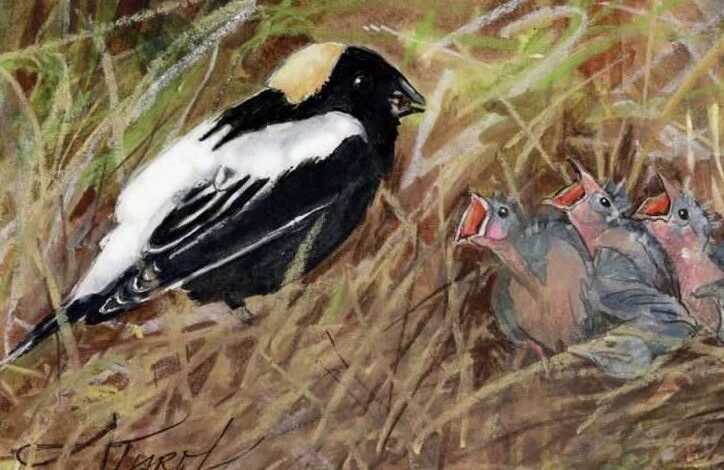
While the female bobolink is cryptic in both plumage and behavior, the male bobolink stands out in almost every regard. His bold black and white plumage (worn in a “reverse tuxedo” style with white on the back and black on the front), effervescent song, and helicopter flight display provide a captivating performance for bystanders.
Bobolinks are members of the blackbird family (Icteridae), and like some other blackbirds (notably red-winged blackbirds), they have a polygynous mating system, where one male mates with multiple females. However, females also solicit extra-pair matings, with around 40 percent of clutches containing eggs sired by different males.
Genetically, this bet-hedging strategy ensures offspring express greater variation than if sired by one male. From a behavioral standpoint, having multiple mates invested in the outcome of a given nest may increase nest protection and nestling provisioning.
Once a female bobolink has selected a primary mate, she then selects the nest location on the ground. She is solely responsible for building the cup-shaped nest.
The female first clears the nest site of all vegetation and creates a shallow depression in the ground. She builds an outer wall of coarse grasses, then lines it with finer material. Once the nest is complete, or close to it, the female lays 3 to 7 blue-gray or beige eggs with maroon or purple flecks.
Incubation lasts about 13 days, and once the eggs hatch, the chicks are fed an invertebrate diet. They grow rapidly, and on day 10 or 11, the chicks leave the nest.
At this stage, they are still unable to fly, but the longer nestlings remain in a nest, the greater the chance an entire clutch will be lost to a nest predator.
By leaving the nest and dispersing into the surrounding grassy habitat, the probability that all chicks are lost to a single predation event drops significantly. After 13 days, chicks are capable of short flights, and by day 17 they can fly extended distances.
Bobolinks prefer to nest away from the edges of their grassland, and various studies have shown that they generally nest at least 50 to 100 meters from the periphery of the open habitat.
This is presumably to avoid nest predators like raccoons, and brood parasites like brown-headed cowbirds, both of which are more likely to search for nests close to the edge of forests and shrublands.
Bobolinks will therefore avoid otherwise appropriate nest habitat that does not provide interior grassland areas sufficiently buffered from the edges of forests, shrublands, or roads.
The bobolink has one of the most impressive migrations of any passerine, embarking on a round-trip flight of roughly 12,500 miles each year, traveling to southern South America for the winter and back to the Northeast in May. These lengthy annual journeys mean that a bird may travel the equivalent of circumnavigating the globe 4 to 5 times over its life.
Like most grassland bird species, the bobolink’s populations have declined significantly in the past 60 years – an estimated 63 percent drop since 1966. The primary causes of its decline are loss of habitat and the early mowing of hayfields before nestlings have fledged.
In the Northeast, old fields and meadows are increasingly disappearing as they revert to forestland or are developed.
To help bobolinks and other grassland birds, meadows and fields can be maintained via prescribed burns and mowing, and hayfields and silage should not be cut until after the young birds have fledged from the nest.
These actions can help ensure that the bobolink – and its wonderfully bubbly song – remain a part of the northeastern landscape.
Read more about New York State’s birds and grasslands.
Loren Merrill is a science writer and photographer with a PhD in ecology. Illustration by Adelaide Murphy Tyrol. The Outside Story is assigned and edited by Northern Woodlands magazine and sponsored by the Wellborn Ecology Fund of New Hampshire Charitable Foundation: nhcf.org.
Source link