
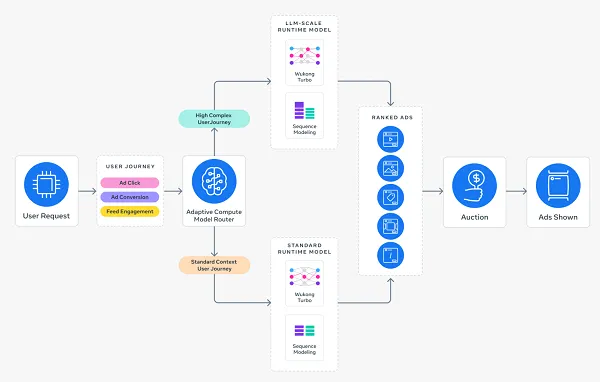
Meta has rolled out an improved ad serving process for Instagram, via a new Adaptive Ranking Model. The updated model is able to process more engagement elements for each user in real time, while also reducing system load to ensure optimized delivery of more relevant promotions.
Meta outlined the update on its engineering blog, using a heap of complex technical language to basically say that Instagram users are now seeing more relevant ads.
As per Meta: “The system efficiently allocates embedding hash sizes based on feature sparsity and prunes unused embeddings to maximize learning capacity within strict memory budgets.”
In other words, less compute requirements for more relevant ads.
Meta said its Adaptive Ranking Model replaces the current approach with intelligent request routing in order to better align model complexity with a rich understanding of user context and intent.
The updated system utilizes LLM-scale intelligence to improve ad targeting. According to Meta, this has already led to an increase in ad performance while maintaining computational efficiency.
“Since launching on Instagram in Q4 2025, Adaptive Ranking Model has delivered a +3% increase in ad conversions and +5% increase in ad click through rate for targeted users,” Meta said.
In essence, Meta is using large-scale processing, the same as it now uses for its AI models, to improve ad display and ensure more individual engagement factors are measured when deciding which ads to show each user.
Meta is also exploring more ways to ensure that its ad models remain fresh and relevant, through improved processing of engagement signals to highlight the best promotions.
This will also mean more effective, responsive Meta ads and improved results for campaigns.
For technical-minded users, the details here outline the specifics of how Meta has been able to update its systems to process more data more efficiently. For everyone else, it simply means that Meta’s ad targeting tools are improving, which should drive better return on ad spend.
Source link