Nicolas Shannon Savard: Hello, and welcome to Gender Euphoria: The Podcast, a series produced for HowlRound Theatre Commons, a free and open platform for theatremakers worldwide.
I’m your host, Nicolas Shannon Savard. My pronouns are they, them, and theirs. After a two-and-a-half-year hiatus, Gender Euphoria is back and ready to invite listeners into deep, thoughtful, hopeful, and complicated conversations with trans and queer theatremakers.
From the top, let’s address the elephant in the metaphorical room. Right now, the trans community in the United States is under attack. Since this show’s last recording in the fall of 2023, the ACLU has reported and tracked over 2,500 anti-trans bills, primarily targeting education, healthcare, public restrooms, sports, and more. As of this recording in April, the 2026 legislative session has seen 755 anti-trans bills introduced, 117 of them at the federal level.
To be a trans person in the US right now is overwhelming, terrifying, isolating, exhausting. There is no pithy way to explain the enormity of the current legislative push to remove us from public life. And that is precisely why it is so, so important, especially right now, that we tell our stories.
Throughout this season, my guests and I will be exploring what work our stories are doing in our communities against the backdrop of the surge of anti-trans politics. What I want to know is, how are trans artists, especially those of us living and working in hostile, political, cultural environments, finding modes of creative joy, resistance, advocacy, and community building? What lessons do intersectional queer and feminist histories offer us in responding to this current moment? How does our work as trans theatremakers fit into a longer tradition of activist art? How and where and for whom are trans stories doing work in our communities? And how are trans and gender nonconforming artists renegotiating, challenging, and reshaping those narratives?
Can’t fully address this political moment without acknowledging that those most severely and directly impacted by the anti-trans political wave have been gender nonconforming and queer kids. The last several years have seen a dramatic rise in discussion and debate about transgender youth in politics and education. Despite this, the actual voices of LGBTQ kids are rarely included in those conversations.
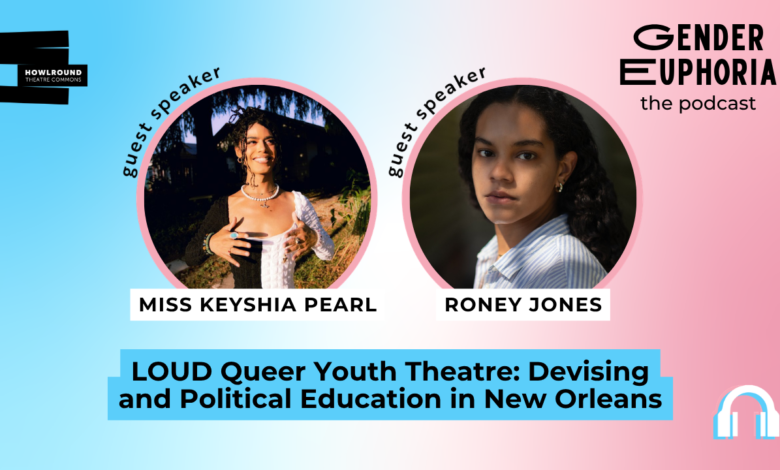
So to kick off season three, I’ll be talking with artist-educators whose programs bring queer, trans, and gender nonconforming youth voices center stage. I sat down with the staff of LOUD Queer Youth Theatre of New Orleans to talk about their political education-informed, devised performance programming and how they build and sustain an intergenerational community of queer artists. Here’s that conversation.
Chorus of voices: Gender euphoria is bliss. Freedom to experience masculinity, femininity, and everything in between. Getting to show up as your own self. Gender euphoria is opening the door to your body and being home. Unabashed bliss. You can feel it. You can feel the relief. Feel safe. And the sense of validation and actualization. Or sometimes it means being confident in who you are. But also to see yourself reflected back. Or maybe not, but being excited to find out.
Nicolas: Hello and welcome to Gender Euphoria: The Podcast. I’m your host, Nicolas Shannon Savard. My pronouns are they, them, and theirs. I am here today talking with a couple of staff from the New Orleans-based LOUD Queer Youth Theatre about their fabulous, anti-oppressive, youth leadership-based devised theatre work. And I could not be more excited to introduce a group of folks to HowlRound Theatre Commons.
I’ll give you a chance to introduce yourselves in just a moment. If you could tell us your name, your pronouns, your role in the company, and just a little bit about you as an artist.
Roney Jones: Hi, my name is Roney Jones. I use they and she pronouns. I have been with LOUD for about a year and a half. I started as a company manager, which is similar to stage managing, but kind of extends beyond the rehearsal space, is kind of how I would define that. And then evolved into one of the co-directors of the theatre. Outside of LOUD, I work as a director professionally, as well as a playwright, and an actor, all for stage, for the most part.
I am in the process of trying to finish a play now and will soon be going out to Idaho to direct a show. So theatre is my nine to five and beyond. Because it’s always more than just nine to five. But yeah, that’s me.
Keyshia Pearl: Hi, I am Miss Pearl, or Keyshia Pearl. Pronouns she, her. I am a Black, Indigenous, trans femme culture bearer from the Seventh Ward of Bulbancha, aka New Orleans. And I always lead with saying that I am a culture bearer who does different artistic practices, because anything that I make creatively, or anything that I take on economically or professionally is in relation to the tether and the responsibilities that I have as a culture bearer to have my actions and my art be related to the well-being of my people and the well-being of our ecosystem.
Nicolas: Could you give us a… Just kind of big picture overview. What is LOUD Queer Youth Theatre? What kind of programming do you do? We’ll start there.
Keyshia: LOUD Queer Youth Theatre is, we’re about over a decade old at this point. Currently we’re being run by relatively new staff, except for our, basically our head, who is Ross.
Nicolas: Ross R. Ross, co-director of political education and production.
Keyshia: They weren’t able to make it here today. Ross is someone who started the program as a youth and went all the way to the highest position that there is. They are our sort of, not sort of, they are our like historian of the organization. They also are able to hold a lot of things accountable.
And we have Simone. Simone is a trans woman, a Black trans woman.
Nicolas: Simone Emanuel, co-director of theatre and performance.
Keyshia: She is a drag performer, as well as an organizer, and also an actress and stage performer, generally theatre work as well, and also a theatre writer. And so what LOUD is at this moment of time in 2026, we serve, we serve youth sixteen through twenty-four years old. And we are not officially like discriminatory or exclusionary, but we very intentionally prioritize and serve Black and Black Indigenous queer and trans youth in the greater New Orleans area.
So you have Orleans Parish, Jefferson Parish, maybe a little bit of St. Bernard Parish, like that’s definitely where we’re engaging and serving. And we run biannual programming, semester programming. Sometimes what exactly, what we’re doing may depend on our funding, but our model is two semesters where we recruit youth. And we bring them on to devise original theatre. Ideally it will either be that they’re using work that was already made within LOUD by youth, maybe even themselves from previous semesters, or that they’re making brand new conceptual theatre. Their work is informed by political education and like current events. So nothing is like random or necessarily from just a vacuum.
We give them space to learn about the work, to make the work, we help them to record and archive it. We serve as a first job space for them. We help them into the professional world and sometimes even into the social world of the queer community. Sometimes they may find queer community with us, whether it’s through meeting their peers, or meeting older people, sometimes even elder people.
And I’ll pause and give Roney some space to speak on what we are.
Roney: Yeah, I think there’s only a couple of things I would add to that. In the two semester model that we use, ideally what we like to do is have that first semester be focused on one person shows. So giving the opportunity for the young people that we work with to either choose from topics that may get brought up during our political education phase of programming, or if there is something that they come into this space really wanting to dive into and discuss, that is welcome as well.
But to choose one of those topics and write a one-person show based on that. So giving them the opportunity to get to know theatre, depending on where they’re coming from with their own skill level, or to deepen a knowledge that already exists. A lot of people come in with some experience maybe in acting through school, or through maybe other community organizations or church. And then LOUD gives them the opportunity to, in a way, both write the piece, act in the piece, and then kind of direct the piece. Of course we step, are kind of those eyes outside of the piece, but when you’re doing a one-person show you are responsible for the vision. And so they have the opportunity to operate in that space as well, is one thing that I would add.
And the second being: part of our structure is kind of almost like a trio of things. So we start with the political education, which typically Ross is at the helm of that, where we will, the model that we’ve been working with recently that I think is really, I really love, is we will start with a topic that we will bring into the space, but the intention is that it will morph over the course of the conversation. So we may pick where our starting point is, but the hope is that their interests and passions and pushback will guide us to, you know, where that conversation ends on any given day. And then it is our responsibility as staff to kind of come from that topic that we end on, do our own research there so that our next conversation in the next week starts from the point that they left us off on. That we’ve done some research now and can bring them some information on. And then we follow that model. So, you know, week one may bring us from point A to point G, and then the next week it will be G to L. But they get to kind of guide. We start, we decide where we start, but they decide where we go.
And then we have a writing section where a lot of them will come with their own creative writing experience, but playwriting is super specific and technical and weird. So giving them the tools to write a play.
And then thirdly, getting kind of mixed throughout that is the actual technique and acting and getting them on their feet and using their voices and their bodies and learning what that instrument is. But yeah, I feel like between that and Miss Pearl’s, that kind of covers both the feeling and the actual meat of what we do.
Nicolas: All right. There are so many threads that I want to pull and unravel and ask all of the questions at once. Do you want to tell me a little bit more about what the devising process looked like a little bit more specifically for some of your most recent projects?
Roney: Totally. Our two most recent projects are called Generation Zeitgeist and Hello Neighbor. And they were both very different processes, just based on what the needs and our capacity as an organization at the time.
So Generation Zeitgeist was a kind of like a first semester. So that was a one-person show semester. And we began that with, I believe, four or five weeks of meeting once a week of political education. And I’m trying to… I’m trying to remember what some of our topics were. One that really sticks out was intersectionality being one of our jumping off points, giving them the space to really discuss, because even as a group of black, trans and queer youth, where it may be, it’s assumed that people are coming in with very, very similar life experiences or similar perspectives and beliefs.
That is so not the case, you know, even among, you know, New Orleans, ward to ward, there’s a lot of different cultural norms. And so, I think we had eleven youth participants in the Generation Zeitgeist semester, and we had eleven different perspectives and eleven different overlapping identities, some of which, you know, could understand each other very easily and some of which those identities created space for like deeper conversation and necessary connections to be forged that didn’t just, you know, walk into the space already, already knowing how to connect with one another.
So we started with intersectionality and it was, yeah, it’s, it’s always very important for us, for them to know from day one that what we discuss and how we discuss it is in their hands as much as it is ours. So we, one big thing to go back a little bit, I suppose, is we create shared agreements. And that’s something that we do at the top of every semester, community agreements about how we treat one another with dignity and respect as both people and as artists and letting them know very early on that they will be viewed as an artist.
The fact that they are coming into the space as a younger person does not in any way diminish what their perspective will be. In fact, it has the potential, in my opinion, and I think in all of like LOUD staff’s position, that youth has an incredible perspective. I think I was at my most hopeful and imaginative and radical when I was young. And that is something that I think they all come into the space just kind of instinctively knowing how to do. So, yeah, creating those shared agreements is how we start every semester so that we don’t have to all come in knowing what to expect of one another to know that we will uphold the dignity and integrity of one another as best we can.
And then digging into those political education discussions. And a lot of the actual writing process, once we start devising, happens as a combination of work in the rehearsal room of like getting on our feet and maybe learning some acting skills of like improvisation and projection. And then the second half is work for them individually to be doing, to go home and to write. I think first we had them write just scenes. So like, I think three page scenes was where we started with the intention, I think, a couple of weeks were spent on those. And then they got to pair up with one another and work on back and forth. How does energy exchange happen on a stage? Because one person shows are a beast. You know, you don’t have that other person to… Yeah. To throw your energy around with. So we wanted them to know how it felt to exchange energy because they would need to learn how to do that with themselves and the audience. How to take what is there, what is being given to them. But yeah, a lot of the process is after we get out of the initial political education and some of the on your feet work, the writing process can become very individual. Which… We’re still kind of playing with how we want to do that in future semesters. But the work that they did was incredible for Generation Zeitgeist.
And Hello Neighbor was quite different. So for Hello Neighbor, we were in a season where we didn’t have as much time because the devising process brings us out quite, sometimes twelve, thirteen weeks. And we wanted to have a shorter period of time actually working. So for Hello Neighbor, rather than doing one person shows, we did an ensemble piece, which is usually our goal is for those people who have now learned what they, who they are individually as an artist to come and make something together because theatre is inherently, you know, collaborative.
So, we had three separate pieces written by some previous members of LOUD. Both youth, like ensemble members and also staff. And they were cast and put together and some of them were double cast. But it was this, I think maybe, maybe thirteen youth participants in total that came together to tell three short ten page scenes for a total of like an hour show, perhaps. It was… Yeah. And it was titled Hello Neighbor. Because the goal was to… Make it a very community focused event. And that one was maybe more similar to traditional theatre than devised. Although throughout the process, they were able to kind of make amendments to the script or to the characters that they were taking up. So there was still some devising in the process, but wasn’t like a traditional devised theatre process.
Nicolas: I have absolutely no transition for this. But I do want to hear a bit more about the political education component of your work. How do I even phrase this question?
Keyshia: I think we can get into it.
Nicolas: Yeah. Tell me more about that. I want to know why, why, I guess, do you specifically find this important to have political education conversations with youth—from the perspective: I’m completely on board. I’m excited!
Roney: One thing I find, especially with the group that we serve of like Black and Black Indigenous, queer and trans youth: It’s kind of what they want to talk about. I want to honor that first and foremost, that, like, it is not a difficult conversation. So often we are so lucky for them to really lead those conversations.
So I think, yeah, first is just it is something that they are really interested in talking about. I think because a lot of times of age where you’re starting to approach the world. You’re starting to figure out where you’re going to fit into it. And they haven’t had any of the fight taken out of them yet. And so all of these things sometimes we as adults can look at and just, you know, can result in helplessness or hopelessness. So often the young people that we encounter aren’t there yet and hopefully will not be there. I say yet and that is honestly, you know, take that right out of my mouth. They aren’t there. They’re at a place where they’re looking for creative, hopeful, imaginative future situations. And so, yeah, I think it’s so often whenever some of these topics that we discuss, whether it is things that are very directly related to them when it comes to like queer and trans issues. We also try and extend it to the world as a whole.
So we discussed Palestine a lot in our December 2024 production of Generation Zeitgeist. One of the poli-ed questions during that semester that we talked about a lot was how folks who are fighting for the freedom in Palestine, how that relates to protests here in the United States. As we’re preparing for this upcoming semester, we’re also planning on discussing, extending that conversation to Congo and Sudan and Venezuela and now Iran, where we want to always be connecting to the world as a whole because, you know, we are all citizens of this world.
So, yeah, I think part of the reason why it’s so important is because it provides a certain agency. Is the word that comes to mind. I think our hope is, you know, they bring a lot of the passion and the integrity to those conversations. And I think we’re hoping to kind of bring the tangibles, the facts, like giving them the opportunity to be informed because sometimes that’s all it takes. They’re ready to carry the torch. We are just kind of placing it in their hands or bringing it into the room, even. So, yeah, I think that’s part of why poli-ed is at the forefront, because it really is. It’s more than just a component. I feel like it is a essential, like, priority for LOUD.
Yeah, it’s weird to say this, and I’ve had it in discussions with, like, friends before. It never feels like it’s going to land well, but I’m going to take a swing and maybe a big miss. I feel like sometimes as a Black queer person and someone who is also perceived as a woman, when it comes to activism, when it comes to standing up for those that are oppressed, my own identities make that easier. The barrier to understand and empathize is pretty low for me. Because I have experienced that. I have experienced my own forms of oppression. And so when I look at someone who’s on the other side of the world that I am taught to see as so different, I don’t. Because even though maybe the methods of oppression that we are experiencing are different, I know that the reasons, you know, and the, quote, reasons why I am being oppressed are just as absurd as the ones they’re making up for you.
And so there’s a… yeah. There’s a privilege in recognizing my own oppression because it makes seeing someone else’s that much easier. I know that I am deserving of humanity. So, of course, you are too. Because it’s not… It couldn’t just be for me. It’s for all of us. So, yeah.
Nicolas: Not a swing and a miss at all. That makes… I’ve never heard it said that way, but that makes so much sense.
Roney: Good. No, I…
Nicolas: So much sense.
Roney: I’m glad. Yeah. It’s… It’s… I think it’s the use of privilege that always makes me feel like, you know, is this going to sound wild? But I…
Nicolas: Maybe, like, advantage. Something like that.
Roney: Advantage. Yeah. Something there. Because I can recognize the… Because there are certain privileges that I think all of us have, regardless of some of the things that we are… Part of our identities or part of ourselves that maybe are discriminated against.
I know that there are also things within my history and within myself that maybe aren’t labeled as privileges but are in one way or another. And in those places, my blind spots can be larger. And so I imagine someone who has greater privilege than I, they are, of course, responsible for those blind sides. But I can recognize that they exist. You know? That I have my own. And so… And maybe they are fewer than you. But they are just as… You know, maybe just as large for whatever the issue is. But, yeah. That’s something that I think a lot about. That’s a topic that I feel very passionate about is extending empathy as we are trying to educate and help people wake up to certain things. That if I had been beat over the head… With my own ignorance. My options are, you know, one, to educate myself. But the easier option, almost always, is to block the thing trying to beat you over the head. And how can we have these conversations where someone maybe doesn’t start on the same page as us. And we don’t shame them while they hopefully choose to catch up. So, yeah. Yeah.
Keyshia: For me, when I think about the political education aspect… I think about how… It’s a few things. One, we know that we don’t want them… Or even ourselves. Because to be clear, as staff, we also actively are making work. Through LOUD, for LOUD, as LOUD.
We don’t want them making anything out of a vacuum. And also… I don’t…. I don’t think that we want them making… Or, like, them mistaking the kind of art that we are in charge of as, like, passive work. To be clear that we are making things with intention. And making sure that what we’re making is relevant to whatever is happening.
Um… And we can do research. We can do research into what has happened. Um… And those things can be complimentary.
But definitely prioritizing, like, what is current. And… And with… With the energy of most things that are current… Not most things. All things that are current are going to connect to history. You know?
But I think that the reason we choose to prioritize what’s current as the starting place… You know? Is because it’s, like… You may look into history. But if you are only focusing on that… Is it tying in, you know, the relevance to the moment? And, like… Is it giving people tools?
Something that… And I’m going to bring it up just because way before we even got on this call… It just was something that I feel like ancestors were guiding me to, like, make note of.
Political education can lead to… Very important awareness as an artist. Like, when you’re conceptualizing and making art… And you start doing research… Particularly when we’re talking about queer, trans sovereignty.
How do we counter our oppressors? So, like, for example… As queer and trans people… Within this… Within this dimension… Not even just the United States, but, like… I guess the westernized, colonized world… We are onslaughted with a lot of things that tell us that we’re not supposed to exist… Or that… You know… We’re, like, abominations… Or… We’re not natural… And that… We only started existing… And that we’re just being trendy or gimmicky or whatever…
There’s documentation. And keep in mind… documentation by white men, you know, by colonialists in their documents. So it’s not even things that just are existing within our, like, oral traditions, but it’s like, it’s documentation of trans, indigenous trans women living in the lower Mississippi Valley, Mississippi River Valley, and having, like, these esteemed positions within their ethnic groups and among the women of their tribe and just different things like that.
And that’s just one example of many where, when you start to do research and you start to look into things and you start to learn how the planet as a whole is just so much more than what we can sometimes see within our little island of a lot going on.
But I say all this to say, if you’re stepping into your queerness, or you’re stepping into adulthood as queerness, and you’re figuring out how do I make art that is challenging the system? What do I talk about? What do I reference?
You know, political education, like the emphasis of it in relation to theatre work is like, we’re wanting them to develop the skills to be able to figure out what’s wrong. Figure out how to express it, but also express how what’s wrong is impacting them. And then further, okay, now imagine those solutions, and then further, learn how to communicate that. And not only to communicate, but to self advocate and potentially even demand to leverage, to barter. By the strength of them knowing information that they are making their art about.
Roney: Yeah, I love what you said, Miss Pearl. It’s like, how can you be in conversation with the world if you are not aware of what’s going on, and yeah, being in conversation, having something to say back. Yeah, I love what you said there.
Nicolas: So many great things. So many great things.
Roney: Yeah, the folks that LOUD attracts on both, you know, on all sides—our audience, our ensemble, our staff—it just seems to, I feel like it has brought out the best in me as both an artist and a person.
So, yeah, we, all of our staff meetings can get very interesting because the quality of conversation, and with our two other staff members that aren’t here, it’s the same where we’re all very clear about our whys and hows can vary so much. There’s so much richness, I think, in every room that we get to be in together, both us as a staff and then with our young people. They really… I think that is 80 percent of what makes it such an incredible job is I think my own fire is sustained by the flames of these young people in so many ways that I say in other contexts, but like they don’t know what they don’t know yet. And so the whole world is a potential answer. And that’s incredible. I’m trying to forget some things I thought I knew. Because… Because it could be something else, you know?
Nicolas: A couple of questions that I ask of all Gender Euphoria: The Podcast guests—one of them ties back to the point that you were making, Miss Pearl, is that kind of central thesis of the podcast is trans people have always been here. We are everywhere. And kind of in that frame of mind, I ask folks to give a shout out to someone who is part of your queer or trans or artistic family tree.
Who has supported you in your artistic work? Who has inspired you or showed a path that was possible for you?
Keyshia: Unfortunately, I didn’t really grow up with a saturation of outside-of-me queerness. Definitely no trans people. Even now, like, I don’t exactly know that many other trans people for real. I would say the person that comes first to mind. Her name is Raina Menne. She’s my best friend. My sister. She is a queer person in my life. Who… She’s in the arts. And she has supported me since, like, 2019 when we started being friends in just so many ways. Like, in some ways, it’s almost like she taught me… She taught me to be a girl. To, like, deeper levels. You know, like, adult levels. She gives care as a friend in a lot of ways that helped me to have self-esteem. And helped me to understand what a friend is not. Yeah. That’s who I would say.
Roney: I love this question. So, for me, Raymond Caldwell, who I met when I was in Howard University’s, like, theatre department back in 2015. I think why they came to mind was because, one, I actually participated in devised theatre under Raymond Caldwell’s direction. That was my first introduction to devised theatre was through Caldwell. Who… The program was called SWAP, conceived by Caldwell, “A Shared World Art Project” where we would attend some of the incredible museums around the DC area. And then devise theatre pieces based on some of the artwork that we saw. It was a really incredible formative experience. I think Caldwell just gave me a lot of permission to push back. So, being at Howard where the work was very, like, Black and very focused on forward movement for Black people, I feel like Caldwell’s definition of what forward movement was was so unique.
It was not centered on either competing with whiteness nor denigrating it. It was about defining Black success independently, not defining itself by what it wasn’t. And I found that really incredible. And I think it really shaped a lot of the work that I have done since then. So, yeah. I adore Raymond Caldwell.
The first time I directed professionally, I remember, like, calling him and being like, what do I do? And him having, you know, one, I think, cackling in my face. And then also answering my questions. So, I adore Raymond Caldwell. And I’m very grateful to have been a mentee of his.
Nicolas: Everybody needs that person who you call during your early professional gigs to be like, “Please help.”
Roney: Right. And I think the laugh helped, too. Because it was a moment of, like, “I’m freaking out.” And he was like, “oh, oh, baby.” And that, like, both yes, freak out. And also, you’re going to look at this and laugh yourself. And I do now think back on it. And so, yeah. Having him not take me crazy seriously in that moment was exactly what I needed. And then to also respect the panic and give me some real answers was also, yeah. I am very grateful always.
Nicolas: I’m going to pause this here. There is so much more to talk about. So, we’ll continue our conversation in the next episode.
In part two, Roney, Miss Pearl, and I will dive deeper into what intergenerational queer community and structures of support look like at LOUD.
Until then, this has been Gender Euphoria: The Podcast. Hosted and edited by me, Nicolas Shannon Savard. The voices you heard in the intro poem were Rebecca Kling, Dillon Yruegas, Siri Gurudev, Azure D. Osborne-Lee, and Joshua Bastian Cole. The show art was designed by Yaşam Gülseven. This podcast is produced as a contribution to HowlRound Theatre Commons. You can find more episodes of this show and other HowlRound shows wherever you find podcasts, including on noncommercial open source apps like Anytime Podcast Player for iPhone and AntennaPod for Android. If you loved this podcast, please share it with your friends, your colleagues, your students. You can find a transcript for this episode along with lots of other progressive and disruptive content on howlround.com. Have an idea for a meaningful podcast, essay, or TV event that the theatre community needs to hear? Visit howlround.com and submit your ideas to the knowledge commons.