
 On May 7, 2026, Judge Colleen McMahon, a senior judge in the United States District Court for the Southern District of New York, ruled that the mass termination by the National Endowment for the Humanities (NEH) of more than 1,400 grants to support scholars, research institutions, and humanities organizations was “unlawful, unconstitutional, ultra vires [a Latin term meaning “beyond the powers”], and without legal effect.”
The decision is one of several issued recently in important lawsuits brought by members of the history and humanities communities of New York State.
In the 143-page Thursday afternoon decision, Judge McMahon granted a March 7, 2026 motion for a summary judgment on all counts in favor of the plaintiffs: the American Council of Learned Societies (ACLS), the American Historical Association (AHA), and the Modern Language Association of America (MLA).
The Court is one of the original 13 courts established by the First Congress’s passage of the Judiciary Act of 1789, signed into law by George Washington. It was one of the first and most important acts of the new federal government.
Judge McMahon was appointed by President Bill Clinton and confirmed by Congress in 1998. She served as Chief Judge for the Southern District of New York from 2016 to 2021 when she assumed senior status.
Her ruling declared the actions terminating the grants in April 2025, the largest mass termination of previously awarded grants in the history of the NEH, were “in violation of the First Amendment, in violation of the equal protection component of the Fifth Amendment, and without statutory authority.”
You can read the ruling here. In it, McMahon also criticizes the Department of Government Efficiency (DOGE)’s use of artificial intelligence, including ChatGTP, to make the grant eliminations.
The lawsuit had argued that DOGE used a flawed, AI-driven process to target projects for termination based on ideological factors, specifically flagging terms like “BIPOC,” “LGBTQ,” and “Diversity.”
Back in March, she ruled in a First Amendment case allowing the deposition videos from the lawsuit to be published online again. In those deposition videos a DOGE staffer, despite being tasked with purging DEI programs, repeatedly struggled to define the term, leading to the widely shared clips of the exchange.
The videos highlighted that the staffers — most in their early 20s with no prior government or grant-writing experience — were making personal judgment calls to cancel long-standing federal projects.
During the proceedings, officials from DOGE — an advisory body led by Elon Musk that spearheaded the cuts — defended the mass cancellations as necessary to “reduce the federal deficit from $2 trillion to close to zero.”
DOGE employees testified that they viewed these grants as supporting “useless agencies” and prioritized fiscal reduction over the potential loss of income for researchers and scholars. One also said the cuts had not reduced the deficit.
The plaintiffs celebrate the court win, but it may not be over.
“This victory belongs to the scholars, students, colleges, universities, associations, state humanities councils, libraries, and local organizations in all fifty states whose work was abruptly disrupted last year,” ACLS President Joy Connolly said in a statement on the victory after the latest ruling Thursday.
“This ruling is an important achievement in our effort to restore the NEH’s ability to fulfill the vital mission with which Congress charged it: helping to create and sustain ‘a climate encouraging freedom of thought, imagination, and inquiry’ through the humanities,” said Sarah Weicksel, executive director of the American Historical Association.
MLA Executive Director Paula M. Krebs said: “The National Endowment for the Humanities was established to affirm the nation’s commitment to research that helps us to make sense of the world we live in and the scholars who help us to understand our own culture and those of others. In a time when it is increasingly urgent to provide a human context for decisions in science, tech, health, and more, we now have a confirmation that the work our members do is essential.”
As of Friday, May 8, 2026, it remains unclear if the administration intends to appeal Judge McMahon’s ruling to the Second Circuit Court of Appeals.
After similar rulings regarding other agencies, such as the National Institutes of Health (NIH), they have sought emergency appeals from higher courts, including the Supreme Court, arguing that such grants do not significantly benefit the public or align with national objectives.
In August 2025, the Supreme Court allowed the NIH to move forward with terminating hundreds of grants, reversing lower court orders that had required the grants to be reinstated.
Legal Fights Have New York Impacts
The NEH was an independent federal agency of the U.S. government established by the National Foundation on the Arts and the Humanities Act of 1965. Dedicated to supporting research, education, preservation, and public programs in the humanities, the act was signed by Democratic President Lyndon Johnson.
According to its mission statement: “Because democracy demands wisdom, NEH serves and strengthens our republic by promoting excellence in the humanities and conveying the lessons of history to all Americans.”
NEH provided grants to every state humanities council for decades – including Humanities New York, (formerly the New York State Humanities Council).
That organization had received about $1 million in the 2025 NEH grant round for redistribution to local organizations. In 2024, Humanities New York awarded grants to 126 tax–exempt organizations and students across all 10 regions of New York State.
The Museum Association of New York (MANY) state-wide project A New Agora for New York: Museums as Spaces for Democracy, was also terminated. The $493,284 NEH grant was hailed by the organization as “a critical investment in civic engagement and museum-community partnerships.”
Several institutions have lost Save America’s Treasures grants, designed to conserve important museum items. The Greater Hudson Heritage Network (GHHN) was granted $269,038.00 from Save America’s Treasures in August, to conserve objects from 10 small and mid- size museums in New York State.
NEH also funded the National Humanities Medals, the National Medals of Arts and the National Digital Newspaper Program, along with numerous projects in New York State and grants from Humanities NY.
It’s still unknown when, if ever, the grants will actually be restored, but the latest ruling has import for the legal fights being carried out in New York.
Is Trump’s Attack on NEH Faltering?
Trump launched his most aggressive attack on the NEH a year ago. Four months later, a federal judge in Oregon ruled that the NEH acted unlawfully when it ended operating grants to state humanities councils.
The ruling in that case brought by Oregon Humanities and the Federation of State Humanities Councils affirmed that these grants — established by Congress more than 50 years ago — are essential to the public humanities and that their lawsuit can proceed.
Back in March, the Underground Railroad Education Center (UREC) in Albany, NY, filed a lawsuit arguing that the Trump administration through the NEH unlawfully terminated its federal grant with racially motivated bias, pointing to Trump’s efforts to dismantle diversity-focused initiatives.
That lawsuit alleges that the cancellation of their $250,000 grant amounted to viewpoint and racial discrimination, violating the First and Fifth Amendments, respectively. It was filed in the U.S. District Court in the Northern District of New York and calls for the funds to be reinstated.
Another lawsuit, filed by the National Trust for Historic Preservation in the U.S. District Court for the District of Columbia (Case No. 1:25-cv-04316-RJL), regarding the extra-legal demolition of a third of the White House by the Trump regime and the attempt to build a large vaguely defined and variously cost estimated ballroom in its place, is still proceeding.
John Warren contributed to this essay.
New York Almanack is reporting on the Trump regime’s impacts, particularly in New York State, but we can’t do it without your help. Please support this work.
Read more about the impacts of Trump’s policies in New York State.
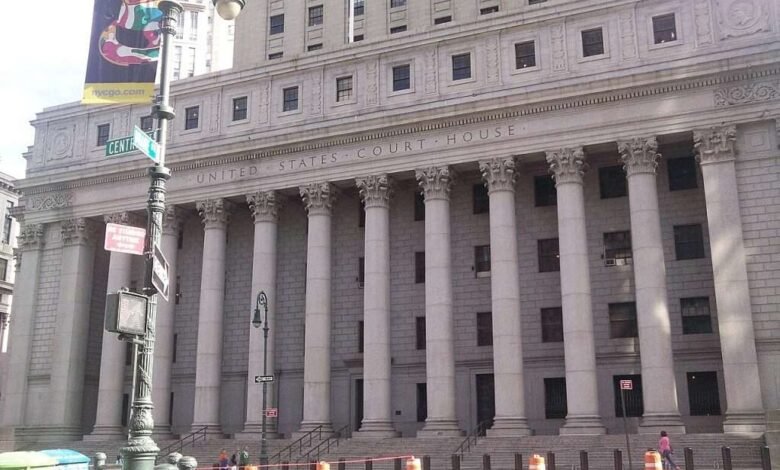
Illustration: The Thurgood Marshall United States Courthouse (originally the US Courthouse or Foley Square Courthouse) at 40 Centre Street on Foley Square. The 37-story courthouse designed by Cass Gilbert and his son, Cass Gilbert Jr., in the Classical Revival style opened in 1936. The United States Court of Appeals for the Second Circuit and the United States District Court for the Southern District of New York hear cases in the courthouse.
Source link