 Whitehall‘s Patrick J. Harvey was lucky when it came to fishing and foraging. In late February 1928, spring-like weather had already arrived. With the milder temperatures, Harvey was fishing from a boat on Lake Champlain. Beneath lay the sunken wreck of the British battlecraft Confiance from the War of 1812.
The once-mighty warship lay near the mouth of the Poultney River.
The angler had accidentally knocked his lunch pail into the waterway. When he quickly tossed his fishing line and hook to retrieve it, a surprised Harvey hauled in a gallon-size crock instead. The sealed jug contained English whiskey over 100 years old.
Harvey’s incident by the HMS Confiance shipwreck site attracted much newspaper attention, too. Further, it was a reminder of the Battle of Plattsburgh during the War of 1812 (1812–1815).
Dr. Russell P. Bellico, a Lake George and Lake Champlain maritime and military historian, said, “Many regional residents aren’t aware that the Confiance was the largest warship to ever sail on Lake Champlain.”
Bellico’s book Sails and Steam in the Mountains lists the Confiance as a 3-masted, 37-gun ship (though some historians say 36 guns). The warship, which had a length of 137 feet, was hastily built at a British shipyard on the Isle-aux-Noix in Quebec, Canada.
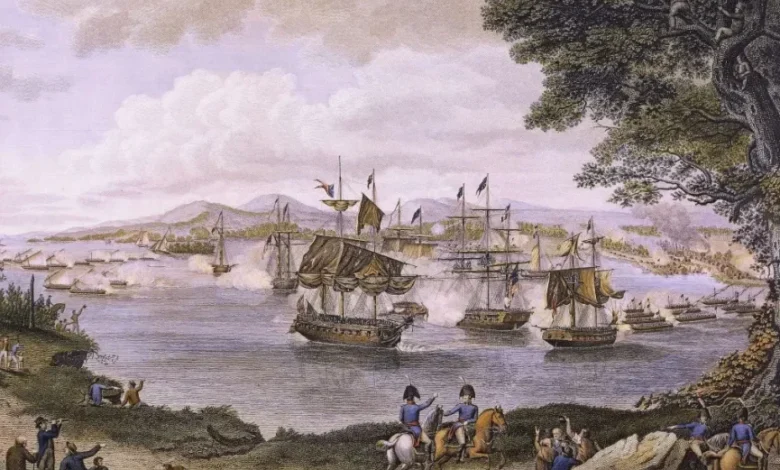
The Battle of Plattsburgh was a land-and-water offensive by the British against American forces over September 6–11, 1814. It culminated in a fierce naval clash in the lake off Plattsburgh on September 11, 1814.
 The U.S. naval contingent of four sizeable vessels and 10 smaller galleys and gunboats, commanded by Thomas Macdonough (1783-1825), defeated the British flotilla of a frigate, brig, 2 sloops, and a dozen gunboats.
Following the battle, the frigate Confiance and other American and British warships were taken south to Whitehall and placed in “ordinary,” meaning the crafts were awaiting salvage or possibly a return to active duty.
In 1825, many of these vessels were sold, ending up abandoned in the shallows off the Lake Champlain channel.
Dr. Bellico wrote, “The famous vessels that changed the course of history thus ended their careers ingloriously as junk.”
In 1873, there was an attempt to blow up the submerged Confiance as it was a hazard to navigation. The first attempt using gun powder failed.
Nitro glycerin was then employed and The Plattsburgh Sentinel reported the 1873 blast blew “a jet of water…two hundred feet high, and planks, bolts and timbers hurled… into the air.”
Today, it is illegal in New York and Vermont to remove pieces of historic shipwrecks and their artifacts without a state permit.
As for Mr. Harvey, his 1928 recovery of a gallon of spirits from the Confiance shipwreck was not his first “stroke of luck.”
In 1927, while searching for wild honey from a bee hive near the South Bay on Lake Champlain, the Whitehall citizen bent over to tie an unfastened shoelace.
At that moment, buckshot from a duck hunter’s gun whizzed over Harvey’s scalp. If standing, the blast would have likely taken off Harvey’s head. Yes, you certainly could say, Patrick J. Harvey was fortunate when fishing and foraging.
Read more about New York shipwrecks.
A version of this article first appeared on the Lake George Mirror, America’s oldest resort paper, covering Lake George and its surrounding environs. You can subscribe to the Mirror HERE.
Illustrations, from above: Detail from “Macdonough’s Victory on Lake Champlain,” shows the HMS Confiance (center) battling American warships on September 11, 1814; and Captain Thomas Macdonough, USN, 1815, by Gilbert Stuart (National Gallery of Art).
Source link