 According to J. Leander Bishop’s A History of American Manufactures from 1608 to 1860 among the early settlers on Manhattan Island was a glass maker Jan Smeedes who is supposed to have been among the first to receive an allotment of land on the present [1880] South William Street between Wall and Pearl.
He probably carried on the business of glass making on the east side of the street just north of Hanover Square. This street formerly bore within the above limits the name of “the Glass maker’s street” and afterward Smee Street from its original occupant.
In addition to this early works at the southern end of the island there seems to have been a glass house located between Eighth and Eleventh avenues and north of Thirty-Fourth Street, as on De Witt’s farm map of New York about 1732, there is an estate called the glass house farm.
The first of these works must have been built early in the seventeenth century at least during the Dutch occupation of the island which ended in 1664.
 [It’s now known that Everett Duijcking, a German from Westphalia near the border of the Netherlands, established glass-making in New Amsterdam around 1645. His glass works was taken over by Jacob Melyer in 1674. It’s believed the Melyer family continued making glass into the third and fourth generations suggesting glass was being produced in Manhattan from 1645 to about 1767.]
[During the New Amsterdam period and throughout much of the 1600s, the community is well known to have produced a crude, green-tinted utilitarian glass.]
[It’s now known that Everett Duijcking, a German from Westphalia near the border of the Netherlands, established glass-making in New Amsterdam around 1645. His glass works was taken over by Jacob Melyer in 1674. It’s believed the Melyer family continued making glass into the third and fourth generations suggesting glass was being produced in Manhattan from 1645 to about 1767.]
[During the New Amsterdam period and throughout much of the 1600s, the community is well known to have produced a crude, green-tinted utilitarian glass.]
It would thus appear that New York equally with Virginia, Pennsylvania, and Massachusetts counted glass making among its very earliest industries dating not much after the first colonization.
From this time for nearly a hundred years no records of the existence of any glass works have been found but no doubt there were some factories in operation at various points and at various times in this state as well as in other states though glass making flourished but poorly in these early times.
In 1754 a glass works was erected by a Dutch gentleman by the name of Bamber in Brooklyn probably the first in Kings County which now ranks second as a glass producing center in the United States.
The Historical Society of that city have in their cabinet a glass bottle having blown on it the name of Mr. Bamber and the date 1754. The record reads manufactured at the glass works started in 1754 on the site of the present glass works on State Street.
 [The glass works located on State Street in Brooklyn Heights — known as the Brooklyn Flint Glass Works or South Ferry Glass Works — was owned by Amory Houghton Sr., who bought it from John L. Gilliland, relocated to Corning, NY [in Steuben County] in 1868 becoming the precursor to Corning Glass Works.]
This enterprise [of Mr. Bamber, ca. 1750s] we are informed was brought to an untimely end for want of sand that is the right kind of sand. From this statement regarding the sand, Mr. Jarves is led to believe that the bottle must have been of flint glass, and the works a flint glass works, as sand suitable for green or black glass abounds on the shore near its location.
[Mr. Jarves is probably Deming Jarves (1790–1869), a prominent 19th-century American glass manufacturer and founder of the Boston & Sandwich Glass Company.] [The term “flint glass” derives from the flint nodules found in the chalk deposits of southeast England that were used as a source of high purity silica by George Ravenscroft in the early 1660s, to produce a potash lead glass that was the precursor to English lead crystal, thus the still common term flint glass for lead crystal among collectors.]This however would not be conclusive evidence of the fact that they were flint works, as we have no doubt that in those days, as at the present time [1880], reasons which are not at all the correct ones were frequently given for the failure of manufacturing establishments.
 Governor Moore in a letter to the Lords of Trade and Plantations, dated Fort George, New York [City], January 12, 1767, says:
“The Master of a Glass House which was set up here a few years ago now Bankrupt assured me that his ruin was owing to no other cause than being deserted in this manner by his servants which he had imported at great expense and that many others had suffered and been reduced as he was by the same kind of misfortune.”
To what works Governor Moore referred does not appear. [1st Baronet Sir Henry Moore was a British colonial administrator who served as the Royal Governor of New York from 1765 until his death in office in 1769. Born in Jamaica to a prominent slave plantation family, he previously served was Lieutenant Governor of Jamaica (1756, 1759–1762) and was the only native-born Caribbean colonist to serve as the governor of colonial New York.]
From this time [1767] until 1786 I have not been able to find any other record. When as the evils of large importations began to be seen and felt and the advantage of establishing domestic industry became impressed upon the minds of the inhabitants of this country, [at the end of the American Revolution] efforts were made in New York as in the other colonies to re-establish the manufacture of glass.
[There were attempts to launch the flint glass industry in New York as far back as the 1760s, but the production of flint (lead) glass only accelerated following new tariff duties on imported glass imposed in 1818 and 1824.]In April 1786 specimens of white glass made at the glass house that had lately been erected in Albany were presented to the American Philosophical Society. Mr. Elkanah Watson [1758-1842] in his Reminiscences of Albany, published in 1788, mentions a visit to the new glass house erected by John [or Jean] De Neufville at a place about eight miles from Albany.
Mr. De Neufville, who was a Dutch gentleman and had been active on behalf of the American colonies during the Revolutionary War, having sacrificed in their behalf nearly the whole of a fortune of a half million sterling, invested the small amount remaining in what Mr. Watson terms “the hopeless enterprise” of a glass house.
 In January, 1785 Leonard De Neufville and his associates, the proprietors of a glass factory situated at Dowesborough [now the hamlet of Guilderland, now known as the Albany Glass Works Site, and on the National Register of Historic Places] in the midst of a well wooded pine forest described as 10 miles from Albany and which was probably the same works as that referred to by Mr. Watson in his memoirs, applied to the legislature for aid in their undertaking urging as a reason for this assistance that £30,000 were sent abroad annually for glass.
They also stated that they were able to manufacture any size superior to English glass. This expression would lead to the belief that the works was a window glass works. [It is now known to have also produced a limited number of commercial bottles.]
In 1793 the legislature of New York voted a loan of £3,000 for eight years to the proprietors three years without interest and five years at 5 per cent but by this time the works had passed out of the possession of the De Neufville family.
In The Appolo, published at Boston under date of September 28, 1792, appears the following regarding this works:
“We learn from Albany that the glass works erected several years ago within a few miles of that city and which has been deserted ever since for want of cash is now owned by Messrs. McCallen, McGregor & Co. who have completely repaired it supplied it with every material and are now manufacturing and advertising for sale window glass of every dimension. They want a good flint glass maker. As this manufactory must be of great public utility it is to be presumed they will receive the greatest encouragement from all American glass dealers.”
The new proprietors McCallen, McGregor & Co. offered in 1793 a reward of £50 for the discovery of a bank of sand suitable for their use situated within ten miles of their works.
In 1796 for the purpose of consolidating and extending the operations, a village ten miles west of Albany was laid out and named Hamilton in compliment to Alexander Hamilton and in the spring of 1797 the Hamilton Manufacturing Company was chartered by the state and the company and its workmen exempted from taxes for five years.
 This works was one of the most extensive glass works at that time in the United States Beside other enterprises in other lines of industry they had two glass houses with three large furnaces employing about thirteen glass blowers and making an average of 20,000 feet of window glass per month beside bottles and flint glass.
It is stated that they substituted kelp for pearl-ash in the manufacture of glass. Their glass however was in good repute and the business was actively carried on for some years. Munsell states that this works suspended in 1815 for want of fuel.
[In ca. 1800, the Hamilton Glass Works was owned by Patroon Jeremiah Van Rensselaer and the Schoolcraft family. By 1813, output had grown to 500,000 feet of window glass per year. Alexander Hamilton and General Philip Schuyler both held large financial interest in the factory.]The next factory of which I have been able to find any record is the Rensselaer Glass Factory which was incorporated by the legislature of the state March 21, 1806. In 1809 two more glass works, the Madison and the Woodstock Glass Manufacturing Associations, were also chartered but I have not been able to find any details of either.
In the census for 1810 however four glass works are reported, one in Albany County, two in Rensselaer and one in Ontario [likely at Geneva, as noted below]. These works made that year 3,805,000 square feet of glass which was valued by the marshals at 16 cents per square foot.
In 1810 or 1811, according to Mr. Jarves, a company was formed in Utica for the manufacture of window glass and quite a number of workmen from the Essex Street works Boston, Massachusetts were induced to leave their employment and break their indentures by the offer of increased wages, but while they were on their way to the New York house and just before they reached the state line, they, with the agent of the Utica works were arrested brought back and an expensive lawsuit resulted. Mr. Jarves states that the latter works were abandoned and never revived.
In the private journal of De Witt Clinton for the year 1810, when as one of the commissioners of the State of New York he examined the country between the [great] lakes and the waters of the Hudson [River], appear several references to the glass works of the state, and under date of Geneva, August 9, 1810, he writes: “A glass manufactory is erecting about two miles from the village. It was incorporated last winter and a little village is already rising up around it.”
One week later he writes: “We entered the town of Vernon in which three glass houses are in contemplation one has been in operation some time. It is rather to be regretted that this business is overdone. Beside the glass introduced from Pittsburgh and from a glass house in Pennsylvania on the borders of Orange County and the glass imported from Europe there are ten manufactories in the state already or about to be established: one in Guilderland, Albany County; one in Rensselaer County; three in Vernon, Oneida County; one in Utica, Oneida County; one in Rome, Oneida County; one in Petersborough [Peterboro], Madison County; and one in Woodstock, Ulster County.”
 In 1818 the manufacture of window glass was begun at Sand Lake [at what is now Glass Lake] in Rensselaer County by Messrs. Crandall & Fox [Nathan Crandall and Isaac B. Fox, in partnership with Abraham V.P. Gregory]. This locality was selected on account of its abounding both in sand and in fuel, but a few years trial convinced the proprietors that the place was ill chosen and the location was abandoned.
(This is Mr. Jarves’ statement of the close of the works. It would appear however from a newspaper paragraph regarding the Durhamville works that the Sand Lake factory was in existence until 1852 when it was burned down.)
In 1845 Mr. Samuel H. Fox, a son of one of the proprietors of the Sand Lake works, built a factory at Durhamville [in Verona, Oneida County] which was in existence in the census year.
The Utica Observer, in an article published some months since, claimed for Mr. S.H. Fox, one of the proprietors of this works and one of the oldest living glass makers in the country, that he was the first in the country to introduce soda ash into the manufacture of glass as he was the first in the state to utilize coal in the furnaces and to introduce wheel ovens.
[In glassmaking, wheel ovens are technically known as lehrs, which are specialized ovens or kilns used for annealing (gradually cooling) glass to prevent shattering due to internal stress. In general lehrs move glass through different temperature zones, now most often on rollers or a conveyor.]From the census of 1820 it appears that there were two window glass factories in Madison County of this state, each containing two furnaces with ten pots each.
 In Oneida County there was one cylinder window glass factory in operation and one crown glass factory idle. [Crown glass was an early type of window glass. In this process, glass was blown into a “crown” or hollow globe.]
In Ulster County there were two window glass factories manufacturing 800,000 square feet a year, but of these works I have not been able to find any further details.
In 1820 some workmen left the New England Glass Works at Cambridgeport, Massachusetts and built a factory in New York City, the business being conducted under the firm name of Fisher & Gillerland, but in 1823 the partnership was dissolved and Mr. Gillerland built a works in Brooklyn.
In 1823 there was a manufactory of glass globes at Albany on a scale which promised to supply the United States with the article. At the tariff convention which was held in New York in 1831, three flint glass factories with twenty two pots were reported in existence in New York and vicinity and two cylinder window glass factories, one at Geneva, and the other at Hamilton, [in Madison County] but of these except the fact of their existence no details were given.
In 1832 the Redford Crown Glass Company was incorporated and began the manufacture of crown glass in Clinton County making a very good quality until 1841 when it failed. In 1846 crown glass was again made at these works. Of the establishment and history of the later glass works no record at all has been procured.
UPCOMING GLASS EVENT: The 46th Annual National Bottle Museum’s 46th Annual Antique Bottle Show and Sale will take place in Saratoga County on May 31, 2026.
Read more about the Glass Industry in New York State.
This essay is drawn from “Report on the Manufacture of Glass” by Joseph D. Weeks in Report on the Manufactures of the United States At the Tenth Census (June 1, 1880), which includes additional sources and footnotes. It was annotated by John Warren.
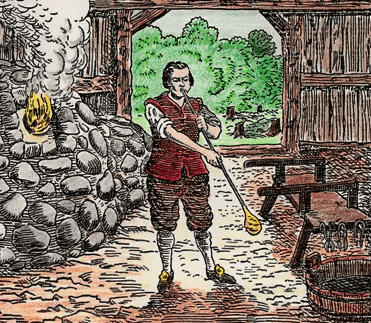
Illustrations, from above: A drawing of a glassblower working in the 1600s at the English colony of Jamestown, Virginia (National Park Service); Everett Duijcking, or here Duyckinck, land in New Amsterdam in 1638, a possible location of an early glass factory; three Gothic style glasses made for a large luxury table service that included a compote (a kind of serving bowl) and a decanter made by Brooklyn Flint Glass Company in ca. 1855, now in the collections of The Met; a common pocket bottle (flask) attributed to Henry William Stiegel and the American Flint Glass Manufactory, 1769-1774 (The Met); a mold-blown half-pint flask made by the Albany Glass Works, ca. 1847-1851, in the collection of the Albany Institute of History and Art; the Guilderland, NY, Glass Works Marker photographed by Howard C. Ohlhous, December 17, 2011, and since refurbished; blowing and flattening the disk in the process of making crown glass; and cylinder blown window glass factory workers using the process common from about 1800 until the Civil War.
Source link