 As the twentieth century dawned, precepts from the 1800s continued in many schools of thought and application, including the construction of buildings to house livestock. One tenet used was that of a round or multi-sided barn, thought to be more economically constructed than a rectangular structure, with good wind resistance and strength under snow loads.
By the late 19th century many round barns existed across New York State, though they have become a rarity in our time.
The Empire State, along with Kentucky and Maryland, host thoroughbred racing’s Triple Crown Events, and the facilities at each location add to the spectacle.
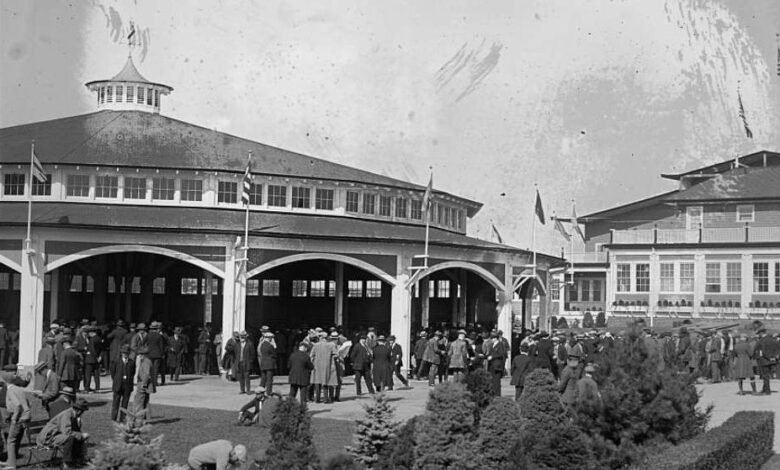
Due to the rebuilding of the Pimlico Racetrack in Baltimore, Maryland, the Preakness Stakes will be contested this year at Laurel Park for the first and only time, if construction stays on schedule. We will all have a chance to see the Laurel Park saddling paddock, which is a wonderful example of a multi-sided barn.
 This Saturday is not the first time the Preakness was run somewhere other than at Pimlico. In the Gilded Age the Maryland Jockey Club ran into leasing issues and conducted the Preakness in New York, first at Morris Park in the Bronx in 1890, and later at Gravesend racetrack in Brooklyn from 1894-1908.
Laurel Park opened in 1911 as part of the Maryland fair circuit, a network of racetracks operated in conjunction with agricultural fairs held across the Old Line State each year.
Laurel Park typically was issued some of the latest race dates of the year, as the autumn season was in its annual transition to colder weather, with its attendant sometimes uncomfortable precipitation.
The majority stockholders decided that an indoor, or at least under cover, saddling paddock would best serve horseman and spectators. Fairs have always been demonstration areas for agricultural concepts and methods, and perhaps that is why a circular structure was chosen.
At the early part of the twentieth century, the round barn was considered the ultimate in efficiency of materials and operation, and the saddling paddock was planned along these lines.
 The summer of 1920 saw plenty of construction activity at Laurel Park in preparation for the late fall racing season, in order to repair and replace buildings damaged by a fire the previous year.
The new paddock was built alongside the clubhouse end of the grandstand, sharing the outside rail tangent of the track with that existing arrangement.
The resulting structure is very pleasing to the eye. The white painted wood structure provides a comfortable pre-race preparation area for thoroughbreds and is a marvelous example of “form-following-function” design.
Interestingly, the Laurel paddock building is neither circular nor round, rather it is an 18-sided polygon known as an octadecagon (a combination of the Latin octo for eight and gonia for angle, further combined with the Latin deca for ten, making the word a simple sum of 8 + 10 angles).
The eighteen sides, six of which contain arched openings facing the track, support the first level of truss supports, roof rafters and collar ties. Above the first-story roof is a bank of windows that surround the entire lower roof, known architecturally as a clerestory.
Pronounced “kleer-stor-ee,” this is a portion of a building above one set of rafters and below another, lined with windows to provide interior light and ventilation.
 The design lends a powerful effect of symmetry on the observer. The upper roof section rises at a steeper pitch to yet another fully louvered clerestory which is only used for ventilation, and a final roof section forming a cupola that is topped by an equine weathervane.
This uppermost portion is supported from below by a grouping of hexagonal open columns that also carry the internal girder structure, which is surrounded at the ground level by a raised stage, which can be used by the paddock judge or auctioneer. This dais is surrounded by an unobstructed walking ring over eighty feet in diameter.
The large and airy well-lit paddock enclosure met with a new stipulation before it even opened. The Daily Racing Form of July 18, 1920 reported from Laurel Park that “local track officials propose to follow closely the edict set down in New York this year, which bars all but owners, trainers and their assistants from the saddling ring.”
A broad promenade and elevated platform allows the public a complete view of the thoroughbreds going to post, being tacked-up in the large stalls, and meeting their jockeys.
The physical plant of the racetrack with the production involved in the racing event are fascinating, as is how well they are woven into the history of the sport. If these walls could talk, they would recall the human and equine legends who contested here.
Read about the history of horse racing in New York State.
Illustrations, from above: The 1928-1931 Bates Barn on Route 12 near Greene, New York; the Morris Park Club House, ca. 1900; and the Laurel Park paddock as seen from the infield (from a Maryland Jockey Club Maryland-Millions advertising brochure).
Source link