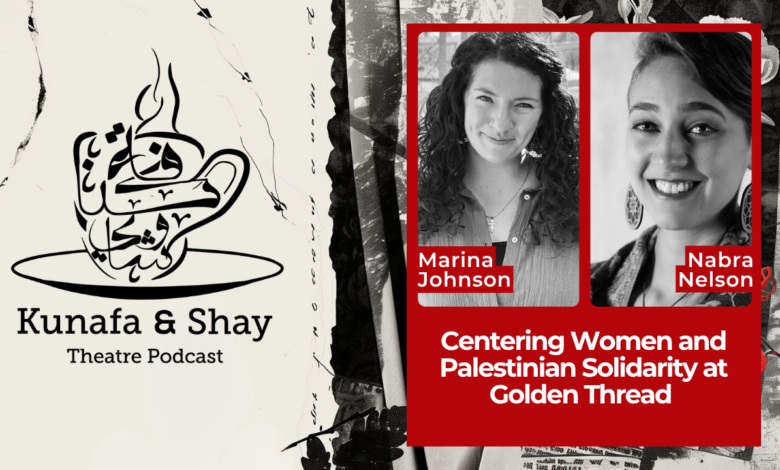
Nabra Nelson: Salam Alaikum! Welcome to Kunafa and Shay, a podcast produced for HowlRound Theatre Commons, a free and open platform for theatremakers worldwide. Kunafa and Shay discusses and analyzes contemporary and historical Middle Eastern and North African, or MENA, and Southwest Asian and North African, or SWANA, theatre from across the region.
Marina Johnson: I’m Marina.
Nabra: And I’m Nabra. And we’re your hosts. Our name, Kunafa and Shay, invites you into the discussion in the best way we know how, with complex and delicious sweets like kunafa and perfectly warm tea, or in Arabic, shay.
Marina: In each country in the Arab world, you’ll find kunafa made differently. In that way, we also lean into the diversity, complexity, and robust flavors of MENA and SWANA theatre.
Nabra: Season six of this podcast marks a double milestone, the thirtieth anniversary of Golden Thread Productions, the oldest MENA theatre company in the US, and my first year as the theatre’s new artistic director. Across ten episodes, we use Golden Thread as a case study to revisit landmark productions from 1996 to 2026, and trace shifting tropes, political urgencies, and aesthetic strategies that shaped the company’s early decades.
Marina: This season also expands to reflect on the past three decades for MENA theatres across the US, not as a closed chapter, but as a living archive, one that illuminates where we’ve been and where we’re headed.
Nabra: In this episode, we spotlight two of Golden Thread Productions’ signature initiatives, What Do the Women Say? and 24 Hours for Palestine. We explore how What Do the Women Say? creates an intimate recurring space to center Middle Eastern women’s voices, foregrounding multidisciplinary performances that are urgent, funny, political, and deeply personal.
Then we turn to 24 Hours for Palestine, a rapid response theatre project that gathers artists to showcase work about Palestine in various media. That’s pre-recorded. Transforming immediacy into collective action.
Marina: Golden Thread’s What Do the Women Say? is an annual event held around International Women’s Day that showcases the work of Middle Eastern women artists across disciplines, looking often at their playwriting, music, dance, poetry, and performance.
Nabra: And it’s really an interesting format because it’s not just a single play or event or format. Instead, it’s really a curated program where audiences experience multiple forms of performance alongside conversation between artists.
Marina: Exactly. And the event brings together artists from across the region and in the diaspora. So one of the additions I was really excited to be able to see was in 2023. This one was titled Fighters for Freedom, and it featured a Persian vocalist, an Iraqi filmmaker and activist and performance artist who was based in Beirut. Our colleague, Andrea Assaf, who’s a writer, performer, director, and cultural organizer, who was alongside Syrian soprano Lubana Al-Quntar, both from Art2Action.
There was an Afghan performer who was accompanied by a Yemeni oud artist. The collective of independent women artists from across the United States and Iraq, Her Story Is, also performed.
And as always seems to be the case with Women’s Day, at the time, the artistic director, Sahar Assaf, facilitated a conversation between all of these different artists and the audience following these presentations.
Nabra: It’s been really a part of the Golden Thread history almost since the beginning. This year, we actually had folks from the first Women’s Day back, I believe, even in the late nineties. It could have been 1999 or… the first few years of the 2000s. But earlier editions have also centered particular themes. So there’s the kind of recurring format that we talked about with different performers of different disciplines, as well as conversations between the artists and the audience.
And then some of them decide to have a certain theme, like the 2023 edition, Fighters for Freedom. 2012 was Pondering the Solo. 2014 was Talking about Sex. 2015 was Poetry of Resistance, Prose of Resilience. 2016 was Building Community Through Art. 2017 was Syria, Mon Amour, Food, Home, and Healing. And 2018 was Dismantling the Patriarchy. And then 2022, for instance, focused on the main theme, Making Home, bringing together artists, exploring diaspora and belonging. And that event included a poetry reading by Lebanese poet Zeina Hashem Beck, a performance from Palestinian actor and playwright Hend Ayoub, and music by Yemeni oud player Layle Omeran.
So you get an idea of some of what comes into putting each of these themes together and really the breadth of performers that you’ll see on these stages for What Do the Women Say?
Marina: Yeah and I think it’s always interesting because it changes so much. So we’re kind of going out of order in different ways based on the things that I think we find most exciting about different editions.
But in 2025, it felt like such a very interesting edition and quite different from some of the others because there was a guided meditation and Q and A session led by Ashira Darwish, a Palestinian journalist, therapist, and activist who was featured in the film Where Olive Trees Weep.
And so Where Olive Trees Weep for two weeks before the event was made available for on-demand viewing. And the film itself, if you haven’t seen it, it offers an exploration of the struggles and resilience of Palestinian people under occupation. Darwish is in the film as are other people that you might know like Ahed Tamimi, a Palestinian who you’ve seen her circulating for sure in different images. She is a blonde Palestinian and the reason I mention this is because whenever Russia invaded Ukraine, there was this picture that was going viral and people were saying this was a Ukrainian girl raising her fist at a Russian soldier. And actually it was Ahed Tamimi, a Palestinian youth raising her fist at an Israeli soldier. But it was interesting because of the way her identity was sort of utilized in different ways. And it was seen sort of as a brilliant resistance move in the Ukrainian sphere and not one in the Palestinian sphere, which of course raises lots of questions that we have answers to, actually, about why that is. But anyway, she is in the film. Israeli journalist Amira Haas and trauma healing work by Dr. Gabor Maté. The film delves into lots of themes, including loss, trauma, and the quest for justice. So if you haven’t seen the film, highly recommend. There are a few other Palestinian artists who I just adore who are involved in this.
But I love that this Women’s Day event really tried to draw focus to this film, ask people to watch it, and then kind of had this follow-up in person about the film and sort of taking these things into a deeper level that can only be reached through this in-person interaction.
Nabra: I did confirm that the first Women’s Day event was in 1999. So it’s been going on since basically the beginning of Golden Thread almost with the advent of Golden Thread, of course, in 1996. And then a few years later, they started with What Do the Women Say? And so thirty years later, the program continues to evolve, but really has a similar structure to what happened in 1999, you know, from what I’ve heard from Torange. The 2026 edition, of course, coincided with Golden Thread’s thirtieth anniversary and brought together the founding artistic director, Torange Yeghiazarian, the outgoing artistic director, Sahar Assaf, who was able to join us virtually from Riyadh. And the incoming artistic director, myself, Nebra Nelson, to reflect on the company’s past and future while featuring music, dance, spoken word, and theatrical excerpt in the spirit of almost thirty years of Women’s Days.
And this year’s program, of course, I was involved in curating it, but Sahar and Torange really took the lead, and we wanted to feature folks who were involved deeply in Golden Thread over the past thirty years, whether recently or from the very beginning. So we featured somebody who was in that first Women’s Day in 1999, Taraneh Hamami, in conversation with Torange about the founding of Golden Thread. And they had these amazing slides of the photos of Torange literally in a living room with a bunch of people in that first meeting to talk about creating a MENA Theatre Company in the US and then some of those early productions and collaborators. It was so beautiful to see.
We had Love Tunes from Iran by Dina Zarif and Amelia Romano as the accompanying harpist, which was so incredibly moving. Dina created a slideshow of people who had been killed in the recent protests in Iran earlier this year and had a beautiful song of mourning and grief and resistance on top of those images, as well as images from the protests and videos of the violence against protesters. So it was really incredibly moving and, you know, moved us all to tears to see what had really been happening.
Marina: Well, and I think something as an audience member at this Women’s Day that was really important about this moment in particular was after each person presented their artistic piece, they all went into like a literal living room that was set up by Golden Thread on the stage. So there were these comfy couches and pillows and things. And so there was a moment of dialogue with them. So the art wasn’t just speaking for itself. The artist also had a chance to speak. Like, and this Iranian artist said, you know, I actually, you know, feel quite conflicted because she’s bringing up the images of people being killed by protesters. And she just asked the question. She said, you know, I and I’m paraphrasing, but Iranians talking about these things, did that make the US government feel like they had the consent of Iranians to do what they’re doing right now? And I think it’s an important question that people don’t get to talk about publicly very often. I know these conversations are happening a lot in different spaces, but for that conversation to get to be had on stage at this event is a very different kind of cultural event where someone can ask that or they’re able to voice their concern because we know that the United States sort of manufactures consent in different ways. And one of the ways that they can do that is where they make it seem like people are asking the United States government. And some people are asking, but making it seem like others are asking for these interventions when it’s a far more complicated and nuanced conversation than that. Just because a particular problem is happening does not mean that someone is asking Donald Trump to put his finger on a nuclear button, for instance, getting to have these sort of beginnings of more nuanced conversations. Of course, there was not time for this complete conversation to transpire, but that was getting to happen. I realized in my heart, I was like, oh, this is such a rare moment that can only happen in these really particular spaces like Golden Thread.
Nabra: The way I was thinking about it is, and I think Sahar and Torange, in this entire format was thinking about it, is centering the artists and just giving people a platform. And of course, then there’s the added element of the trust in the community that’s been built around Golden Thread and the ability to have very deep conversations in a very short period of time. To trust our audiences, to trust our artists, to continue that conversation and to grasp the nuance and the complexity through just art and a little bit of conversation. And it’s interesting because this was really curated as a celebration of thirty years of Golden Thread. And then when the violence against protesters and the protests in Iran started, and then of course the war in Iran started, it became very clear that we wanted to dedicate this event to the people of Iran. And we did, of course, but there was a question of like, okay, how do we reconcile this idea of celebration and this dedication at this moment? And it went back to centering the artists, giving them the space, and knowing that all the artists we had already invited are going to be responding in some way to what’s happening in Iran and elsewhere. That’s in all of our hearts. And so we just trusted that that was going to be a response. And of course we had Iranian artists already really highlighted in this program. And so we knew that that was going to be spotlighted through their work and their conversation.
And we also decided to continue with this idea of celebration. So as we moved into the rest of the program, we wanted to be able to have joy and celebrate ourselves, our art, and the incredible legacy of Golden Thread. And so it was a very tricky curation this year.
Marina: So after Dina’s presentation, which involved video clips of different violence against protesters, many performers later, Bahar Royaee was one of the people who was going to be presenting. She is the co-composer with Amal Bisharat on Mornings in Jenin Musical, which I am thrilled to be the dramaturg on this project. But Amal couldn’t be there because she was sick. But Bahar, one of the first things that she said on the stage was, you know, thank you, Dina, for this and for talking about this. My cousin was one of the people that was in the video, my cousin who had been killed in Iran. And so there was this moment of, I don’t know that either of these people knew that this was going to be a moment that was shared between them, but it very much was. And I think it’s one of the things where the rest of us had to stop and take stock of that moment in a different way as we continue to hear about these artistic productions. So these things are not happening ever in isolation, but they are happening as part of these moments together and these moments of sort of shared grieving and shared celebration, as the event was focusing on celebration in different ways and how we can celebrate artists and artists being able to talk about the things that they hold most important and dear in this community is a moment of celebration in itself.
Nabra: And then we had other pieces by non-Iranian folks. We had a dance by Amal Tafsout, who is an Algerian dancer. She entitled that dance Healing Humankind, a tribute to women. And so again, having this traditional dance in this context really would have, I think, felt different than in a different context. And it was clear that she was responding to the moment in that way.
We had an homage to Fairuz and Ziad Rahbani by Naima Shalhoub. So bringing in these very classic singers in this feeling that was both mourning and grieving and celebration. So it was really beautiful integration of that, which is something that music can do so well. We had an excerpt from our playwright-in-residence, Denmo Ibrahim, who has been featured in this podcast before. And it was an excerpt about putting together the pieces of your identity. And then we ended with this big celebration with Aswat Women’s Ensemble, featuring the Sudanese singer Salma El-Assal, that were ceremonial wedding songs from Sudan. And that’s something that I really wanted to bring to this year’s Women’s Day because of my Nubian background and because of the genocide in Sudan. I wanted to make sure that Sudanese voices were present and featured. And that Palestinian voices, of course, were still present and featured with Mornings in Jenin Musical. So there was really this undercurrent of solidarity throughout and this ability to mourn and grieve together and also have joy as a form of resistance together and to celebrate being in this space together and whatever celebrations that we needed at this moment in a time that feels so uncelebratory.
Marina: And something that Torange said to us before, and I actually don’t remember if it was on the podcast or just in us talking to her in general, when asking her about What Do the Women Say? she had sort of said, and she said this at this event too, in celebration of thirty years of Golden Thread, often people would say to her, well, women in Iran, her context, they’re silenced. They don’t have anything to say. Where are they? Where are they speaking? And she was like, I don’t know who you’re talking about. All of the women I know have these long, loud, strong voices. They’re saying plenty. Are you listening? Are you checking to see what the women are saying? Or do you just assume these orientalist, Islamophobic narratives that women are silenced? And so I really appreciated that framing of her saying, oh, you think that the women from these countries aren’t talking? Here, come to this event. If you show up, we will make it easy for you and actually show you what women from these different places are saying. Because of course you should do your own work, but I love that Torange said, I’m going to make it easy for you. Just come. What an important way to spotlight women and to use International Women’s Day to say, hey, the women are talking. If you’re not hearing them, it’s because you’re not listening. Absolutely.
Nabra: I love the way Torange expresses things. It’s so clear. And sometimes she’ll say things that you’re like, yeah, of course. Why haven’t we been thinking this way? Why haven’t we done this before? And this was another example where I was like, yeah, obviously. This was just the clearest and cleverest way to respond to that kind of stereotyping in our community.
Another event that Golden Thread has begun hosting or co-hosting, it’s happened twice so far, is 24 Hours for Palestine. And this project emerged in 2024 as a partnership with Art2Action during the ongoing genocide in Gaza as part of Golden Thread’s broader programming responding to the crisis.
Marina: The first edition, which was in 2024, was titled A Moon Will Rise from Darkness. And so this is a twenty-four hour livestream. It’s all being shown in the twenty-four hour span, but they’re prerecorded episodes because we wanted, I mean, I think Golden Thread wanted to make sure that these things could all sort of happen feasibly. Although a twenty-four hour programming is, it’s a pretty huge undertaking, like kind of a Herculean effort is needed to make this happen. And it can happen, of course, with these different participants who have agreed to sign on. It was organized by Golden Thread and Art2Action. So Sahar Assaf and Andrea Assaf, they created this together in partnership with organizations like MENATMA, the MENA Theater Makers Alliance, ASHTAR Theatre, the Freedom Theatre, Zoukak Theatre, Noor Theatre, Donkeysaddle Projects, Dunya Productions. And then it was all livestreamed, the first version, on the HowlRound Theatre Commons, a frequent collaborator with Golden Thread.
Nabra: Some of the sessions included conversations with Palestinian artists in the diaspora and presentations from theatres working under extremely difficult conditions to really understate what they’re going through. For example, one session focused on the Freedom Theatre in Jenin, where artists discussed continuing to create theatre amid military violence and occupation. Another session brought together Palestinian artists such as Ra’eda Doha and E.S. Younis to discuss theatre’s role in preserving Palestinian narratives and collective memory.
Marina: The program also included poetry readings and performances inspired by the work of Palestinian poet Mahmoud Darwish. And the title of the event itself, A Moon Will Rise from Darkness, is inspired by Darwish’s poetry. So the idea is not just to present art, but to mobilize the theatre community sort of in this global way. And what I also love is that if you sort of were following along in different iterations, so like Nabra was talking about the Freedom Theatre piece, Alaa Shehada, who is in the upcoming video performance, The Horse of Jenin, that he created, it’s his monodrama that’s touring in a virtual video format, that you would have seen him in this Freedom Theatre session.
There are so many other sessions that I think were really amazing and wonderful, and you can still check these things out. So A Revolution’s Promise, for instance, is a play that was written and came out of Jenin. Ahmed Tobasi is the one who usually performs this, but the excerpts were read from that. There was a session called Gaza Now, Witnessing the Witnesses, Shared Struggles and Resilience, which looked at Afghan artists exploring the common struggles there, right? So looking at solidarities.
There was a play reading from a Yussef El Guindi play, As We Near the End, or What Adorno Said. So what Adorno said, I’m paraphrasing, “to make art after Auschwitz is barbaric.” And actually Adorno changed his mind later. And so looking at what that means in conversation with other artists.
Palestinian art and queer resistance. Often people think that there is no queerness, which is of course incorrect.
There is a Field, which Nabra has worked with Donkeysaddle Projects before. That play is incredible and very much worth looking at. In the year 2000, a seventeen-year old Asel Asleh was killed by the IOF. This play is featuring the story of Asel, told by his sister Nardine, but it also really connects the Black Lives Matter struggle in the United States with the story of Asel. Looking at police violence across these different contexts, trying to build solidarity across these intersectional struggles for liberation and decolonization. And these networks have always existed and this play is bringing particular attention.
Another session on Silencing Voices for Palestine in Hollywood, which is very much something that has continued to happen.
Feminism, Censorship, looking at Palestinian journalists. One of my personal favorite plays in the world is Dalia Taha’s Fireworks. That play has a small excerpt, it’s read, Letters from Palestine. This is actually a Dunya Productions piece. Do you want to talk about that at all Nabra?
Nabra: Yeah, what we ended up offering, I was still producing very actively with Dunya at the time. And when we got the call, we already had filmed versions of Letters from Palestine in the Time of the Virus and Loved Ones, Families of the Incarcerated, which were our virtual Zoom productions. So we, you know, excerpted those and then also had a filmed version of The Return by Hanna Eady and Edward Mast which we had produced earlier that year. So we kind of did this like amalgamation of excerpts of our virtual work and with a beautiful intro by Hanna Eady as well, a Palestinian company member to contextualize all of that.
Marina: A few other ones to mention from the 2024 session, Arab, Jewish, and Sephardi artists. There was also one in solidarity with Native American artists, Letters to Gaza, which is from Ashtar Theatre. And that project, you’ve heard of the Ashtar Theatre The Gaza Monologues, where people in Gaza had written monologues, continued to write The Gaza Monologues as the different sieges and genocides have happened.
But Letters to Gaza was also a chance for the international community to write back to artists in Gaza. And so I highlighted a lot of these pieces just because frequently people will talk to me and say, oh, but do you know any indigenous people or Jewish people who are in solidarity with Palestine? Yes, and you can too, right? You can look at these pieces. Or do you have any favorite Palestinian plays? I have a ton and you have access to some of them as well. So I highlighted these things just to draw attention to this existing archive that Golden Thread has lovingly put together with artists from across the globe. And we should all access it.
Nabra: And I love the fact that it’s documented. It’s there. There are now forty-eight hours of various Palestinian performance in different disciplines across organizations in solidarity as well as Palestinian organizations and artists in the US and abroad and in Palestine. So truly, this is an incredible archive and resource for all of us to highlight this work and these artists and to really reach out to them to do things since the genocide in Palestine simply continues.
Golden Thread framed this event as a call for artists to use their platform to speak out against violence and support Palestinian liberation. So the call was really broad and we could really bring anything we wanted to the forefront. It’s, again, letting artists lead and seeing how those conversations lend to each other and kind of come together into a cohesive event through that shared call.
The initiative continued with a second edition in September 2025 titled 24 Hours for Palestine: to Our Ultimate Freedom in partnership with The Arab American National Museum, Artists on the Frontline, Ashtar Theatre, Aviva Arts, Calling Up Justice, Decolonial Dharma, Donkeysaddle Projects, Dunya Productions, The Freedom Theatre, Meem Collective, New Arab American Theater Works, Noor Theatre, The Palestine Institute for Public Diplomacy (PIPD), and Zoukak Theatre Company. So there is really a large and growing community behind this event and, of course, Palestinian liberation. Thank God.
Marina: Once again, more than a hundred artists, scholars, and activists participated, giving another incredible iteration of 24 Hours for Palestine.
Nabra: It involved all these partner organizations and reached audiences in over forty countries, demonstrating the global scale of the theatre community’s response. Some sessions explored how artists confront censorship or reclaim language when discussing Palestine, while others presented new theatrical works by Palestinian and allied artists. For example, Dunya presented a reading of Hanna Eady short play Gitmo Lab that I performed in as well, which was about Palestinians in Guantanamo Bay and, of course, a critique of the US military-industrial complex and an examination of indigeneity in the context of Palestinian liberation and solidarity in the United States.
Marina: There was poetry. There were some documentary screenings. If you’re familiar with Bisan Owda from Gaza, there’s a short documentary series that features her, Palestinian artists in Lebanon. Again, Donkeysaddle featured. This was a short documentary that is called Severed, and it looks at the story of Mohamed Saleh, who’s a Palestinian teen from Gaza who they’ve been working with for years and years. When he was 12, he lost his leg, and he has survived five different Israeli military assaults. This looks at his leg, but also the larger question of disability justice in Palestine. As we know, in Gaza, there’s the largest cohort of child amputees and the amputations. Most of them happened without anesthetic. This is a big disability justice issue as well.
Tennis in Nablus, a play by Ismail Khalidi. There were some scenes presented from that. This was the first time I had heard of a photo poem video, but Do You See Me was the seventeen minute photo poem video that was built from raw images of children in Gaza whenever we knew that the famine was sort of at its peak. Among so many other things, again, looking at queerness, looking at music for liberation, looking at different testimonies from Gaza.
Oh, yes, I moderated Envisioning Futures, Curating Freedom, Ashtar Theatres, Performing Arts Village, and Academy. I had just come back from Palestine, and Ashtar Theatre reached out. They were like, we need a moderator. I was like, great, always happy to do this with you.
Nabra: I mean, there were so many sessions. It’s always so robust. I really recommend you go onto the archive, either on Golden Thread’s website or Art2Action’s website or just YouTube, of course, and check this out and see what you would be interested in revisiting. It’s great because there’s so much involvement from Palestine, which is difficult because, of course, all of the constraints of being in occupation and genocide and apartheid, but also because of time difference. So having this twenty-four hour event allows for a lot of Palestinian folks and organizations to be involved and to tune in when it’s comfortable for non-US audiences to tune in. And then, of course, there’s the archive, so make sure to check it out.
Marina: What began as an emergency artistic response continued into this ongoing platform for global artistic solidarity. So if we look at, What Do the Women Say? and 24 Hours for Palestine together, we see that they illustrate these two different but connected roles that theatre institutions can play in really spotlighting what is happening in different parts of the world and highlighting the artists who are always responding to this work.
Nabra: On the one hand, they can build long-term artistic platforms like What Do the Women Say?, highlighting Middle Eastern women’s voices annually for decades. And on the other, they can respond rapidly to political crises by mobilizing artists and audiences across borders like 24 Hours for Palestine. And often, both of these events are doing both.
Marina: So in this way, Golden Thread has shown us how theatre can function not only as performance but as a way to build community, conversation, and collective action. If there are other events like this from other theatres, please let us know in the comments. We know that theatre is often this responsive media and we would love to know what other responses you have seen that we might be able to look at for future iterations of the podcast or just for us to know about in general.
Nabra: This podcast is produced as a contribution to HowlRound Theatre Commons. You can find more episodes of this show—and other HowlRound shows—wherever you find podcasts, including on noncommercial open source apps like Anytime Podcast Player for iPhone and AntennaPod for Android. If you loved this podcast, please share it with your friends. You can find a transcript for this episode, along with lots of other progressive and disruptive content, on howlround.com.
Marina: Have an idea for a meaningful podcast, essay, or TV event that the theatre community needs to hear? Visit howlround.com and submit your ideas to this knowledge commons.
Marina and Nabra: Yalla! Bye!