 On May 21st, The Late Show with Stephen Colbert will officially end after being canceled by CBS. With that, the doors to the Ed Sullivan Theater will be shuttered for the foreseeable future.
While the immediate implications of Colbert’s cancellation are dire (considering the blatant censorship of political opinion and corporate cow-towing of CBS’ parent company Skydance Media) there is also a dramatic loss for the arts that comes with the uncertainty of closing such a historic venue.
Over the decades, countless celebrities and musicians from Elvis to The Beatles have graced this hallowed venue with iconic performances that have transcended their time. So before Ed Sullivan theater closes its doors, let’s look at the history and memorable moments of the famed theater.
Early Years of the Theater
The Ed Sullivan theater has worn many names and donned many hats since it opened almost 100 years ago. Located at 1697-1699 Broadway between West 53rd and West 54th, in Manhattan, New York, the building was designed by architect Herbert Krapp and built by Arthur Hammerstein.
 The theater was originally named in honor of Arthur Hammerstein’s father, Oscar and first opened its doors in 1927. The original interior has been compared to a Gothic cathedral.
The theater featured 10 grandiose stained glass windows, each illustrating a different scene from many of Hammerstein’s popular theater productions. The orchestra pit could hold up to 50 musicians.
There was a $50,000 pipe organ and an $18,000 bronze statue of Hammerstein’s father.
The opening musical, called “Golden Dawn,” featured a young Cary Grant (then performing under his real name, Archibald Leach). However, a string of show failures brought the enterprise quickly crashing down.
Enter The Ed Sullivan Show
During the Great Depression, Hammerstein fell on financial troubles and went bankrupt, allegedly with only $5 left to his name. Subsequently, he was forced to sell the theater, which went through a variety of changes in a relatively short period.
In 1931, it was the Manhattan Theater. In 1934, it became a nightclub called Billy Rose’s Manhattan Music Hall. In 1935, CBS acquired the space. Originally CBS used the theater for radio broadcasts, christening the theater as Playhouse No. 3.
 According to the Hollywood Reporter, “during World War II, Playhouse No. 3 served as the main stage for Command Performance, the popular military-minded variety show ‘recorded and short-waved every Sunday to America’s armed forces all over the world, written and produced under supervision of the Radio Branch of the Bureau of Public Affairs of the War Department.’ ”
In the 1950s, the theater was transformed into a soundstage to fit the growing medium of television where the theater became formally known as Studio 50. It wasn’t until 1953 that Ed Sullivan began to call the theater home.
Previously, Sullivan was hosting his variety show called “Toast of the Town” in the Maxine Elliot Theater, also owned by CBS. Needing a bigger space for the growing popularity of the broadcast, Sullivan took over Studio 50 for the next 23 years.
In 1955, the show’s name was changed to bear his name. To mark the anniversary of the show’s 20th year, the theater itself was officially named the Ed Sullivan Theater in 1967.
It’s worth noting, the Ed Sullivan Theater has always been a place where various degrees of censorship were imposed on its performers.
You can read more about that, and the more recent history of the theater in an essay by Ryan Bieber at our arts and culture reporting partner NYS Music.
 NYS Music offers daily music reviews, news, interviews, video, exclusive premieres and the latest on events throughout New York State and surrounding areas. Subscribe to their newsletter here.
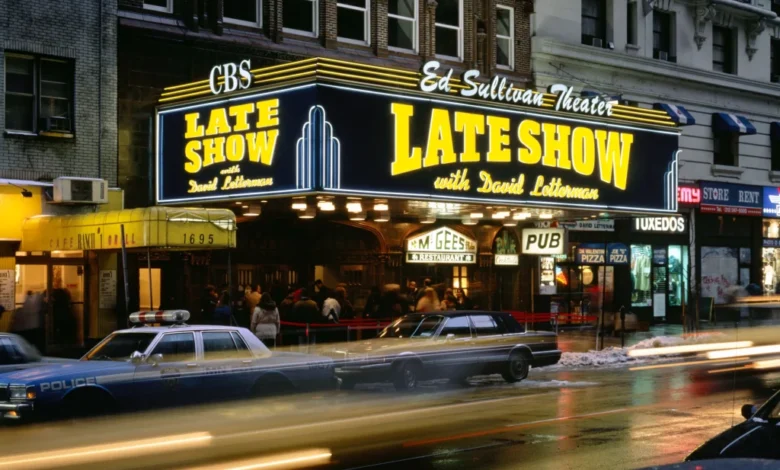
Illustrations, from above: The Ed Sullivan Theater on August 30, 1993, promoting the Late Show with David Letterman; as Hammerstein’s theater in 1929 (photo from Lost Broadway Theaters by Nicholas Van Hoogstraten); and as CBS Radio Theatre (Studio 50) in 1951.
Source link