
 On Wednesday, May 20, 2026, the US District Court for the District of Columbia granted emergency relief in the American Historical Association and American Oversight’s lawsuit challenging the Trump administration’s effort to evade the Presidential Records Act (PRA).
The injunction, which takes effect at 9 am on Tuesday, May 26, enjoins the White House Office, the National Security Council, the US DOGE Service, and all advisors to the president to comply in full with the PRA.
The order specifies that compliance includes preserving all presidential and vice presidential records as defined by the act.
Also, refraining from creating or sending any presidential or vice presidential records via text or ephemeral messaging accounts without copying an official account to preserve the records, and maintaining records retention policies that are in compliance with the PRA.
Defendants are also required to circulate a copy of the order to covered employees, and file a notice with the court on or before May 28, 2026, describing steps that have been taken to comply with the court’s order.
 Today’s ruling centers on a request for emergency court intervention filed by the American Historical Association and American Oversight and last month, seeking the court to block the Trump administration from disregarding the PRA and to prevent the destruction or loss of presidential records.
The motion argued that without urgent court intervention, records documenting presidential decision-making could be “lost to history.”
The request for an emergency court order came just days after the groups filed suit challenging a sweeping opinion memo from the Department of Justice’s Office of Legal Counsel (OLC) declaring the PRA unconstitutional and advising that President Trump “need not further comply” with its requirements.
The 54-page memo, issued April 1, 2016, was signed by T. Elliot Gaiser, the Assistant Attorney General for the Office of Legal Counsel. It argued that the PRA unconstitutionally infringes on the independence of the president by “aggrandizing the Legislative Branch at the expense of the constitutional independence and autonomy of the Executive.”
T. Elliot Gaiser was nominated by President Donald Trump on April 29, 2025, confirmed by the United States Senate on July 30, 2025, and sworn in by then Attorney General Pam Bondi on August 4, 2025.
Attempt To Protect Presidential Records
The sweeping nature of the opinion drew sharp criticism from legal scholars and historians. The motion argued that the Trump administration’s position is clearly unlawful, pointing to binding Supreme Court precedent that has already upheld Congress’s authority to require the preservation and eventual disclosure of presidential records.
The motion emphasized that the OLC’s opinion relies on virtually no legal precedent and instead attempts to override settled law by declaring the PRA unconstitutional in its entirety — a conclusion the Supreme Court squarely rejected when it considered the constitutionality of the PRA’s predecessor after Watergate.
Because the administration now has OLC’s approval to disregard the PRA, the motion warned that there is an immediate risk that records documenting official actions could be permanently lost.
Additionally, the motion emphasized that the Trump administration has refused to commit to preserving all presidential records during the course of the litigation, including records created on personal devices or sent or received on encrypted messaging platforms.
 The administration’s failure to commit to its basic record-keeping obligations is especially concerning given its position that it is no longer bound by the PRA’s requirements.
Without those safeguards, key records documenting government actions could be deleted, destroyed, or never captured in the first place.
Because the PRA establishes that these records belong to the United States and must be preserved for eventual public access, the motion argued that any loss would cause irreparable harm that cannot be remedied after the fact.
The filing also underscored that the administration’s position could have sweeping consequences beyond the current presidency, threatening access to records from prior administrations and undermining the ability of historians, journalists, Congress, and the public to understand and evaluate government decision-making.
In their motion, American Oversight and the American Historical Association asked the court to order the administration to comply with the PRA, preserve all presidential records, and prevent any destruction or loss of materials while their case proceeds.
Presidential Records Act History
The Presidential Records Act was enacted in 1978 in the wake of the Watergate scandal to ensure the preservation and public accessibility of presidential records.
Previous to the PRA, the 1974 Presidential Recordings and Materials Preservation Act was created by then Richard Nixon’s attempt to move the records of his administration, including those related to various crimes, to California.
Watergate involved dozens of crimes, primarily centered around burglary, illegal wiretapping, and a massive criminal cover-up orchestrated within the White House.
 Ultimately, 69 Republicans were indicted and 48 — including top administration officials — were convicted of various offenses.
Afterward the Presidential Records Act (PRA) established that presidential records are the property of the American people, not the president.
In upholding a prior law governing Nixon’s records, the Supreme Court rejected claims that such requirements violate separation of powers, affirming Congress’s authority to regulate the preservation and disclosure of presidential materials.
Since then, no presidential administration — including Trump’s administration in his first term — has questioned the law’s constitutionality.
As recently as last year, the Trump administration itself acknowledged in litigation that White House agencies and offices are subject to the PRA and must comply with its requirements, underscoring the self-serving nature of its current reversal.
Ruling Reactions
In response to the ruling, the American Historical Association and American Oversight and released the following statements:
Dr. Sarah Weicksel, Executive Director of the American Historical Association: “This ruling reaffirms the essential place of presidential records in documenting our nation’s history and a core principle of the Presidential Records Act: that these records belong to the American people, not to any one individual.
“Historians—and the public who engages with and learns from the histories we write and curate—rely upon the integrity of the historical record. Americans deserve the ability to understand the entirety of their history. By requiring continued compliance with the Presidential Records Act, this preliminary injunction is an important step forward in ensuring that the documents that tell our nation’s history are preserved for future generations.”
Chioma Chukwu, Executive Director of American Oversight:
“Today’s ruling is an important victory for presidential accountability and for affirming what decades of law and practice already established—the constitutionality of the Presidential Records Act. The court recognized the serious danger posed by the administration’s attempt to cast aside longstanding federal law governing presidential records and replace it with a system dependent largely on presidential discretion and public trust.
“This case has always been about something larger than records management. It is about whether a president can treat government records as personal property—deciding for himself what will be preserved, what will be disclosed, and what can simply be destroyed.
“The court’s decision helps ensure that the American people—not the White House—retain ownership over the historical record of the presidency. It reaffirms a basic democratic principle: presidents do not get to decide unilaterally what history will remember and what the public will never see.”
 American Oversight is a non-partisan, 501(c)(3) nonprofit ethics watchdog that uses public records requests backed by litigation to expose official misconduct, threats to democracy, and abuses of power at all levels of government.
Documents obtained by American Oversight have supported investigative work by journalists, congressional committees, and independent watchdogs, and have been featured in hundreds of news reports across the country. Learn more at americanoversight.org.
The American Historical Association was founded in 1884 and incorporated by Congress in 1889 for the promotion of historical studies. The Association provides leadership for the discipline and promotes the role of historical thinking in public life.
The association defends academic freedom, develops professional standards, supports innovative scholarship and teaching, and helps to sustain and enhance the work of historians.
As the largest membership association of professional historians in the world (over 10,000 members), the AHA serves historians in a wide variety of professions and represents every historical era and geographical area. Learn more at historians.org.
New York Almanack is reporting on Donald Trump’s impacts in New York State, but we can’t do it without your help. Please support this work.
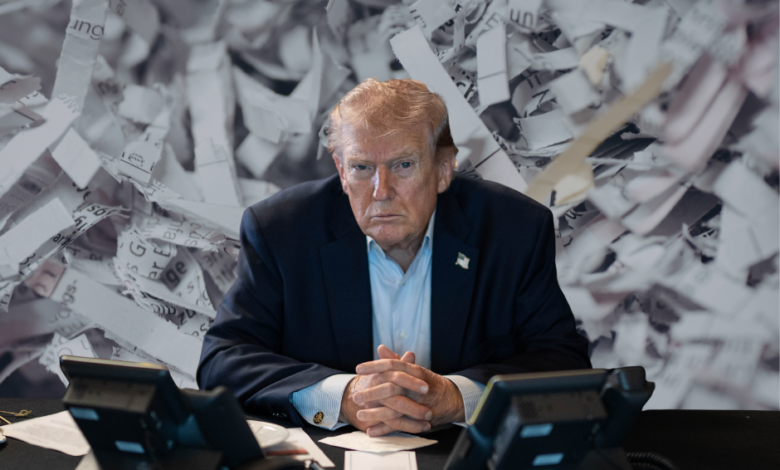
Illustrations, from above: The E. Barrett Prettyman Courthouse, home of the US District Court for the District of Columbia (Wikipedia user Toohool); an American Oversight provided illustration of Trump shredding the Presidential Records Act; a photo from the indictment against former Donald Trump showing boxes of records illegally stored in a bathroom and shower in the Lake Room at Trump’s Mar-a-Lago estate in Florida; New York Times Watergate headline, March 2, 1974; and boxes of records from the Clinton Administration transported to the National Archives in January 2001 (NARA).
Source link