Nicolas Shannon Savard: Hello, and welcome to Gender Euphoria: The Podcast, a series produced for HowlRound Theatre Commons, a free and open platform for theatremakers worldwide.
I’m your host, Nicolas Shannon Savard. My pronouns are they, them, and theirs.
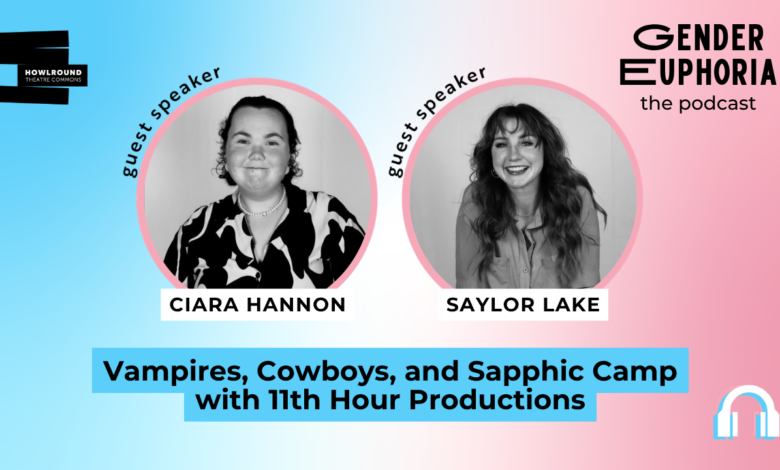
For this episode, I am joined again by Ciara Hannon, pronouns they/them, and Saylor Lake, pronouns she/her, the creative duo behind 11th Hour Productions. 11th Hour is a collective of nonbinary and queer women theatremakers who create queer-centered art with and for the queer community in Central Florida.
In last week’s episode, we talked about queer community in and around the Orlando Fringe Festival, as well as the political side of their work, performing queer work in a very conservative state despite direct targeted backlash from the governor’s office. Their response to which they’ve incorporated into their promotional materials for their shows.
And I quote, “if you want to see the queer art that’s making the Florida governor shake in his lifted boots, we’ve got you covered.”
I highly recommend listening back to that episode.
Today, we are diving into the content and style of 11th Hour’s work. We’ll use their show Mary Kay Vampires, which they performed at Cleveland’s BorderLight Fringe Festival, which is where I met them, as a starting point for digging into a deeper discussion about campy comedy and its role in queer culture and community. To start us off, I’ll drop us back into the conversation with Saylor Lake and Ciara Hannon describing the kinds of stories and roles they wanted to create space for with 11th Hour Productions.
Chorus of voices: Gender euphoria is bliss. Freedom to experience masculinity, femininity, and everything in between. Getting to show up as your own self. Gender euphoria is opening the door to your body and being home. Unabashed bliss. You can feel it. You can feel the relief. Feel safe. And the sense of validation and actualization. Or sometimes it means being confident in who you are. But also to see yourself reflected back. Or maybe not, but being excited to find out.
Saylor Lake: Hi, my name is Saylor. I am the co-owner and company manager of 11th Hour. I do everything that Ciara doesn’t. I’m mainly an actor first though, so I did not intentionally intend to own a theatre company. Growing up, it was always something that I said I wanted to do because I realized that I found myself in a position wanting to present in roles that were not originally made for me. So whenever I’m talking about, oh, my dream role, my number one dream role is Professor Callahan in Legally Blonde.
Nicolas: Such a good one.
Saylor: And there is never a universe that I would ever get to do that. But with 11th Hour, I know that I could have that potential. There is that possibility and I’m giving somebody else that potential possibility as well. It’s something that kind of fell into my lap by happenstance and I wouldn’t have it any other way. I get to flex a lot of muscles that I grew up building because I was originally a tech theatre artist. I was not an actor first. I auditioned for my first show when I was a senior in high school. And then I was like, okay, wow, this is actually kind of cool. And then I actually went to college for tech theatre. So here I am. I’m now a professional actor. I just became SAG eligible, and I work at the local Orlando theme parks, and that’s my full time daily job is theme park work.
Ciara Hannon: I’m Ciara. I am the artistic director and co-owner of 11th Hour Productions. And to kind of echo what Saylor said, I do everything that Saylor doesn’t. And kind of going back to like the Professor Callahan of it all is, you know… I grew up, loved reading scripts, and the ones that were queer that I’d read the most were like Angels in America, The Normal Heart, which is like great, but my God, why is it all so sad? And like, I understand that is a part of our history, but like when I first wrote Gay Cowboys—which is like going to be published soon! Yeah! So when I first wrote Gay Cowboys for my playwriting class, and this was like my first like legit big boy college thing. And I’m sitting there, they read the scene, and then it’s quiet. And then someone raises their hand, they go, “Do you write fan fiction?” And I go, “What about it?” And she’s like, “This sounds like a fan fiction. And I mean that as a compliment.” And so it’s kind of like that idea where I enjoy writing and bringing to life stories that like, you would read alone at like three a.m. Like that like comfort fan fiction everyone turns to. That’s the kind of art that I enjoy creating, but like still basing it in like truth and reality and not making it Heartstopper, but not making it TheNormal Heart, making it this like living, breathing thing.
Nicolas: Love it. So we met at the BorderLight Fringe in Cleveland this summer, where you were touring your show Mary Kay Vampires. I was there with my show, Five and a Half Feet of Fearsome. Found my people in the very gay shows. Synopsis for context:
Set in the 1980s, Mary Kay Vampires follows Esther Davis, a former pageant queen, Vera Marsden, an intellectual enigma, a mysterious affliction known as the hunger. And you guessed it, the infamous pastel pink pyramid scheme of Mary Kay cosmetics. It’s blush, it’s lipstick, it’s a lot of LED pads. 11th Hour says, “Come for the camp, stay for the blood. Girl, if you love Drop Dead Gorgeous, What We Do in the Shadows and season four of American Horror Story, this is the show for you.” Esther Davis was played by Saylor Lake, Vera Marsden played by recurring 11th Hour cast member Sarah Rae Jackson, and Ciara Hannon and Christina Ramos played a variety of characters in this show from Esther’s agent to the pageant director to multiple victims who mistakenly let vampires into their homes with the promise of a makeover to Mary Kay herself.
Could you tell me a little bit about Mary Kay Vampires and how does that fit into your repertoire of queer work?
Ciara: Like for me, I kind of always have either a title, or like a grab, like a hook that I’m like, “That’s a show”… I don’t remember, but it kind of happened when I was in college of, it was just an idea of a vampire just in like, the like business pink suit of just saying, “hi, hon, can I come in?” and just like the like big eyes and stuff like that.
And then I think I mentioned this, like when we were like out at one of our production meetings—meaning we’re at a bar. And I was like, “Oh, you know, it’d be really cool—you know Mary Kay?-—if there were vampires in Mary Kay.” And then Saylor goes, “Well, I’ve always wanted to do an eighties show.” And so then it was like, the eyes met. And it just kind of melded into place.
And how it kind of fits with 11th Hour is… How do I word this? It’s almost like we think of the genre first. Like we have a cowboy show, we have a gay pirates show, we have vampires, you know, so it’s like, it’s, we think of the genre that we want to touch first, or like the type of show we want to do first. And then I don’t want to say that the queerness is like an afterthought, because I don’t think that that’s true. But it’s like, it’s very much so much a part of it. But then again, it has nothing to do with it. Do you know what I mean?
Nicolas: Yeah, it’s like a world of queer people. Yeah, it’s not about like identity.
Ciara: Yeah. And, I really think how Mary Kay fits into all of it was that our gorgeous, gorgeous, gorgeous friend, Miss Sarah Rae Jackson, she has the most beautiful wife, and she keeps on going, “Oh, you know, my wife.” And we’re just like… just like the power and the like, slay-ness of that. Of just hearing, “Oh, my wife.”
And so Mary Kay, like Vera and Esther, who were our two lead vampires kind of became that idea of, “Oh, I’m so sorry. Oh, the most beautiful woman in the room. That’s my wife,” like that power. And that’s kind of where, like Mary Kay, I guess sits. It’s that thing of these two women have been dating each other since the beginning of time, and are just so confident in their love for one another, but not in like a, how we kind of almost see in like the Portrait of a Lady on Fire where it’s like, “your skin burns with the delicateness of roses.” It’s like, “Nah, bitch, you’re hot as fuck. Come here.” Like it was that idea for Mary Kay.
And we’ve always wanted to do like campy fun-ness. I love a good ensemble show. I love a show where it is ninety-five seagulls in a room, and everybody’s just kind of squawking at each other. So that’s kind of like what Mary Kay was for me writing it. And then also, with Mary Kay, this was the first time that me and Saylor really like made a show together. Like it was us sitting in her apartment being like, “So what, she’s a beauty queen?” And then we’re just being like, “She’s a beauty queen!”
Saylor: Ester sort of went through a lot of phases in her inception. Most of them at my kitchen counter.
Ciara: Yes. But yeah, so I think that’s kind of how Mary Kay came to be.
Nicolas: Two responses when I first read the description of this show on the festival website was one: This is fabulously gay, and I need to see it immediately. And two: this might be the queer theatre history nerd in me, but I’m hearing resonances with Charles Bush’s 1984 very campy gay theatre classic Vampire Lesbians of Sodom. I will put a summary in there for post-production for the people who listen to this in classrooms. Was that a connection you were making in writing?
Ciara: It was just a little bit. Or yeah, a lot of ideas for Mary Kay kind of came from every Sandra Bullock movie ever.
Nicolas: I see this as well. Yeah.
Ciara: It kind of came from Miss Congeniality, even better Miss Congeniality 2. It kind of came from that idea of when all the beauty queens are in… Oh, I love that movie. But that’s kind of where I think some of our inspiration came from is the campiness that it is to be a Mary Kay woman. Um, and treating it almost like drag, you know, like, and really leaning into almost the comedy of drag with Mary Kay. What other inspiration do we have for Mary Kay? Help.
Saylor: Well, it was Agatha from WandaVision. “Hiya, hun.”
Ciara: Yeah. Yeah. There was a lot of, there was a lot of anything that Kathryn Hahn does, like that, like, that almost like mommy energy. Um, and oh my gosh, there was like something else. What was it that we’re like, I watched it and I was like, this is Mary Kay. Oh, it was, um, is it Stepford Wives?
Saylor: Oh yeah. Stepford Wives.
Ciara: Yes. Um, that kind of also took a lot of inspiration. And then like with like the lesbian, like lesbian, that type of energy just kind of came, like I said, naturally through like what we know how to write and what we feel authentic doing. Um, and then the vampire stuff, not gonna lie there. I have to watch the genre and then I can like replicate it. Um, every single adaptation of Dracula could be three hours shorter. Oh my god. The longest, like my—pick it up. Two-X speed, dawg.
Like, so, uh, like with like the vampire stuff, it was also deciding what do we want to keep and what do we kind of want to throw away? Cause we’re like, how are we going to do a Mary Kay show and nobody can look in a mirror. So we kind of had to throw that out the window. But then we wanted to keep the sunrise and the sun and that type of stuff. Um, so yeah, it was, it was definitely like a pick and choose when it came to like the vampirism of it all.
Saylor: We suspended a lot of believability with her. Y’all, cover it up with pink blazers and hope nobody asks questions.
Nicolas: I think that’s the beauty of like doing it in a really campy style is like we’re along for the ride. We’re not expecting realism here. We’re not expecting all the questions to be answered. There are fabulous eighties dance breaks in this story about vampires.
Saylor: What else could you want?
Ciara: And, and that was a hundred percent planned and not us realizing these scene transitions take a long time. Just dance while you’re moving the chair.
Saylor: It was like, “go ahead and turn it up for us for about thirty seconds.”
Ciara: Saylor being like, “Okay, I need to get out of the blazer and into a whole other pantsuit. Stall!” And then me and Cristina going, “Yeah. Alright.” And then just cranking it out. Like so yeah.
Nicolas: Theatre magic!
Ciara: Theatre magic, theatre magic, BFA realism.
Nicolas: Okay. So it turns out the Charles Bush influence was pretty tangential, but I do want to talk a little bit about why I saw that connection beyond just the similarity of the titles between Mary Kay Vampires and Vampire Lesbians of Sodom. It has to do with queer culture, the stories queer folks perform with and for queer audiences and how gender play, campy comedy, and pop culture show up in theatre history.
So real quick, what is Vampire Lesbians of Sodom? It’s one of Charles Busch’s and gay theatres, most famous plays, and one of the longest running plays in off-Broadway history, five years at the Provincetown Playhouse from 1985 to 1990. Vampire Lesbians of Sodom tells the saga of two fatally seductive vampiresses whose paths first collide in ancient Sodom, their bitter rivalry as bloodsuckers, but more importantly as actresses, endures for two thousand years with stops in 1920s silent movie Hollywood and contemporary, as in 1980s Las Vegas.
In a New York Times review of the off-Broadway production, D.J.R. Bruckner wrote, “The legitimate stage, if that’s what it can be called in this case, may have found the answer to the Rocky Horror Picture Show. One can imagine a cult forming. Costumes flashier than pinball machines, outrageous lines, awful puns, sinister innocence, harmless depravity, it’s all here.”
So as he did in many of his shows, Charles Busch played the title character and leading lady in drag. It’s a kind of drag that’s less about the man in a dress of it all and more about just fully embodying these iconic larger-than-life high femme characters. Busch and his contemporaries like Charles Ludlum were both key players in defining what queer aesthetics looked like in gay theatre, and a big part of that is camp.
So what is camp? It’s an aesthetic sensibility and performance style. It’s a kind of a comedic framing of the serious. Lots of exaggeration, double meaning, and the creation of instant characters. It plays a lot with pop culture, parody, and satire, taking recognizable, usually unquestioned tropes and roles and turning them upside down, inside out, exposing the cracks with humor. The audience is often sort of a co-conspirator, very much in on the joke.
The most succinct and clearest definition that I’ve found, which I really think gets at the heart of how the camp aesthetic works, comes from Esther Newton’s book Mother Camp. She describes camp as “a system of laughing at one’s incongruous position instead of crying.”
So here we’ve also got to talk about lesbian camp. I hear so much resonance between 11th Hour’s shows and the lesbian feminist theatre coming out of the Wow Cafe Theater in the 1980s and 90s from groups like the Five Lesbian Brothers and Split Britches. Common characteristics of their work included ensemble shows with all-female—usually all-lesbian casts, that use of instant character, gender-bent performances, and performers playing multiple roles across multiple vignettes. And that instant characterization was something that made Mary Kay Vampires so much fun and was something that I thought Ciara Hannon and Cristina Ramos, who played opposite them, did so, so brilliantly in the production that I saw in Cleveland with their physicality and vocal work and small changes to costume. No matter the age or the gender, there were at least ten characters between them. You got an immediate impression of who that character was and the dynamic they were bringing to the scene, often to very, very comedic effect.
I can see 11th Hour building upon the classic lesbian camp storytelling in Mary Kay in the way they’re bringing a queer comedic lens to pop culture and playing with and repurposing genre conventions and archetypes. As Ciara mentioned earlier, they treat Mary Kay, the brand, the persona, as drag and give it nefarious double meanings by setting it in the vampire genre. One of my favorite queer feminist theatre examples of earlier work doing this is The Well of Horniness by Holly Hughes. The title is a riff on Radclyffe Hall’s 1928 novel, Well of Loneliness, which was very popular in newly forming lesbian communities in the US and UK in the mid-century since it offered a rare literary exploration of queer sexuality from a woman’s perspective.
As you can probably guess from the title, it is sad. The Well of Horniness is a film noir-style mystery. A quiet New England town is overrun by lusty lesbians and murder. It takes just about every historical lesbian trope in the book and in film and blows it up, taking the butch femme drag performance of it all and cranking it all the way up. I think there’s more to be said about high femme drag and the beauty pageant and Miss Congeniality influences 11th Hour is drawing on in Mary Kay. This conversation got me thinking about how Miss Congeniality might really just be lesbian camp pretending to be an early 2000s rom-com, but I digress.
All this is to say, as much as what 11th Hour is doing is innovative and bringing much-needed levity to the queer theatre landscape, their storytelling strategies are in line with a much longer queer theatre tradition. They stand on the shoulders of hilarious lesbian, feminist, and gay artists. If you want to learn more about this history, I recommend starting with Holly Hughes, Carmelita Tropicana, and Jill Dolan’s book, Memories of the Revolution: The First Ten Years at the Wow Cafe Theater, and also former Gender Euphoria guest Kelly Aliano’s book, Theatre of the Ridiculous, A Critical History.
Okay, now back to Ciara, then Saylor, to talk about touring queer shows.
I’ll stick with Mary Kay for now. You’ve toured Mary Kay Vampires as well as I know some of your other shows. You have been touring them. You started at Orlando Fringe. You’ve been to other places. Tell me about where have you gone with it, and what’s your experience been like?
Ciara: Absolutely. Where are we starting? Are we starting at Fringe timeline?
Saylor: No, start with Cowboys.
Ciara: Start with Cowboys? Okay, picture it. 2025, New York City.
Saylor: No, really! New York City!
Ciara: No, seriously, it was New York City. This was definitely a moment of us realizing, oh, the worst that can happen is that we get in. We just mentioned offhand, what if we went on tour? There’s a bunch of other Fringe festivals out there. What if we went on tour? We Googled and we found the Queerly Festival, which is a theatre festival in New York, at Under St. Mark’s Theatre, where they run the New York Fringe out of. It was just LGBT shows. I was like, oh my God, we kiss women. This is perfect for us. We submitted Gay Cowboys, which is exactly what it sounds like. It is a western, not quite Brokeback Mountain, but it’s more just like the saloon and that type of idea, but it is just two women falling in love in that genre.
So we started in New York and we went for a run there. That’s where we got a review from Broadway World. This is where we started getting stars and feathers in our cap, if that makes sense. That is also where somebody from the publishing house that I’m signed with saw it and they were like, “We want to publish this.” I was like, “that’s crazy!” We did Cowboys and then we found out that we’d got in for Cowboys, yay! And then BorderLight—so, we submitted Mary Kay Vampires. We gave them a repertoire to pick from and we were like, “Oh, they’re going to pick Cowboys. Then we can just take the same cast…”
Saylor: Load them up on a plane.
Ciara: Load them up on a plane, have them do it again. Going from a western to an eighties vampire romp with two very different casts—well, actually, no, not with two different. Well, yeah, it was some different cast, but it was Saylor and our good friend Sarah Rae going from mother and stepdaughter in Cowboys where they hate each other and they’re like, “You’re not my mom!” Then she’s like, “Yes, I am!” To Mary Kay where they’re like, “Come here, come here.”
That was a quick turnaround because we got back from Cowboys and then we had three days of rest… or at least the cast did. Me and Saylor were like, “Hey, can you check scene seven? I don’t think it makes sense.” But then we had a very, very quick turnaround with Mary Kay of getting that rehearsed in what, three weeks? And then off to Cleveland we went.
I think what was so exciting about touring those two of like, in the summer, was it was seeing how different queer audiences react. Because here in Orlando, we’re thirty minutes from the parks. At Orlando Fringe, it’s very much based on like that type of entertainment. It’s based off the audience is here with you. They’re yelling, they’re screaming, they’re connected. And it was just interesting, like in Cleveland, they were very, I don’t know…
Saylor: Everyone was so respectful.
Ciara: Everyone was so respectful. And that’s the thing is, we’re like, you can hoot, you can holler. Like when Saylor takes her shirt off, you’re allowed to cheer.
Saylor: Like, I need everybody to clap or I’ll die.
Ciara: So that was just really interesting, was just seeing the way that different audiences react to, especially something that’s sapphic. Because something that I think we deal with a lot is the very much—because we were talking about this at rehearsal the other day of like the difference between like the Heated Rivalry, like the gay man stuff of it all. And then like the new Bridgerton season that’s about lesbians and how differently that’s received. And I know that we definitely feel that sometimes as a theatre company where we’re like, “No, we can still be funny! It’s okay!” Like we really try to like bite into that and get audience members on board with that. But yeah. And then hang on, Cleveland, then what happens?
Saylor: Leviticus.
Ciara: Thank you. This is why I keep her around. And then we had a really, really cool opportunity to partner with… Can you talk about it? Because I know you know all the words.
Saylor: Sure. So we partnered with the Agape Table out of South Carolina and our good sweet friends there actually fundraised for us to come up there and take one of our, probably one of our earliest shows, if not the earliest, our first show in our repertory that Ciara wrote back in 2019 and premiered in 2021.
Ciara: 2019.
Saylor: Oh, it premiered in 2019. So this is the show’s fourth iteration.
Ciara: Wait, regular Fringe, Winter Fringe, Audubon, Unity, and then Agape.
Saylor: So, on the third round, I was Olive. On the fourth round, I played Levi, who the show is about. And getting to see… that’s just really, really interesting because I got to see both sides. I got to see the church side of it because Olive is very, like—they’re both very involved in their church, but one represents the church and one represents herself. So it’s like getting to see both sides of that. Anyway, that’s a story. That’s a, that’s a whole nother twenty four hour podcast that I can talk about.
But getting to go there, that was the first time we didn’t have to raise our own money to tour. And we were like, “You know, we might’ve just done something here!” It’s different when you don’t have to worry about it. We got princess treatment the whole time. All we had to do was answer emails and be ready to go at eight o’clock for them to pick us up.
Ciara: It was really such a cool experience because Leviticus is a site-specific show performed inside church sanctuaries. And like the first ten minutes is talking about like, as a queer person, oh, like this feels, oh, this feels weird. And even like, it makes like people like emotional, right? So it’s like, the biggest thing is like, that was what I think was like, so cool about it is that a lot of the times we have to kind of be like, “Hey, that we want to do this here.” But it was more like, “We want to invite you guys here to come share your story.” And I think that’s also when it kind of kicked in for us where it’s like, it matters.
And in the, in the plainest, like simplest terms, it matters. Like what we do in hearing people like, come talk to us, like after the show, being like, “This is my story.” And then also like telling people, “Hey, pookies, we do comedies too.”
Saylor: We’re so funny!
Ciara: We’re so funny! We promise! So yes, that’s kind of been where we’re up to now. And then what? We got back from, where did we go? South Carolina. And it was kind of like radio silent. We’re trying to figure out like what we’re going to do. And I saw this thing that said, what is it? International Gay Dublin Theatre Festival, something like that. And I was like, “Oh my God, let’s go to Dublin.” And she said, “Shut up.” And I said, I said, “But wouldn’t that be so sick?” And she goes, “Stop.” And I’m like, “No, but come on. How fun would that be?” And she goes, “What are you even, are we going to bring?” And I go, “We can figure that out later.” And so we kind of came up with this two person show. And it’s actually so, so cool because, well, not today. Well, I don’t know when it’s coming out, but today it was just like, we were allowed to like publicly speak about it. We’ve known we’ve been in it since January, but we haven’t been able to tell anybody, but yay!
So it’s this huge gay theatre festival up in Dublin. We are one of three shows from the States. And I really think it’s interesting because they’re both from Georgia. So it really is about like the reddest—or some of the reddest—parts of the United States going and telling our stories. And I think what I’m super excited about is, just from like internet stalking the other shows…
Nicolas: As you do.
Ciara: I mean, yeah. And so what I am so, so excited for and like what I’m excited to kind of be like, “well, look…” is that a lot of the shows from just from what it looks like, it is about the queer experience. But the show that we’re taking The Enhanced Venus Experiment is more about like AI and like, if you were like a Disney XD kid, if that… trust me, it makes sense. But I think that’s what I’m most excited about is that it’s—in these shows they are talking so much about the queer experience. Ours is just a sci-fi that it just happens to be two women, you know?
Saylor: Ours isn’t focusing on, like, the experience of being gay. It’s more like the escapism that queer art can bring, I think.
Ciara: Yeah. Yeah. Yeah, brother.
Nicolas: I can see that. I can see that.
Saylor: I think that’s really what we’re good at is the escapism.
Nicolas: Maybe that might be a good lead into talk about like, what are you finding people are connecting with most about your work? What are they responding to the most?
Ciara: I’ve been doing 11th Hour for a while, and I love just like listening to people react to the shows because in Orlando, they’re so responsive. The biggest reaction we ever got during a show is—it’s our show called An Adele Horror Story, which is Adele hunting a bunch of queer people in the woods, stealing their heartbreak, so that she can harvest it and make music. You know, it’s very much like the Evil Dead, like Cabin in the Woods type vibe. It’s so dumb. It’s so much fun. And, and I was so nervous because also this was my first time leaving my baby because I had to be at a wedding, and I had to miss the second performance. And so my friend filmed it. And there’s this part where, you know, of course, we’re doing a lesbian show. So one of the lesbians dies. She gets caught in the crossfire of Adele’s like, blowout, right? So Adele falls. And then we all look over and the little lesbian softball player is like on the ground. And everybody’s like, Oh my god, the lesbian died. Damn. And then one of the girls who’s kind of like the naive like virgin stereotype, she goes to the center and she starts clapping and she goes, “I believe in fairies.” And she starts getting it going with the rest of the cast of just like the Peter Pan trick. And so they’re now they’re cheering, “I believe in fairies” And then the whole audience starts moving. And the video that I was sent, it was so loud that the audio cut out.
And like, every time that like, we, like, I don’t know—sometimes if we get like lost in, like, the state of Florida, or the state of just everything going on around us… I’m not gonna lie, that video for me is such a grounding thing. There is so much power in the comedy that we do. And that in the “it’s so stupid, it works,” like idea that we bring to people of just, like, I think one of my favorite reviews that we’ve ever gotten is it really just says “this show is nothing but an hour of pure queer joy escapism.” And I was like, “slay”.
So like, that’s kind of how we’ve been received is that it’s also, it’s just, I don’t know, I don’t know, like, it really does, like, leave me speechless. Because when people come to our shows, like, especially Gay Cowboys, they thought it was going to be like a cowgirl being like, “I knew I was different when I was twelve.” Like, we don’t really cover that. That’s not really our thing.
Nicolas: The Broadway World review of the show written by Alex Del Cueto expands on what Ciara is saying here and speaks to what audiences are drawn to in 11th Hour’s storytelling.
Quote, “What made Gay Cowboys especially refreshing was its treatment of queerness as a fact of the show, not the focal point. Fancy and Lady’s relationship wasn’t questioned. The sheriff’s frustration came from jealousy, not bigotry, and the town never labeled their love as anything unusual. During Pride Weekend, it was a gift to see a queer story that didn’t center trauma or discrimination, but instead celebrated love, agency, and unapologetic weirdness.”
Okay, back to Ciara.
Ciara: So yeah, that’s kind of what I think is like the biggest response that we’ve gotten and the biggest, like, self assurance that I know that we’ve still got so much. We are just getting started. But like, that video affirms for me that we are on the right track. Do you have anything to add, Pookie Bear?
Saylor: No, you got it. That was it.
Ciara: Thanks, Barbie.
Nicolas: It’s a lovely note to wrap up on, I think. Question that I ask all guests of Gender Euphoria: The Podcast is, I’d like to invite you to give a shout out to someone who is part of your queer artistic family tree, who’s someone who supported you, inspired you, showed you a path to become the fabulous queer artists that you are.
Saylor: I’m actually gonna shout out Ciara. I’ll start, hang on, I’m gonna cry. I don’t think that I would have been as open with myself about how queer I actually was, had it not been for Ciara and for 11th Hour. Me and Ciara have matching lightning bolt tattoos. I am not a matching tattoo person, but me and Ciara both have matching tattoos in the same spot. But without Ciara, I don’t think I’d be as accepting of myself, even as I am thirty years old and owning a queer theatre company. And I feel really, really grateful every day that I have somebody who is just so okay with me being like, “Okay, hear me out, Shadow Cast, Step Brothers, but it’s me and you in boy drag.” Because me and Ciara make the joke of like, we only speak in clicks and whistles. And anybody that’s around us can attest to that. And I don’t know that I’ve ever had somebody like that in my life. So, my brother.
Ciara: My brother. I really do feel like this podcast has been like couples therapy. And it’s like, and “I uplift you because…”
Saylor: We’re never this nice to each other in real life. Usually we’re trying to choke each other out. We’re on our best behavior.
Ciara: Somebody who I would love to shout out is, she is a local trans playwright here in Orlando. Her name is Billie Jane. She is going on her own little tour of the world. And she’s also doing this whole thing of taking a trans story, I believe she’s touring, her show, Then, Eve.
The plays that she writes are nothing short of phenomenal. She is a fantastic writer. She’s a fantastic artist. She performs in all of her shows herself. And she’s also kind of doing the whole—I think we might be crossing paths in a festival up and coming, but I don’t think we’re officially allowed to announce any of that yet. But we’ve known each other at the Orlando Fringe. She’s had so much success at the Orlando Fringe. And she is honestly, yeah, she’s honestly someone to watch out for and someone to keep your eye on because she is phenomenal. And she is also doing this whole telling an LGBT story from a very, very red state. So she’s phenomenal. So I would love to shout her out, Miss Billie Jane.
Saylor: She’s such a force. We love you, diva.
Ciara: We love you, diva.
Nicolas: You can find her on Instagram @billiejaneismyname. Billie is spelled b-i-l-l-i-e to learn more about Then Eve. To keep up with 11th Hour Productions tour and adventures through Ireland this summer, follow them on Instagram @11hourproductions That’s all one word, 1-1-h-o-u-r productions.
That’s all for this episode. If you’re listening to this audio when it’s published in June 2026, I want to wish you a happy Pride Month. May it be filled with many moments of community connection, queer joy, and gender rebellion.
This has been Gender Euphoria: The Podcast. Hosted and edited by me, Nicolas Shannon Savard. The voices you heard in the intro poem were Rebecca Kling, Dillon Yruegas, Siri Gurudev, Azure D. Osborne-Lee, and Joshua Bastian Cole. The show art was designed by Yaşam Gülseven. This podcast is produced as a contribution to HowlRound Theatre Commons. You can find more episodes of this show and other HowlRound shows wherever you find podcasts, including on noncommercial open source apps like Anytime Podcast Player for iPhone and AntennaPod for Android. If you loved this podcast, please share it with your friends, your colleagues, your students. You can find a transcript for this episode along with lots of other progressive and disruptive content on howlround.com. Have an idea for a meaningful podcast, essay, or TV event that the theatre community needs to hear? Visit howlround.com and submit your ideas to the knowledge commons.