 For a century and a half prior to the American Revolution the people of New York had been accustomed to act through representative committees in order to win one concession after another for self-government.
During the Dutch period the Twelve Men (a committee chosen in 1641 by the residents to advise Willem Kieft on relations with Native Americans), the Eight Men (Remonstrance of the Eight Men, 1644), the Nine Men (Remonstrance of the Commonality, 1649, led by Adriaen van der Donck), and other groups, wrested rights for the people from autocratic New Netherland governors and the West India Company.
Similarly the English on Long Island and in Westchester County, accustomed to the town meeting, expressed their protests through their local committees. Thus almost from the outset the people of New York had perfected the machinery for uttering their discontent and demands.
During the Leisler Rebellion in 1689, Stephen Van Cortlandt wrote to Governor Thomas Dongan on July 9, 1689: “They have appointed a Committee of Safety” which “opens all letters” and “raised 60 men whereof Jacob Leyslaer is Capt.”
“Our present Govt here is a Committee of Safety,” British informant John Tudor reported to Francis Nicholson, Lieutenant Governor of the Dominion of New England (in effect 1686–1689).
This committee took over the customs house, carried on correspondence and kept minutes of its proceedings. It even ordered new elections, and some of the members of the committee were summoned by Leisler to serve in his council.
Even the colonial assemblies created committees of correspondence. The Assembly of New York had such a committee, which was delegated to represent the colony in the Stamp Act Congress. Indeed that Congress, held in the city of New York October 7-25, 1765, was a “convention of committees.”
These early committees grew out of specific needs, but they were the prototypes of those that followed.
This essay begins a series of looks at the history of these committees during the American Revolution.
The Revolutionary Era
As the conflict between the colonists and the English government became more acute, the people, distrusting their regular representatives, gradually assumed the leadership of resistance.
 When Governor William Tryon (1728-1788) fled to the British warship HMS Halifax in New York Harbor on October 19, 1775, the city’s Council ceased to meet regularly, the Colonial Assembly seemed like a ship without a rudder, and colonial governance virtually ceased. Out of this situation the committee system arose as a logical and natural solution.
Called into existence by necessity, the committee system performed the important function of tiding over the transition from colony to statehood. It provided orderly government during a period which otherwise would have been one of anarchy and chaos.
It was based on the eighteenth century political philosophy that whenever life, liberty, property and the pursuit of happiness suffer at the hands of an established government, “it is the right of the people to alter or abolish it, and to institute new government… most likely to effect their safety and happiness.”
The historical significance of the committee system in the change from a monarchical to a republican government has not been sufficiently recognized by historians of the Revolution.
Too much attention has been centered on the military skirmishes and battles and too little on these extra-legal local and state committees which, before an orderly civil government was created, had to enact law and enforce it, perform judicial and police duties, suppress the Loyalists, raise funds, recruit soldiers, furnish military supplies and perform a thousand other duties which were necessary to keep the peace, protect property, safeguard the rights of the people and carry on an orderly organized society.
It took as much intelligence, heroism, sound judgment, foresight, and patriotism to attain these objects as it did to defeat the enemy on the battlefield.
These committees enable us to see how the common people in their various communities throughout New York State were doing their share to win the blessings of self-government.
Indeed the actual revolution did not take place on the fields of bloody encounter. It occurred first in the changed ideas of individuals. Then it expressed itself through the resolves and activities of the numerous committees representing the patriot portion of the people.
Finally it was realized through the changed institutions — political, social, economic and cultural — of the colonists. The defeat of the English and the Loyalists on the field of battle did not effect the Revolution — it merely cleared the stage for its realization.
The committees, and congresses, without the sanction of either colonial or imperial law, organized the Revolution and military victory itself was largely dependent upon the successful accomplishment of the tasks of these various committees.
The history of the committees is interesting as an account of how the system operated. Unfortunately the minutes of most of the local committees have been lost. Sufficient records have survived however to present a fairly accurate picture of both the organization and the operation of the system.
Available Committee Minutes
Albany County boasts the most comprehensive and well-preserved set of local committee records in the state. Because 18th-century Albany County encompassed a massive territory (including what is now Saratoga, Columbia, Rensselaer, and Schenectady counties), these records cover multiple modern communities. They were published by the State in 1923.
 Among them are The Minutes of the Albany Committee of Correspondence (1775–1778), which survive in near-entirety. They address everything from tracking suspected Loyalists to managing local trade.
The minutes of the Schenectady District Committee (1775–1779) are also complete. They are unique as the only fully intact records of an individual sub-district committee within the old Albany County borders.
Some of the minutes of the King’s District Committee (in modern Columbia County) survive as well. This district encompassed the modern towns of Canaan and New Lebanon. The physical document is preserved at the Library of Congress.
Tryon County covered the entire western frontier of revolutionary New York, including modern-day Montgomery, Herkimer, Oneida, and Otsego counties. The Tryon County Committee of Safety’s Minute Book (1774–1775) is largely extant.
It captures the tense period of border warfare, interactions with the Iroquois Confederacy, and the ousting of British authority in the Mohawk Valley. The minutes were edited by Samuel L. Frey (1833-1924) of Montgomery County and printed in 1905.
In Suffolk County on Long Island, the minutes survive for the Committee of Brookhaven, the Manor of St. George, and the Patentship of Moriches. The records span from August 3 to September 21, 1775, tracking emergency actions, gunpowder procurement, and the suppression of local Loyalists before the British occupied Long Island. The original manuscript is held at the New York Public Library.
There are key documents, pivotal resolutions, and official letters to Boston (1774–1775) of the Manhattan-based revolutionary enforcement committees preserved in various historical repositories.
These include the May 1774 to November 1774 documents of the Committee of Fifty-One (Committee of Correspondence) as they organized early resistance from Fraunces Tavern and rallied support for the First Continental Congress; and the November 1774 to April 1775 records of the subsequent Committee of Sixty (Committee of Observation), which was specifically elected to enforce the British trade embargo (the Continental Association) called by the First Continental Congress.
Because the British occupied New York City in late 1776, later localized rebel committee records for the city do not exist.
Fragments of “Lost” Counties
If you are looking for records from counties not listed above (such as Dutchess, Westchester, Orange, or Ulster), their formal local committee books are considered lost or destroyed. However, substantial fragments of their correspondence, localized petitions, and militia appointments were sent upward to the state government.
You can find these individual local transcripts compiled in the two-volume Calendar of Historical Manuscripts, Relating to the War of the Revolution.
The New York Provincial Congress was itself a revolutionary state committee. It appointed various temporary and permanent committees and commissions with judicial and executive functions; of these the minutes have survived in two instances:
The Minutes of the Commissioners for Detecting and Defeating Conspiracies, Albany County Sessions, 1778-81, were published by the State in 1909; and the Minutes of the Committee and of the First Commission for Detecting and Defeating Conspiracies, 1776-78, were printed by the New York Historical Society in 1924-25.
In the Journals of the Provincial Congress, the Calendar of Historical Manuscripts Relating to the War of the Revolution and Peter Force’s American Archives there are many letters of local committees and in a few instances portions of the minutes.
Read more about New York’s Revolutionary War Committee System.
The first section of this essay is drawn, with minor editing for clarity, from Peter Nelson’s “The American Revolution in New York; its political, social and economic significance. For general use as part of the program of the Executive committee on the one hundred and fiftieth anniversary of the American revolution,” published by the University of the State of New York’s Division of Archives and History in 1926.
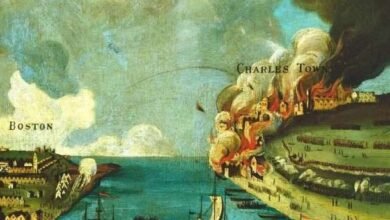
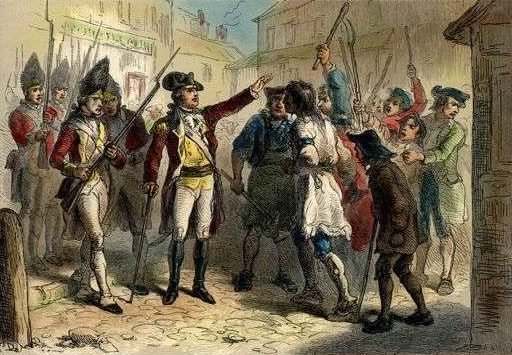
Illustrations, from above: Engraving of John Lamb of the Sons of Liberty reading the Tea Act to a crowd in New York City; engraving “Governor Tryon and the Regulators” engraving by A. Bollet Company (University of North Carolina at Chapel Hill Library); and a map showing New York during the American Revolution.
Source link