 With the 19th Amendment offering greater rights for women, and the nation’s economy recovering from the First World War, the Roaring Twenties opened the door for young and old alike to shake off the Victorian Era restraints of the previous century. This was the era when women were “flappers,” and their men “sheiks.” It also gave rise to the speakeasy and to jazz. It was a time when numerous crazes, such as flagpole sitting and a dance called the Charleston, swept the country.
Another of these crazes was a secret society whose members went by the name of Shifters. The origin of this movement has never been discovered, with theories ranging from a prank by New York City high school girls to a marketing scheme by a novelty jewelry company.
In New York State the society was apparently first reported in late February of 1922, when the Ogdensburg Journal spoke with members on the campus of Clarkson College (now Clarkson University).
Calling it a “mystic order,” and rumored to be as old as the Garden of Eden, it had been brought into Potsdam by players from a visiting basketball team. With the
members unwilling to talk about the group, the only evidence of being a Shifter was a small brass paper clip marked “OK,” worn on the lapel. The reporter went on to commend Shifters for accepting men, women, and children of all walks of life into its ranks.
Around the same time that the Shifter movement started in Potsdam, members of the society began initiating high school students in Saratoga Springs. By the end of March, nearly every student in the school was said to be a full-fledged Shifter.
As a result the school principal met with the prominent students who were members and brought society activities to a halt. With the group disbanded, some students were finally willing to reveal that the society was a kind of pyramid scheme in which members earned rewards by bringing in new recruits.
Allegedly, it would start with a Shifter asking whether someone was a member. With the answer of “No,” the game would begin. The uninitiated are then told of this mysterious, secret society and invited to join.
The initiation was said to be simple: The Shifter had the recruit follow along as he raised his right hand over his head and placed his left hand over his heart. The right hand was then brought down and outward with fingers extended. This “secret” sign of the order was said to signify the society motto “Grab. Get something for nothing.”
The final step to becoming a Shifter happened when the recruit gives something to their introducer. Sometimes this is as little as a quarter, or whatever was on hand of value, candy, scarves, or any other small item. This giving to the one who initiated you into the society did not end with the initiation, as gifts might be demanded whenever the two met again.
With the initiation completed, the new Shifter was encouraged to bring others into the society, since anything they could get was theirs to keep.
Some of the young men and women who joined the Shifters would engage in what became reported as the “Shifter Walk,” which was described in this manner:
First, the left foot is slowly advanced, in a languishing manner, and at the same time, the right shoulder is slightly advanced. The second step is similar to the first, the right foot and left shoulder being advanced together. During the motion, the head is carried horizontally, first to the right and then to the left, the walk of the more advanced Shifter being made in a bored manner.
 The society has a reputation for promiscuity and skipping class. The resulting moral panic highlighted the darker side to the Shifter fad, one where members, especially women, were seen as acknowledging their willingness to participate in intimate contact with others.
Even some of the “lingo” that went with being a Shifter was slanted this way, with examples “Cash or Check,” and “Produce the Cash”, which was seen as asking for a kiss; “Check your Hat,” meaning “kiss you later,” and “Bank’s Closed,” being a refusal to kiss someone.
The greatest opposition to the Shifters came from the New York City-based Vacation Association, which had been established to provide access to low-cost vacation opportunities for working women. With the shifter craze, this group said they saw a marked decline in the savings collected from the workers they supported.
In the New York Morning Telegraph of March 24, 1922, the association put out this pronouncement against the Shifters:
“Since the Shifter Society has passed from the status of harmless fad to that of dangerous craze, we seriously want to urge that all self-respecting women, boys, and girls recognize just where this organization belongs, in the category of senseless, useless, and harmful pastimes.”
Businesses were quick to capitalize on the rapid growth of the Shifter movement, with Shifter products hitting the market only weeks after phenomenon began.
One of these companies was the Franklin Simon Company on Fifth Avenue in New York City. A large advertisement in the New York Evening World promoted their Shifter Hat with a prominent place for the society clip, asking the reader, “Are You a Shifter? It’s the Smartest Thing Be!”
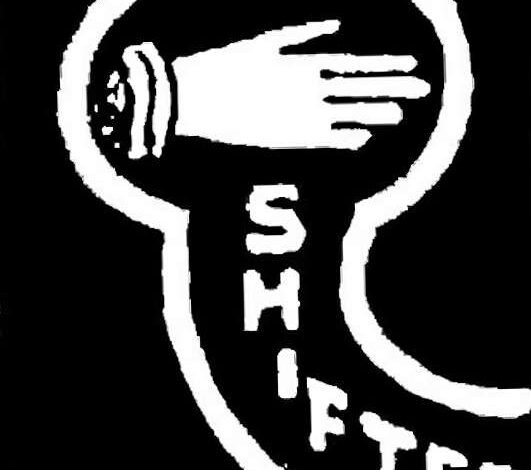
On an even larger scale, the Kestenman Brothers Manufacturing Company mass-produced pins featuring a distinctive extended-hand logo. Soon, marketing themselves as the unofficial Shifter headquarters, they published the society rules, “The Shifters are an Organization of Brotherly and Sisterly Love.”
These bylaws encouraged members to be “a good fellow or sister,” and “help other shifters at all times.” Next, both the secret handshake and the password were said to be revealed. Open palms passed close together, then the hand placed in the pocket, followed by the saying, “Be a Good Fellow, Get something for Nothing.”
The password? “I Have Paid my Checks.”
The Shifters died out quickly, and by the fall of 1922, only small pockets of this craze still survived. One of these was Jamestown High School on the western edge of New York State, where over 1,000 students were believed to have joined the society in October. The craze was quickly dissolved when the principal called the sophomore class together and censured their behavior.
With the 1929 stock market crash and the Great Depression that followed, money to pay for the lavish Roaring Twenties lifestyle dried up, and the Flapper era with its short-lived Shifters Society came to a close.
Read more about Pop Culture History in New York State.
Illustrations, from above: A Shifter logo; and OK Paper Fasteners – the pin of the 1920s Shifters fad.
Source link