After two full sessions on the power of rage and resilience, poetry and dreams, the group split off on two adventures. We were given the choice to attend the open studio at the Art Lab or to visit Popham Beach State Park. As a water sign, I will always choose the beach. Popham Beach State Park was like a visit to another world. Equipped with an assortment of umbrellas, rain jackets, and the wrong footwear, our group began the endless walk towards the water’s edge. Because we’d arrived at low tide, the waves felt miles away from the shoreline. We all left soaked, exhausted, and feeling fully alive.
Day Three: Exploring Floating Times and Lineages
On our third day, we expanded our circle by joining a group of students at the Seguinland Institute. Walking across the bridge to the Institute, Samaa pointed out plant allies along the path to those of us who lingered at the bottom of the line. She handed some of us mallow and encouraged us to crush the plant between our fingers so that we could savor the sweet fragrance. With the plant still in my pocket, I followed the group up the stairs of a large treehouse, where we were met by twenty plus young folks on a gap year, exploring what it means to live the good life.
Now that our group doubled in size, we introduced ourselves with a theatre exercise led by Nick, where we made eye contact and orbited each other in greeting. Next, we were split into small groups of Seguinland students and MicroCosmos participants and assigned various meeting points along the campus. My group gathered in a clearing by the marsh next to a statue of a crow. Our four hosts shared creative projects they’ve been working on with us, ranging from a personal manifesto, poetry, a comic, and a visual collage. Each student asked us questions about our creative practices, our communities, and our dreams for our futures. The conversation covered a range of topics, including Braiding Sweetgrass, the local clam industry’s impact on the ecosystem, Zen Buddhism, making altars out of public art, and the vulnerability of sharing art. After a nourishing vegan meal of red curry and more informal conversation, we headed back to the Annex to continue our sessions.
Session Three
Our third session included contributions from Nick Slie, paris cyan cian, Danielle Arroyo, and Eli Nixon. The conversation ranged from altars to grief; collaboration with land, coasts, and waterways; and exchanging linearity for primordial time.
Danielle describes themself as a disruptor and curse-breaker whose practice is deeply rooted in grief. After losing their mother to breast cancer, they began the heart healing work of making altars out of flowers and other natural materials and offering them back to the ocean at low tide. Danielle dreams of creating a sustainable cemetery with a grief garden.
As a clown and puppeteer, Eli makes work rooted in challenging our relationship to colonial time toward a resourcing relationship with primordial futurism. This has been at the center of their work paying homage to horseshoe crabs through writing and illustrating a book that proposes a new floating holiday called BLOODTIDE. Eli shared about their recent project to amplify public health concerns and coastal access needs along the port of Providence via ancient technologies of wind, shade, and gargoyles. How do we generate land return, reparation, and ecologies of repair to bring intergenerational normalcy to being in service to the land, especially in sites of active destruction?
Growing up in New Orleans’s Ninth Ward, paris has been shaped by change and impermanence of home. As a dancer, her practice focuses on memory and rememory. Working in the legacy of Black feminist writers and land artists like Zora Neale Hurston and Beverly Buchanan, paris has been drawn to collaboration with the oyster, which has ultimately led her into collaboration with the shoreline of the Gulf Coast. In a deep practice of devotion, paris has been building a wearable oyster reef that can be worn and processed into the water in the asymptotic act of re-sourcing a New Orleans shoreline.
As a tenth-generation Southern Louisianan, Nick’s work has been shaped by the question of his relationship to the water. For twenty years, the work of Mondo Bizzaro has been about land and coastal loss, including large-scale outdoor performances. Their ongoing project, Invisible Rivers, is a floating performance in honor of floating communities, rooted in the knowledge that staying fixed is not the way. In Nick’s words, “When you move like the flood, everything moves with you.”
Session Four
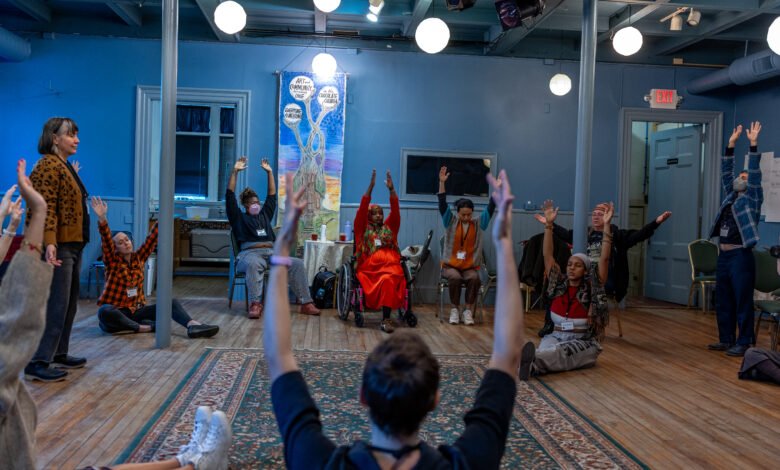
By now, the synergy between each session felt palpable—it’s hard to describe how it felt in the room, but it had dawned on the group that we were all meant to be here, having these specific conversations. During the break, we made an altar to the ancestors in the middle of the room, and the rest of our conversations happened facing this altar. In the words of Marty Pottenger, “The ancestors have a bit of an attitude: thanks for making space for us, they’re sure lucky they invited us.” With that in mind, we began our fourth and final session, which included Marty, Matthew Glassman, Liza Bielby, me, and Sir Curtis Kirby. We spoke about offering reverence to chosen and biological families, lineages of artistic training and cultural traditions, and a deep devotion to study.
In a beautiful expression of vulnerability, Marty experimented with the form of the circle and called on Nick, javiera, and Matthew to each name something they appreciate about her work. What emerged was an organic conversation about the impact of her decades of making civic performance and centering community conflict and resolution. Nick shared the impact of City Water Tunnel #3 while javiera recalled Marty’s impact in creating work with faculty, students, and staff at Hampshire College while the university was in financial crisis. Matthew honored Marty’s ability to shapeshift through writing and ability to engage in deep dialogue with communities. Marty ended by stating that a civic arts practice, like her Portland, Maine project Art at Work, which uses arts to engage necessary dialogue with police and the public, is filled with “upset and possibility.”
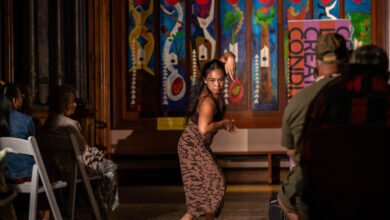
Kirby transformed the circle into a performance space, offering us a glimpse into his solo performance exploring his mixed identity as a Black Ojibwe man, his work with urban Native youth in Minneapolis, and coming into his craft as a director under the tutelage of his mentor Dipankar. “My people believe that we’re here because of seven generations before us and we do the work for seven generations to come.” In Kirby’s moving story, he spoke about how he was his grandfather’s dream, and how his Ojibwe name reflects his Eagle heart. The power of his storytelling stayed with me during our break as those of us gathered outside the Annex watched an eagle circling above our heads.
Liza spoke about the importance of lineage in her work as a co-founding member of the Hinterlands, a Detroit based theatre company whose work is rooted in play, placemaking, and irreverent possibility. As Liza reminded us, training is also a lineage. The Hinterlands’ last piece explored family stories, white identity, and grief through song. The power of song as an embodied methodology is that it allows things to move and pass through your body. And the company’s newest work is now moving towards technology, disenchantment, and grief.