 During the controversies over the enforcement of the Navigation Acts, the Sugar Act of 1764 and the Stamp Act of 1765, committees were created in New York to correspond with those of other colonies and to contrive means of opposing those measures. Similar committees were organized elsewhere.
The Townshend Acts of 1767 reawakened the disturbance occasioned by the Stamp Act and furnished a renewed occasion for protests through committees.
These Acts provided (1) that customs officers should be sent to America to collect the duties; (2) that new customs duties should be placed on glass, paints, tea etc.; (3) that writs of assistance were legal; and (4) that concessions to the East India Company should enable it to sell tea in America at a price low enough to drive out smuggled tea.
 Objection had been raised to the stamp duties because they were a direct tax. These new duties were an indirect tax, and the colonists themselves had admitted the legality of such a tax.
It was also proposed to pay the colonial crown officers out of these revenues and thus make them independent of the assemblies. Governor Henry Moore was the first royal governor of New York to be paid out of the imperial treasury.
Having won one victory over direct taxation as a result of the Stamp Act protests, the colonists now proceeded to fight the imposition of indirect taxes. In a circular letter to the other colonies in 1768, Massachusetts asked them to protest against the custom duties.
The Non-Importation Agreements
At a meeting of merchants in the city of New York on April 8, 1768 a committee was appointed to revive the non-importation agreement as the best means of securing the repeal of the Townshend Acts. The Sons of Liberty once more became active.
The Assembly protested against the new measures and thanked the merchants for their patriotic zeal. When goods arrived from England they were stored unopened.
Cadwallader Colden (1688-1776), who had served as the governor of New York in the 1760s, but was then serving as acting Governor, announced that the objectionable duties would probably be removed. When the Assembly voted money for the British troops, at a protest meeting of 400 people a committee of eight was appointed to carry the objections of the gathering to the city authorities and to the Assembly.
During the years 1769 and 1770 the city of New York had the reputation of standing firmly by its agreement to boycott all English goods. On March 13, 1769, a special committee was named to “inspect all European importations.”
The merchants of New York on May 30, 1770, resolved “That we will, to the Utmost of our Power, by all legal means, preserve the Nonimportation Agreement inviolate in the city and colony” until the objectionable duties were repealed. Upriver towns like Albany had their own local committees to communicate intelligence and to enforce the non-importation pledge.
On April 18, 1770, however, the Albany committee announced the intention to restrict the boycott to tea. Knowing that other colonies were not rigidly enforcing the non-importation compact, the New York Committee of Correspondence asked other cities to send delegates to a conference at Norwalk, Connecticut, on June 18, 1770, to formulate some general plan “for the benefit of the whole.”
When the other colonies refused to do so, sentiment in the city of New York was divided as to the course to follow. One group opposed separate observance of nonimportation; the other faction insisted on action without waiting for the other colonies to conform.
This latter group was defeated however in a vote taken in the city, when 3,000 persons voted to modify the nonimportation agreement and 1,154 to enforce it unchanged.
After this action was taken, neighboring colonies criticized New York. “You have certainly weakened the Union of the Colonies… and deserted the Cause of Liberty and your Country,” wrote the Philadelphia merchants.
Connecticut was surprised that the people who were first to sign the agreement should be the first to break it. During the years 1771 and 1772 conditions in New York were quiet and almost normal, and the committees became inactive.
Samuel Adams in a circular letter in 1772 urged the organization of local committees, and by January 1773, Massachusetts had eighty or more of these bodies. In 1773 the House of Burgesses of Virginia suggested the creation of a standing committee of correspondence.
The idea found a ready response and by 1774 every colony except Pennsylvania had its provincial committee.
The colony appointed a committee of 13 in the General Assembly of New York on January 20, 1774, which was directed to keep watch of the acts of parliament, to correspond with “our sister colonies,” and to report to the house.
New York’s Tea Party
 Meanwhile in the fall of 1773 the people of New York began to be agitated over the tea tax. Public thanks to the captains of London ships for refusing to accept consignments of tea for New York were printed in the newspapers on October 15th. Many of the rumors that tea ships were approaching kept the people stirred up.
Some of the patriots, organized as an unauthorized committee calling themselves “the Mohawks,” served notice in loyalist James Rivington‘s Gazette, on December 2nd that they were “prepared to pay an unwelcome visit” to any persons arriving with the forbidden tea.
The Sons of Liberty circulated an “association” pledge which was generally signed not to buy, sell or use tea. The governor’s Council on December 1st decided to store any tea that might arrive in the fort or lower barracks. The “Liberty Boys” immediately protested against such action.
On December 6th Henry White, Abraham Lott and Benjamin Booth were appointed agents for the sale of the tea of the East India Company. They declared, however, that they would not receive the tea and suggested that it be stored until its disposition was decided.
 Governor William Tryon at the same time announced that he would not use force to compel the people to accept the tea. Meanwhile before news of the “Boston Tea Party” on December 16th had been received, there was organized on December 17th, the Committee of 15 in New York City to correspond with other colonies concerning the detested herb. A meeting of 1,000 citizens expressed their opposition to the landing of tea.
As the opening days of 1774 passed with constant rumors of the shipment of tea, the people were in a continual state of emotion. The press bubbled with news, the patriots boiled with indignation and the Sons of Liberty once more assumed leadership.
On March 14, 1774, they were ordered to meet every Thursday until the tea ship “arrives and departs.” Four days later they celebrated the anniversary of the repeal of the Stamp Act — a ceremony which had occurred annually since 1768. The tea pledge continued to be signed.
At last on April 18, 1774, a broadside announced that the ship Nancy had arrived off Sandy Hook. Captain Lockyer was told that the people were resolved not to permit the tea to be landed. After several days of excited bickering the ship was sent back to England.
Another ship in command of Captain James Chambers was boarded by the “Mohawks” on April 22nd at 8 pm and 18 cases of tea were dumped into the water. This was “New York’s Tea Party,” one of more than a dozen similar protests which have been largely overlooked by historians.
Committees of Action
The controversy over the tea ships developed a new phase of the committee system. To meet the emergency a Committee of 51 was chosen on May 16, 1774, by the people in the city of New York, “to correspond with the neighboring colonies on the important crisis.”
This committee was the first body in the colony definitely organized for action, as distinguished from correspondence and measures of nonresistance against those measures which precipitated the Revolution and to its suggestion the Continental Congress owed its origin.
New York having just heard from the express rider Paul Revere on May 17th that Boston‘s port would be closed as a penalty for destroying tea, was greatly alarmed by the news, and urged the renewal of the severance of all trade relations with Great Britain.
A committee of the Sons of Liberty immediately offered their aid to Boston. After the Boston Port Act went into effect, which was on June 1st, effigies of four of the authors of the measure hanging by the neck were carried through the streets of the city of New York in protest.
 On May 23d the Committee of 51 urged upon the other colonies the assembling of an inter-colonial congress without delay. A month later the Assembly’s committee of correspondence approved the call.
On July 4th the Committee of 51 selected the names of five men to be submitted to the freeholders for approval at the polls. Philip Livingston, John Alsop, Isaac Sears, James Duane and John Jay were elected.
Various localities of the province now began to organize committees. On August 27, 1774, the Palatine district of Tryon County out on the frontier, met at Stone Arabia in the upper Mohawk Valley and organized a committee of safety, which was the basis for a county committee.
Albany had a committee as early as September 1774. No doubt other sections of the province followed these examples.
The First Continental Congress of September 5, 1774, was regarded as a great national committee to safeguard “the rights and liberties of the colonies.” It asked every county, district and town to organize a committee and thus seemed to give a legal sanction to these revolutionary bodies.
The New York Provincial Congress on May 26, 1775, appointed a “standing committee of correspondence” and the next day ordered all the counties to name committees for the counties, towns and districts to have the “general association” signed, in order to execute the orders of the Continental Congress.
Every citizen was to be invited to sign the “articles of association” and by July 1775, all the non-signers were to be reported to the Provincial Congress.
Read more about New York’s Revolutionary War Committee System.
This essay is drawn, with minor editing for clarity, from Peter Nelson’s “The American Revolution in New York; its political, social and economic significance. For general use as part of the program of the Executive committee on the one hundred and fiftieth anniversary of the American revolution,” published by the University of the State of New York’s Division of Archives and History in 1926.
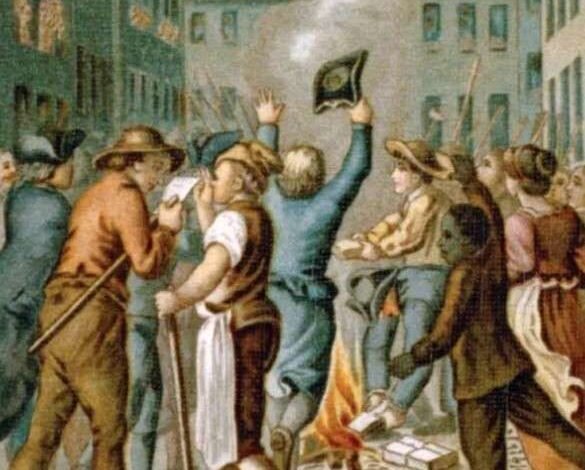
Illustrations, from above: A later illustration of The Sons of Liberty burning a copy of the Stamp Act in 1765; “An Emblem of the Effects of the fatal STAMP,” a warning against the Stamp Act published in the Pennsylvania Journal, October 1765 (New York Public Library); “Destruction of tea at Boston Harbor,” Currier & Ives, hand-colored lithograph, 1846; An invitation to the first New York Tea Party, April 21, 1774, from The American Revolution in New York (1926); and a map of New York State 1775-1783.
Source link