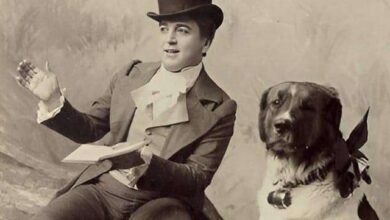
 Henry Davis Minot was born near Forest Hills (part of the Jamaica Plain neighborhood of Boston) in 1859, the sixth of seven children of William and Katharine Maria Sedgwick Minot.
He took an early interest in ornithology (the study of birds), recording careful observations, including, at the age of 11, what he believed to be a new species of bird in 1871 (it turned out not to be the case).
In 1876 Minot entered Harvard University where he befriended fellow ornithological enthusiast Theodore Roosevelt. Throughout their friendship, the two exchanged letters and went on birding expeditions to collect birds and eggs.
These included an expedition to the northern Adirondacks in 1877. Roosevelt used this expedition and two others to write The Summer Birds of the Adirondacks in Franklin County, NY at the age of 19. The 97-bird catalog was based on observations near the Saint Regis Lakes.
(This was near Spitfire, and Upper and Lower St. Regis Lakes, now part of the St. Regis Canoe Area, New York State’s only designated Canoe Area, and one of the largest wilderness canoe area in America.)

During the Adirondack expedition Minot caught and preserved a Blackburnian Warbler (Dendroica Fusca). The preserved relics were placed in Minot’s personal papers and were found by an Massachusetts Historical Society archivist when the collection was processed.
Minot left Harvard in his sophomore year, confiding to Roosevelt that his decision was due in part to the student body’s lack of morality. After leaving the University he entered the railroad industry, but never left behind his interest in ornithology.
(Minot served as a director of the Great Northern Railroad, and later President of Minnesota’s Eastern Railroad into Superior, Wisconsin, to company-owned local steamships and streetcars. The city of Minot, North Dakota, was named in his honor.)
Throughout his travels to Mexico, England and Scotland, and the American Midwest, he kept counts of the birds he saw and made observations of species that were new to him.
He wrote multiple books and essays on birds, including Land-Birds and Game-Birds of New England (in 1877 when Minot was just 17), Notes on Colorado Birds (1880), and New England Bird Life (1881).
Diary of a Bird
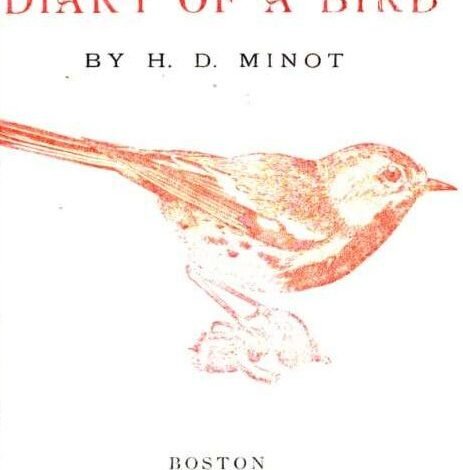
In 1880, Minot became not just an observer of birds, but an advocate for them with the publication of Diary of a Bird, Freely Translated into Human Language.
In this short publication, Minot acts as “translator” for a black-throated green warbler who has kept a diary “for the purpose of amusing, instructing, and enlightening mankind,” even though the diarist claims he does not approve of the practice of diary-keeping amongst birds.
 The diarist does not have a name, reporting that “in a bird-community, every member is expected to know his own mate and children; beyond that, we make no distinctions.”
“I myself, for instance, have no individual name, and am very well content,” our avian narrator says “for among us are no rights of property and inheritance, no law-suits, no marriage-ceremonies; but each of us lives for himself.”
The warbler writes of the end of his migration from southern Mexico to the White Mountains of New Hampshire, his mate’s efforts to build a nest and sit on their eggs, a run-in he has with a birder, and the activities of raising his family.
Our feathered diarist often makes use of turns of phrase used only by birds. For instance, he describes a lake “as long as the flight of a heron with thirty or more wing-beats.” Minot helpfully explains that 30 heron wing-beats is about 500 feet.
A Meeting of the Birds
The major event of the diary is a meeting in early September of all of the birds of Massachusetts, organized to discuss “The Destruction and Extermination of Birds; how caused and how to be prevented.”
The meeting, held in the middle of the woods to avoid notice by humans, is attended by all types of birds, leaving our warbler amazed at the sight of so many feathered friends. During the meeting, various species of birds describe their greatest threat.
It is widely agreed that humans, with their traps, guns, nets, light-houses, clear-cutting, and domesticated cats, are the most dangerous threat to birds.
“Men seem not only for the most part to have lost all appreciation of Nature, the best source of health and pleasure,” the diarist writes. “but to be so utterly improvident as not to appreciate the mischief they are doing to themselves, or at least to their young, in deforesting the country.
“Their depravity is melancholy. Can’t they live without disturbing Nature, just as birds do? I can’t understand why they should ruin large tracts of country, as they often do, and then, instead of using them, leave them covered with pine-stumps, and bushes or stunted saplings.”
 As the warbler is speaking out against the use of birds in human fashions, the meeting is interrupted by the foe himself: a man with a gun, intent on shooting our diarist and his friends. I’ll leave it to you to discover what happens.
In a letter to John Burroughs on March 20, 1880, Minot writes that the Diary was “a serious appeal for wiser thought and stronger action in the matter of protection of our birds.”
He sent copies of the book to naturalists and it received praise and statements of hope for the future from some of them.
Naturalist Samuel Lockwood wrote back: “This plea is very prettily put; and most heartily do I wish it God’s speed… I love the birds, and cannot shoot them… Would that your little Warbler’s life story might still many a gun.”
Sadly, Minot died in a train collision in Pennsylvania in 1890 at the age of 31.
He never saw the conservation efforts of the Massachusetts Audubon Society, which was founded in 1896 by Harriet Hemenway (1858-1960) and Minna B. Hall (1859-1951), two Boston women who used their social standing to save birds by persuading other upper-class women to abandon the fashion of wearing feathers.
I like to think that he would have appreciated and supported their cause.
If you would like to learn more about Minot’s (and by extension Roosevelt’s) ornithological pursuits, the history of the Audubon Society of Massachusetts, or consult the personal papers of other Massachusetts ornithologists, consider visiting the Massachusetts Historical Society Library and viewing the papers of Allen H. Morgan (1923-1990), which contain many of their letters.
A version of this essay by Hannah Elder, Associate Reference Librarian for Rights and Reproductions at the Massachusetts Historical Society, first appeared in The Beehive, the Society’s online blog; John Warren also contributed.
Illustrations, from above: Portrait of Henry Davis Minot, circa 1880-90; The Blackburnian Warbler, described as “Ornithological relics of my Adirondack Excursion with Theodore Roosevelt, June 1877,” (Henry Davis Minot Collection); the cover of Minot’s, Diary of a Bird, Freely Translated into Human Language (1880); and John N Hyde’s “The cruelties of Fashion; Fine Feathers Make Fine Birds” (Frank Leslie’s Illustrated Newspaper, November 10, 1883).
Read more about birding in New York.
Source link