Chorus of Voices: Gender euphoria is bliss. Freedom to experience masculinity, femininity, and everything in between. Getting to show up as your own self. Gender euphoria is opening the door to your body and being home. Unabashed bliss. You can feel it. You can feel the relief. Feel safe. And the sense of validation and actualization. Or sometimes it means being confident in who you are. But also to see yourself reflected back. Or maybe not, but being excited to find out.
Nicolas Shannon Savard: Hello and welcome to Gender Euphoria: The Podcast, a series produced for HowlRound Theatre Commons, a free and open platform for theatremakers worldwide. I’m your host, Nicolas Shannon Savard. My pronouns are they, them, and theirs.
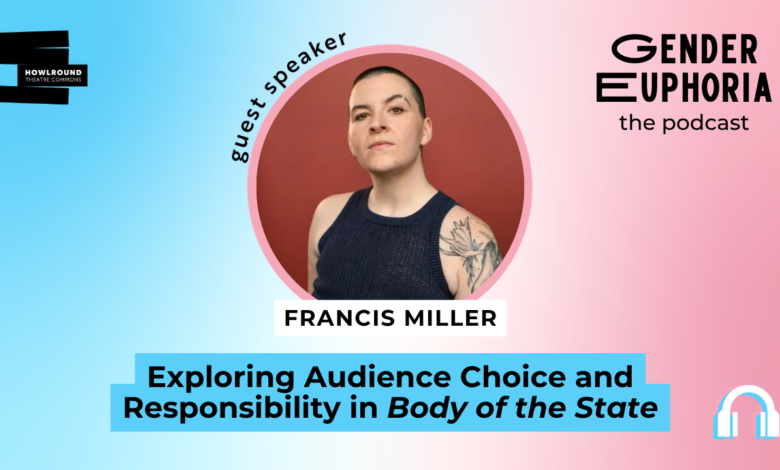
I am here today talking to solo performer and fellow Ohio State Theatre grad, Francis Miller. We are talking about their show Body of the State today. Before we dive all the way into that, Francis, I want to give you a chance to introduce yourself. Who are you? Where are you calling from? A little bit about you as an artist.
Francis Miller: Yeah, thank you so much. Thank you for having me. So my name is Francis. My pronouns are they/them. I’m currently calling from Chicago, Illinois. I’ve been based in Chicago for a little while. I guess for a good long while. With a brief sojourn to Columbus for my graduate degree. But before that, Chicago. I’m a solo performer. I’m an actor. I’m a theatre educator and a theatremaker. I learned a really long time ago to try and be like a theatrical Swiss Army knife. I really want to try and do as much and as many different kinds of things in the theatre as I can. And that has become very useful in trying to become a solo performer and being a solo performer.
Nicolas: Swiss Army knife of the theatre. I’ve not heard the phrase before, but it’s just such a perfect description of so many fellow theatremakers I know who are doing fabulous work. So we’re talking about Body of the State today. Just to give a little bit of introduction for the audience. How do you describe this show?
Francis: All right. So Body of the State is a solo performance work. I wrote it. I produced it. I perform it. Body of the State, it’s a piece that I started again working on in my graduate program. It was part of my graduate capstone thesis. But it’s really become something completely different and much larger than I ever thought it could kind of be. It’s a play about my own experience in attempting to get gender-affirming care. And also the experience of many people in my community. It is an incredibly involved play where a lot of audience participation is required. It’s honestly begged from me to the audience. I really need their help for this thing to work. It is a really physically grueling play to perform. It is an endurance-based work. And I get to perform the whole thing with my shirt off, which is a huge bonus.
Nicolas: Nice. Nice. When I came across your work on the show, I saw an immediate connection to one of the major through-lines for the season, which one of the questions I’m asking is: How are trans artists working in politically hostile environments responding to what’s going on? How are we finding modes of resistance, solidarity, queer community building?
Could you talk a little bit about your process developing and, it sounds like quite a bit, growing Body of the State through that lens?
Francis: Yeah. Oh, yeah. Okay. I have a lot to say about this. All right. So I started just working on this thing in my graduate program. And it started as like three different plays. So I was working on this other play, The Botanist. And it was great and really fun to do. It was really hard to do. I performed most of it on a rolling chair. It was a piece of solo sci-fi work about being, like, ejected from a spaceship and a metaphor of, like, queer exodus from conservative and rural states. And I was really noodling on that. And I wanted to expand it into a larger piece for my senior capstone for my MFA. And so I was working on it. I was trying to make it like a triptych, like three different pieces all together that I was calling Station Tower Cave. And like it was, part of it was going to be in a firewatch tower and some in a cave. And I was really kind of trying to noodle on it for a while. But I kept getting distracted because while I was working on this piece, I had started the process of getting top surgery.
And I quickly realized that the only thing I could think about was getting top surgery. Every thought that I had was like a sub thought of getting surgery. And so I couldn’t really focus or care about Station Tower Cave. And I did love it. I still love it. I really want to do it. But I was just so distracted.
One of the good things about academia is that you have deadlines. And so I had like some deadlines I had to meet. And one of the deadlines was like this big, this pitch. I had to write like a big pitch for this project. And my instructors had been like, I’ve been talking to them about Station Tower Cave. And I completely pivoted. And I pitched them a play that at the time was called Tran of the People. And it was—the title is garbage, obviously. Tran of the People is gobbledygook. But the concept from my original pitch has remained the same. And it’s been now almost two and a half years. It then became Body of the State.
I wanted to try and make like, try and utilize live research of my own experience while I’m getting surgery, using like my immediate reactions of how am I feeling right now? What I want to write, what I want to talk about? How do I, what is going on in my world trying to qualify for these surgeries? And why? And also, like not only trying to qualify personally, but also paying attention to what’s going on in the world.
Now, constantly inundated by the terror, you know. You know the terror, the fear?
Nicolas: I am familiar with the terror! Deeply familiar.
Francis: Yeah! Like, I’m like, living in this terror, in this fear, and I know I’m not alone. And so I’m like, “Okay, I just, I guess I just have to make something about it.” And I learned that I really like working in short form. So I like making small things, small plays. So what it ended up being, that first iteration, was like eight small plays, or like four plays and two songs, that audience members would choose from for me to perform based on some different kind of mechanics. And the mechanism, that basic structure, has held and has allowed me to continually work on and react to it and add to it. Since there’s no, like, central plot for it to hang together, I don’t have to try and worry about things breaking. I can just, you know, now, add and subtract whatever feels right.
Nicolas: Can you talk a little bit about what those eight… ten? … eight plays are?
Francis: Yeah. Yeah, I super can. So the play is built into—now, it’s built into five portions. The portions all have titles. And the titles are “Make Me Choose,” “Make Me Move,” “Make Me Suffer,” “Make Me Speak,” and “Make Me Sing.”
And in each of those five categories, audience members can choose one of two plays for me to perform in each category, based on a ballot that I make them fill out when they come into the space. So for “Make Me Choose,” they have to choose either “Boy” or “Girl.” And I don’t give any more information than “make me choose: boy or girl.” And I’m a trans nonbinary person.
And so “Boy”—the piece “Boy” was the very first thing I ever wrote for this play. It’s still one of my favorite things to do in this play. But I immediately make audiences choose “Boy” or “Girl.” Just make a choice. All the titles within these little categories, “Make Me Choose,” “Make Me Move,” “Make Me Suffer,” etc. They’re like partners with each other. They’re not binary choice, obviously, or they’re not necessarily at least. We’ve got “Boy” and “Girl.” I have a “Morning and Evening.” I have “Output” and “Intake.” I have “Whereas” and “Therefore,” and “Stranger” and “Sweet.” So the choices can feel a little abstract because they super are. They’re titles that I gave to pieces that I wrote. And some of them are, they do match and partner with one another and talk—the pieces talk to each other, even if you only get to see one. So if you choose “Girl,” you don’t get to see “Boy” at that performance. If you choose “Whereas,” you don’t get to see “Therefore.” Because of that, every time you go, it’s a pretty unique experience. You kind of build your own, build your own Body of the State.
Nicolas: Tell me a little bit more about what you’re up to with making the audience choose and giving them that power over how the performance unfolds.
Francis: Yeah, okay. That’s a great question. So when I first started working on this thing, I was, I was, and I mean, I still am… But my very first impulse in writing this play was that I was incredibly angry. I was hurt and frightened, of course, but I was, I was… Anger has a lot of action in it. It’s hard to sustain over long periods of time, but it has a lot of forward momentum. So I was really angry. And my thought was, people just want to vote on what I can do with my body anyway. So I’m just going to let them do that. I’m going to empower my audience to choose what I get to do with my body every night.
So when audiences come in, and they receive their ballots, they’re often a little uncomfortable. The ballot is, it’s cute little card stock. It’s smaller than a postcard. I give them a little golf pencil. This little sign by the door that says, take a ballot and cast your vote. And I later collect the ballots in the introduction. And the introduction is very warm and fun and friendly. And I really want audiences to feel welcome because we are doing this thing together. But my initial impulse was really, gosh, I hesitate to use like the word aggressive, but it really was. I kind of wanted to punish my audience, which is not a helpful place to be. Like you want your audience to be with you a little bit. And of course, not all theatre should be like completely audience friendly, but people should feel like they are good to be there.
And like the performer doesn’t want to like bite their head off, you know, and that was the direction I was going. And I was really like, “You want to control me so bad? Control me.” And that initial impulse, luckily, led to this really cool ballot and this idea of control, of audience control. Because of that, because audiences have this control, it’s, it allows for, they immediately have an opinion as they come in. They’re like, do I want to do “Boy” or “Girl”? They look at the heading of “Make Me Suffer,” and they’re like, “I don’t want to. I don’t want to do either of those. I don’t want to do the suffer section.” Like, you will have to. The play breaks if you don’t choose one.
So yeah, the initial impulse was really, oh man, it was really intense. It’s absolutely softened because I’ve learned a lot from it. I’ve like made these—I initially made these proposals to my audience about like, “Well, you’re so ready and excited to see me hurt. So watch me hurt.” And that wasn’t very great for my audience, but they often would then propose something back that really enlightened and made me see these choices in like a new, and I guess a little gentler light.
Nicolas: I’m intrigued. Can you give an example of one of those?
Francis: Yeah, absolutely. And I’m glad you’re intrigued because I certainly baited you.
Nicolas: You did, you did it so well.
Francis: Thank you, I’m a professional storyteller. There were these two impulses that came to my mind immediately when I was feeling so hurt and so angry and so frightened, right at like trying to get surgery. All of these things are happening, right? These two impulses, one was this ballot.
The next impulse was that I really wanted to shake the hand and make eye contact with every single person in my audience. The impulse was, I wanted to punish my audience a little bit. I wanted to be like, look me in the eye and see that I’m here with you. I was feeling a little immature about all of it. I wanted to confront my audience.
I felt… I was feeling very attacked and very vulnerable by the world at the time. I thought that my audience needed to receive that ire. Obviously they didn’t. They wanted to see my play. So I, this impulse that I tried, I tested it, right? I tested the crap out of this play because it was like, I needed to see if it was going to work. So the initial proposal, and this has also stuck, before the play begins, I do my introduction and I walk up to audience members. And as I shake their hand, I say, “Thank you so much for this opportunity. I am so grateful.”
And the first time I did it, I, before I even started speaking to the first person, I touched their hand and we made eye contact. And I realized that I wasn’t angry at them. I really wasn’t. And when I said, “Thank you so much for this opportunity, I’m so grateful.” I really meant it. I was really glad that they were there and that they had come to be a test audience. So I did want to thank my students for being there.
And so I started with that impulse and I, honestly, it never ever landed the way that I thought it was ever going to land. And it became, that little portion became, I think, almost like the heart of the play. I like doing this for a really intimate crowd. So I’ll, I take the time. Sometimes it takes a little while, but I shake everyone’s hand. I move through the whole audience and we make eye contact. I say, “Thank you so much for this opportunity. I’m so grateful.” And we move on. And then after seeing how moving it was at the top, I then decided to add at the very end of the play as well. So I do it at the very beginning. And after I’ve done all of these pieces, I’ve done all five sections. We, at that point, we’ve kind of been through a lot together, me and the audience. I go back through in the exact same order. I shake everyone’s hand again. I say, “Thank you so much for this opportunity. I’m so grateful.”
And by then audiences are different. We’re both, we’re both kind of different. We’re all different. And sometimes I stand and I hold people’s hands for minutes because they don’t, we don’t, want to leave each other. And I was, I’m still honestly. Honestly, I’m, I’m, I’m moved right now. It still has been a, I think the biggest surprise in working on and producing this play. And I think it really speaks to like trusting and wanting to seek community in audiences, not just in content and on stage.
Nicolas: You’ve performed this in a few different places. How have audiences responded? Did that change across the different contexts that you performed in?
Francis: By and large, audiences have been incredibly supportive. Because I’ve been touring this a bit and I’ve brought this to some different venues, and because of the person that I am, I have made some choices to go where I’m wanted right now. I’m going where I’m wanted. I’m going where I’m safe. It’s a play in which I’m performing with my shirt off, and I’m doing some real vulnerable acts. So I am, I am performing on like, not necessarily like home turf, but audiences that are already a little warm.
Nicolas: Could you name drop real quick? Where, where are the places that you have performed?
Francis: Yes. Yeah. Okay. So I, I performed, the very first performance was at, it was my MFA solo festival. And then from there, I had like a series of small workshops. I worked with Ohio State University’s student organization, the black box theatre. And that was like the next official iteration of it. Gosh, it had, I had added like half as much time onto it. It just exponentially grew every time that I did it up to a certain point.
Oh man, I completely, I almost forgot this! I did this incredible, insane thing on a whim—kind of on a whim—before I even did this black box thing. I decided that I was going to try and do this play ten times in two days.
I booked like the back room of a bar here in Chicago. It was the same place me and my wife got married. The play at that point was twenty minutes. It was a twenty minute play. It was still an endurance-based play. So it was physically grueling and exhausting and emotionally, it still is, all of this, emotionally exhausting and physically exhausting. But I was like, okay, this is a great opportunity to get a lot of reps in. I can, because a lot of, I love to work in repetition. It’s a huge backbone to where I come back to always is like, how can I repeat this and change it? So I’m like, if I do it ten times in two days, I can not only explore repetition, but I can also explore endurance.
So if like the, I wanted to know the difference. It was, it’s not, it wasn’t, and it isn’t very important to me for audience continuity for like an audience who sees one performance, sees the same performance later. I’m not very interested in that. I don’t know if that’s a controversial opinion. I don’t really care, but I was really interested in like, okay, what is it going to be like for myself and for audiences to see the first performance, the fourth performance, the seventh performance, and the tenth performance? I had set up that I was doing every hour on the hour for four hours straight, two days in a row. So I would just start it, do it, end it. And I was in a bar. So I would just like, chill, I’d sit down and talk to my audience. And then I’d be like, okay, well, I guess I got to get back up. I’d go, “Do you guys want to see it again?” And they’d be like, “Yeah, yeah, yeah!” So I just get back up and I do another iteration. And then I’d sit down and I’d talk and I’d do it again. I’d get back up and I’d do it again. And I’d get back up and I’d do it again. And I’d get back up and do it again. And I learned so much, and I really wore myself out.
But I—the play kind of exploded after that. That’s how all of a sudden I had all of this information about what I wanted it to be or, more importantly, what it could be. I realized that it was not a twenty minute solo piece. It was absolutely, I think it’s about, it’s forty-five minutes now. I love this length. I think it’s an appropriate length. It is a little grueling. I think it’s, I think this is a fair length to ask myself and of audiences. So I did this ten times in two days. God, I can’t believe I almost forgot about that. That was so spectacular. And honestly, so gutsy, so gutsy of me. I’m so proud of that.
The ten times in two days. I went back to the student organization. I shared what I’d learned that summer. And then I, man, oh gosh, I did it… Where else did I take it? Wow. Holy moly. I did it at the Great Lakes Michael Chekhov Consortium in Kent, Ohio. Shout out to Great Lakes Michael Chekhov Consortium. Best Michael Chekhov education that you can get in the Midwest. Love that group. If you’re listening to this, go sign up for it. Free plug. I’m not sponsored. I just love them so much.
Nicolas: Link will be in the transcript.
Francis: Please do. I love them. The work is incredible. I learned so much. Good people, real good people, incredibly inclusive environment. I have never felt more welcome in an educational setting. But I did it at the Great Lakes Michael Chekhov Consortium with educators and students. I mean, man, I just love that. That was so fun. And I learned so much.
And I then did a short, I did a residency. I was invited to do an artist residency at Grinnell College in Iowa by my dear friend, Karie Miller, no relation. And gosh, I did that at Grinnell. I loved Grinnell, loved performing it there. Around that time, I moved back to Chicago. I did it at Rhino Fest here in Chicago, which is a small fringe festival here in the city. I did it. Oh, man, where else I did it? I prepped. Yeah, I did Rhino Fest and then I did Grinnell. That was it. Whatever.
And then I just now got back from doing it at Denver Fringe. Yeah, I did it at Denver Fringe. Before that, I also did just a little tasting portion of a couple of pieces of by the state at with a company here in town called Stop Motion Plant. They let me do just a little tasting, a little teaser, which was really great and let me kind of brush the cobwebs off before I took it to Denver.
Yeah, so I’ve been able to hop around. I think one of the things I really enjoyed about doing it in all these different settings, because it has been like full production, full tech in some places and in some places, it’s like the back room of a bar where I’ve got my wonderful wife, who is a therapist, running the lights and like doing, or like no lights. Or no tech. I’ve done it outside. I do it in a gallery, in a bar, on a stage, in like a classical theatre setting.
The fact that this thing is so flexible has been incredibly useful to me because I can bring it anywhere I want. I built it this way too, is that there’s so little demand. There’s only some light cues in it and I don’t even need them. That it can be done wherever. Anytime that I got some space, I can do it. And because of that, it’s let me really kind of go wherever I want. It’s been great.
Nicolas: Built to travel.
Francis: For sure. The only thing, the whole thing fits in just like a little rolling suitcase, like a rolling suitcase, like a poster tube, because I do have my white butcher paper, which is my only set. It’s the only part that I’m like, that does need to stay. Everything else, I don’t really care about, but the butcher paper is important. So yeah, it’s all so compact. And it’s good to go. Body to State, always good to go.
My favorite audiences are university audiences and students. I’ve qualified this play before as an “educational play.” It doesn’t teach anything, I don’t think. But the way that students react has been so huge and has changed the play so much that I always get the most out of educational theatre environments. And the students often find some meaning, some really different kind of meaning that I often don’t find in fringe crowds or professional theatre going audiences. Which they’re like down—professional theatre audiences are like, “Yes, awesome, solo work, hell yeah!” But students are often sometimes seeing a solo performer for the first time, seeing content like this for the first time. I actually… It’s interesting because I have, even in these university settings, I have had students who are finding me as a queer elder, which is wild and incredibly meaningful, but finding me as a queer trans elder and finding a lot of safety in seeing the play and always wanting to talk after the play.
Audiences always want to talk after the play, which is great. I do a lot of talk backs, but I find like students who are effusive and warm and moved and tearful and just want to share and hold my hand for a long time at the end of the play. But I’ve also found some really large responses in sort of a different direction.
The one that jumps to mind is that I had a student at a university I visited. I had been really lucky to teach a couple of classes and be involved with some other stuff. But I knew him. We were kind of buddies. He was one of the many students that we were hanging out with, that I was hanging out with all week. But he saw Body of the State and that evening, he did my talk back and he was pretty clear that he did not like it. That evening, the play “Boy” had been picked and the boy, I call it the boy-track, or like there’s like a track. There’s several reprises of these early plays. And so we see Boy and then we see Boy as he’s a little older and then Boy as he’s a grown man, and we just kind of revisit the character as the play goes on. He made it clear that he did not like the play and that he disagreed with my assessment of boyhood and manhood.
And I found that to be incredibly meaningful because I wanted to know more. I want to know why. I’m like, yeah, man. Yeah, that’s great. I’m like, tell me every single thing about you, dude. Yeah. I was very lucky. The student was, he didn’t want to talk to me anymore, which was fine, but he talked to a friend of mine and my friend was able to talk to me a little bit about it and we were able to really kind of get to the heart of, and my friend was also able to really get to heart of what the student was getting at. But it really, it kind of like freaked his feet a bit. Kind of like broke his brain a little bit about like what the impact of art can do. How it can, like if a piece of art pisses you off, then the art has won. It’s doing its job, right? Yeah. Even if you don’t like it or if it’s bad art, if it pisses you off or if it does something to you, then it’s won.
Nicolas: Some really good art is going to break your brain a little bit.
Francis: Yeah. Sometimes it’s just going to make you mad or it’s just going to be like, I disagree with this. Like, great. You have an opinion. That’s awesome! And like that really wonderful student, I’m like, “Dude, you’re nineteen. You have a really strong opinion of this. I want to hear it.” So like, and like, I’m not getting that same sort of feedback often from professional theatre going crowds. And like professional theatre going crowds are so great, but the students, because they’re in an educational setting, are already, they’re already thinking like, “Okay, what am I looking at? How can I try and reflect upon this? What can I learn from this?” And that’s very exciting. It’s very exciting, especially in a piece like this, which is kind of constantly growing and changing. And I’m always looking like when I do that piece now, I think about that student and that he’s, he’s now in this play in my brain, which I don’t think that was his goal, but he got it. He got it.
Nicolas: Does the audience choose, make all five of their choices at the beginning or do they have to keep coming back and keep choosing?
Francis: So they have to make their choices all at the very beginning. Yeah, before the play even begins, before they see anything—except for me, they see me. I still have, I have my little costume. It’s like I still got my shirt on and all that they’ve seen so far is me and my only set piece, which is a big roll of white butcher paper down the center of the space. And I give my little intro. I have a spiel at the top about how the play works and to finish voting and that they should finish voting now.
I actually recently—I’d love to share this because I’m very proud of it, honestly. I recently added a mechanism to the very beginning of the play where… Traditionally and usually, I have audiences vote and then I collect the ballots and I have an audience member choose a ballot from like a fanned out, like deck of cards, pick-a-card-any-card-style, face down.
I do this because like counting ballots is a huge waste of time in our setting. I’d love to be able to do it democratically, but…
Nicolas: Ain’t nobody got time for that.
Francis: There’s no way. There’s no way! I tried it. No way.
Nicolas: Like in a fringe festival setting? Not happening. No way.
Francis: Are you kidding me? I can’t. No way. Who’s going to do that? No, no one wants to watch that. That’s boring. Uh, so I have them just, I usually have a fan out and they pick one. I’m like, “This is the ballot. This is the play we’re doing.” But recently I’ve added a mechanism where an audience member can purchase the play. And if you purchase the play—it’s one of the first things that they hear me say after a little brief introduction and “please finish voting.” I say, “If an audience member would like to purchase this play, if you purchase this play, then I will perform your ballot.” And I say, “I’ll perform your ballot. And I only take cash, but any amount will do.”
And I’ll tell you, since I added that mechanism, I think I’ve only had one performance where somebody did not buy the play. It’s effective. And because of me, pretty much immediately people go, “Oh, right.” So people, people have been buying the play. And then any piece of audience interaction past that, anything that I need assistance with or, um, any sort of audience involvement falls to the person who purchased the play. It’s their play.
Now, instead of it being like one person over here is going to help another person over here is going to help. Now it’s just your play. This is your play. You are the patron. You paid for it. So everything falls to you. Everything that happens to me tonight is because of you, which can feel a little complicated because some of the things I do, it looks, kind of looks and is a little painful, physically painful for me to do.
I do make them make all their choices really quickly. And that even includes like, “Oh, I want to, I want my ballot performed,” but then the, like the fallout from that can feel… Ooh, it can be really intense. And a lot of—sometimes people tell me like, “I didn’t quite know what I was getting into.” And I’m like, yeah, really, really, really makes you think, really thinks your thinker, don’t it?
Nicolas: I love that tension just between like, oh, make a quick fun choice. And now you are responsible for what happens in this play. And I’m going to keep coming back to you.
Francis: Yeah, it’s, it does. Cause at first it’s like, “Oh, this list of titles, this is interesting. I guess I’ll just pick some stuff.” And I really wanted it to—like, the ballot, the way that it’s built, it looks pretty official. I’ve tried to make it really look like a government document. I really wanted it to feel like voting, you know, when you go vote and you know some for sure. You’re like, I know the people that I have to vote for. And then you’re like, there’s ninety judges that I have to vote for. I guess I’ll just pick the ones that are in my party? Or I guess I’ll just, uh, I’ll pull up a guide somebody else has put together. That’ll work too. And I’m like, I’m not innocent in this either. Right? Voting is a really, really hard thing to do. On purpose. They’ve made it very hard. So I really wanted to mimic that to be like, you don’t know what you’re voting for, but you must vote. And the fallout can be painful to watch. And you may not know at all what you’re doing, but you did it. And now you have to pay for it.
Nicolas: I love it. I love it. It’s great. It’s so uncomfortable, and it’s great.
Francis: Thank you, I really appreciate that. Cause I want, I really love the tension of like, I want my audience to be with me and like having the, having the handshakes at the beginning. I call that section, “The Gratitudes.” Having “The Gratitudes” at the beginning and the end and having like this nice warm introduction—it’s not that I want audiences to feel taken off guard or like they’ve been tricked or deceived or misled. It’s not what I want. But I want them to feel like even if they regret their choice, or they do buy the play and they then have to watch me or are in control of whatever’s going on—I want them to feel like it’s still okay. That it’s okay, that I put myself in this position. I asked them to be here and that no one is being punished. Not me, not them.
Nicolas: You did write the play.
Francis: Yes, I did write the play. I did submit for Fringe Fest. I am here on purpose, and I asked you to do this. Even if it’s hard to do, it’s important to do.
Nicolas: You talked about the performance being physically grueling. I need to know what, what are you doing?
Francis: Yeah. So I have a couple of portions in this play where I recite some text that is part poetry, part prose. It’s very flowery and very, very nice to listen to. But as I’m reciting this text, I’m holding like a very strenuous yoga position. Like these positions that your yoga teacher is like, “And we’re just going to stay in this for five seconds.” And I’m there for minutes or several minutes. And it really constricts my breathing and it tightens and seizes muscles. And you can really see, audiences can really see, the effort that this takes.
I really wanted to, especially in those portions, because there’s some other physically grueling portions, but those portions, I’ve been really interested in like, although this text is very pleasant or very evocative, I wanted to really illustrate the strain, the toll and the pain that it takes to just kind of continue, to continue moving forward. I also have a couple of, I have a section which I originally wrote it. I mean, this is how writing goes, right? Where you write a thing and you’re like, yeah, this is going to be the bleeding heart of the play. And it was for a little while, but now it’s, now it’s a, it really feels more like an interlude. It really feels like it serves to like bridge a section. It’s just very interesting how it’s changed. But in that section, I am either repeatedly falling to the ground as if I’m being struck or I’m sliding backwards as if I’m being pursued. And I’ve learned now through trial and error that I, although I performed this play with my shirt off and I’ve just got like a pair of briefs, I do wear knee pads and elbow pads. I can’t not. I learned pretty quickly. I mean, I’m in my thirties now. God, I have to, especially if I’m going to keep doing it.
Nicolas: You know what? Picturing doing that every hour on the hour in the bar. Yeah. Knee pads.
Francis: I wasn’t even doing it with knee pads yet at that point. Oh, that next day I was like, I’m going to—
Nicolas: That is why now you are!
Francis: Yeah. See, that’s one of the things I learned. Like I, because at first I’m like, “No, audiences really need to see me hurting myself.” No, they don’t. They don’t. They need like—it’s enough to see the motion. It’s enough. There’s a, there’s a small portion of which I repeatedly like kneel and stand and kneel and stand. And I do that for a while and it’s exhausting and it’s near the end of the play too. So I’m like already pretty spent and I used to do it without knee pads and it sucked to do. It still really sucks to do.
Intimacy and fight choreographers really get this where it’s like, there’s a big difference between like theatrical danger and danger, danger. Where audiences were like, I could feel them cringing a little bit and I could feel them lean back just a hair when they could see me doing that. I could see, I felt like you could almost see their thoughts going, “Oh my God, their knees” instead of being like, “Oh my God, them. Oh God, Francis.” Instead of, “Oh my God, Francis’s knees.” So I didn’t… The move in this physically strenuous play to add protective, like, padding, it did end up being like, I just wanted to keep my audience in it a bit.
So even like an endurance-based play, a taxing toll play, I want to be able to continue doing it. And I want my audience to be able to continue watching it and—not have a good time. It’s hard to have a good time watching this play the whole time. Parts of it are very fun, but parts of it are not. But I want them to have an okay time. I don’t want them to be scared for me. Not like that.
Nicolas: You want them to be engaged enough to let it break their brain.
Francis: Yeah. Yeah. I want them to be able to like continually engage with the bigger picture and the larger questions. The bigger… I’m really compelled by the many metaphors that kind of drove this play. And I want the audience to be able to, to engage with those and not be distracted by the physical danger that could be present.
Nicolas: I feel like this is a really good lead into my next question, which is about sustainable performance.
Francis: Yeah.
Nicolas: Politically engaged solo performance—I’m also a solo performance artist who does things part autobiographically, part looking at the broader picture of what is happening with trans politics right now. And that asks a lot of us, keeping one foot in the creative realm, one foot navigating ongoing impact of policy and whatnot on us personally, and also a finger on the pulse of unfolding political situations.
So for you during the writing, rehearsal, production, touring process, what have you done to make staying engaged with this work sustainable for yourself? I’m asking for a friend. The friend is me. The friend is a hundred percent me, please help. So are there practices or strategies that you found especially helpful that you’d be willing to share and/or struggles with this? It’s hard.
Francis: It’s hard. Yeah. Of course. I mean, it’s super hard. Oh gosh, I hope this sounds the way I want it to sound. I think that we can continually assume the struggle and that it’s all a conversation about what can we do to like, not like muscle past it, but like continually view with hopes and wishes of a better world. Right? So, okay. So as far as I go…
Nicolas: The image that’s coming to mind for me is like, breathe through it.
Francis: Yeah. Breathe through it, breathe with it. Right. It’s like, it’s not going to change anytime soon, but we can, we can attempt forward momentum. Working on Body of the State, the fact that it came out of an educational setting, I’m super grateful for. The play wouldn’t exist without the assistance of academia, which pisses me off that I say that, but it’s true. I did not birth this fully formed with no backup or inertia. This was assisted by a structure of an institution. It was frustrating, but it’s true. But because it came from an institution, because it was at first an assignment, I had people around me that I was, I was kind of beholden to in this process. Not in the content and what I was making. That was luckily very flexible, but I had people that I owed some things to.
In particular, I realized really early that I owed this play to my trans and queer students. My very first test audiences were mostly my queer and trans students in the classes I was teaching. They weren’t getting credit. It was out of their own time that they came to help me. I just asked, and I’m certain that they came to help me because they liked me and because they were looking for some support and looking for some assistance in a queer elder. I learned from those young students and those young early audiences that I, that though this play was about me, and though I wrote it about me, and I wrote it about, that it was super not for me. That I was continually performing it, and I was experiencing my own catharsis and my own processing, and I was, and I am still constantly processing my own grief on stage. Which is really, really lucky is that I have this incredible outlet that I’ve built where I can process what’s happening all the time. I am, I do get to do that. But that’s not the point.
I feel very lucky that the point is that I can and get to do this for the queer and trans people in the audience. That, for me, has been a huge marker of sustainability. Because I’m a white person, because I’m a transmasculine person, I’m a nonbinary person, I often pass as just like a big lesbian. Because I have a lot of these markers of privilege, I can and owe it to audiences to continue. I’m robust enough, I can do it, and I want to do it, so I should do it.
And it also feels often like the only thing I can do. I can show up, I can continue doing this play, I can continually remind students, or young trans people, or old trans people, or anyone, queer people, honestly any audience member, I can show up for them. And I can continually revise the play for the same reason. I recently added a section, I recently added this section about purchasing the play, right? And every audience member understands and resonates with it really quickly.
I added recently a small section in which I confront an audience member about making a social media post. I say that their social media post has restricted their access to getting gender-affirming care. And that’s brand new, that’s brand new. And some audience members are really taken aback by that, and really moved by that. And if I’m continually responding to the world around me, and everyone else is also living in this same world, then we can all continue to have the conversation. I can do this, I can respond, I can keep working, so I should, and I want to.
That being said, there’s a limit. I want to continue to make the metaphors in Body of the State pretty obscure. I like it to feel pretty delicate, pretty deft, pretty easy. I’m not saying, I’m not mentioning names of people who were murdered. I’m not, I’m really not, I’m not calling anybody to the carpet anymore. I’m not confronting my audiences anymore. I’ve learned a lot. Also by inviting, allowing them to be in the space and inviting everyone in, it feels like a really warm experience. It really feels like we’re all together. And so it, although it is physically taxing, and it does, I sometimes will describe this play as, as that it hurts to do. Because it does, it hurts to do. It still feels so valuable. And that value is the thing that really continues to bring me forward.
Nicolas: I think to wrap us up, I’ve got a couple of questions that I ask of all Gender Euphoria: The Podcast guests. So first, I would like to invite you to give a shout out to a member of your queer trans artistic family tree, who’s someone that’s inspired you, supported you, showed a path to becoming the fabulous queer artist you are today. Helped you breathe through it and keep moving forward, even when it hurts.
Francis: Yeah, yeah, yeah, yeah. Okay, so I did mention her name earlier, but I do want to formally and officially mention my friend Karie Miller. Karie is also a graduate of The Ohio State University. You might have met them.
Nicolas: I know Karie!
Francis: Yes, I thought that you might!
Nicolas: Hi, Karie!
Francis: Karie’s the best. Hi, Karie. I love Karie. Karie is absolutely the best. Karie is formerly an instructor at Grinnell College in Iowa. I met Karie at, I mean, similarly, we had discussed that you left. I just missed you at Ohio State University. You had left, and I had just come in like two weeks later. Karie was the same sort of thing. Karie just whoop, gone. And it was like a year or something, but she was gone, and then I came in. I met Karie at the Great Lakes Michael Chekhov Consortium, and so like I’ve also, once again, shout out to that. Can’t talk enough, can’t say enough good stuff about them, but Karie saw… Not only was Karie and is Karie an incredibly dear friend and a super talented collaborator, they have a focus on hospitality and making spaces comfortable and warm and pleasant and welcoming. And I just admire them so much. I look up to them so much. I respect them so much. Karie saw me perform Body of the State at the Great Lakes Michael Chekhov Consortium and immediately was like, “I’m bringing you to the college. I’m bringing you immediately to the college.” And then you know what? And then she did. And then she did. She brought the show like six months later. It was huge. It was incredible. So shout out to Karie. Karie, I love you. Karie Miller, no relation. I love Karie so much. Yeah.
Nicolas: Karie is fantastic.
Francis: The best.
Nicolas: Just wonderful, wonderful collaborator, artist. She was my grad office mentor, informally, for a good long time.
Francis: Karie’s just that good. Karie’s spreading it around.
Nicolas: And finally, would you leave us with a snapshot of what gender euphoria and/or joyous queer community look like for you on stage or off?
Francis: Yeah, yeah. You know what? I’ll tell you what. Two things come to mind. One is that when my wife and I moved back to Chicago, we were looking in like a familiar neighborhood and we were really eager to come back because we love this city. Best place for new work in the United States by far, as far as I’m concerned. But as we were looking for places, our main priority was that we were near our best friend. And we have been able to move right across the alley from my best friend, Lauren. I went to college with her and our friend, Lo. Lo’s across the hallway from Lauren. I’ve been very lucky to be able to be surrounded by and within spitting distance of some of the people that matter the most to me. And I’ve been incredibly lucky to, in my adulthood, prioritize that physical proximity.
Whenever this question comes up, I always have the same answer. Not only is it that beautiful thing about proximity, but I also want to mention, I have to mention cargo pants. I must. I just, I’ll tell you what, a couple years ago, I started wearing cargo pants and it really changed every single thing about me. Every single thing. I shaved my head. I got, I bought some cargo pants. What do you know? Recognition, euphoria, ring of keys. It’s happened. Buy some cargo pants!
Nicolas: Buy some cargo pants. Get yourself a carabiner with a ring of keys.
Francis: Yes. Yes.
Nicolas: This is not the first time “Ring of Keys” has come up this season.
Francis: What can you say? You know, sorry. Sorry. All right. I’m a lesbian. It’s happened.
Nicolas: We are, we are a small world. Thanks so much for coming on and having this conversation. It’s exciting to hear about your work.
Francis: Oh, thank you for having me. This is great. Thank you so much for letting me talk about Body of the State. I love this play. I love this play. I’ve loved talking to you about it.
Nicolas: This has been Gender Euphoria: The Podcast. Hosted and edited by me, Nicolas Shannon Savard. The voices you heard in the intro poem were Rebecca Kling, Dillon Yruegas, Siri Gurudev, Azure D. Osborne-Lee, and Joshua Bastian Cole. The show art was designed by Yaşam Gülseven. This podcast is produced as a contribution to HowlRound Theatre Commons. You can find more episodes of this show and other HowlRound shows wherever you find podcasts, including on noncommercial open source apps like Anytime Podcast Player for iPhone and AntennaPod for Android. If you loved this podcast, please share it with your friends, your colleagues, your students. You can find a transcript for this episode along with lots of other progressive and disruptive content on howlround.com. Have an idea for a meaningful podcast, essay, or TV event that the theatre community needs to hear? Visit howlround.com and submit your ideas to the knowledge commons.