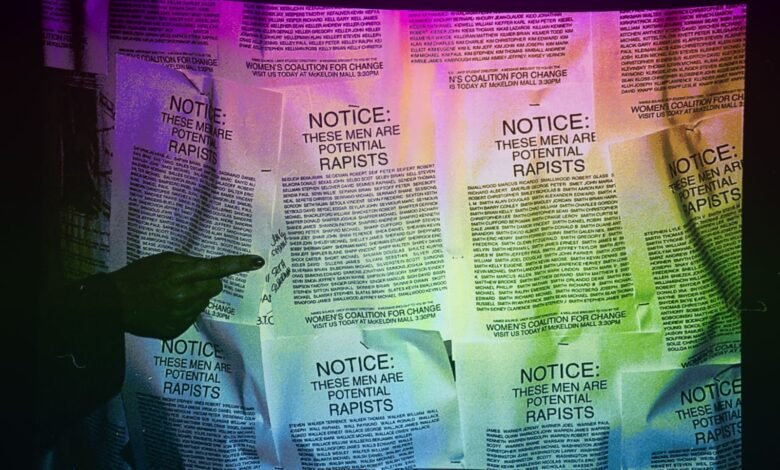
Recorded, Relived, Reactivated: “These Men Are Potential Rapists” and the Women’s Coalition for Change

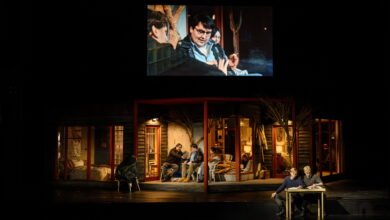
The film featured members of the Coalition dressed head to toe in anonymous black. They stepped forward, one reciting spoken word poetry while another wrote the words in white paint on the speaker’s clothing. The film then shifted from live capture of the event to documentation of media reaction. News segments from Fox and CNN positioned the actions of the Coalition and their faculty advisor, Dr. Josephine Withers, as a reckless and unjust accusation against innocent men rather than as an artistic intervention. In doing so, contemporary reactions largely ignored the action’s intended attack on rape culture, failing to address systemic rupture in their individualized persecutions. By presenting how the systemic inequity at the heart of the action went largely unaddressed, the 2024 screening’s reactivation of the original action in a modern social context highlighted the continued inequities in the discourses surrounding incidents of sexual violence.
The archival footage placed viewers in the past, but the panel discussion reactivated its significance in the present. After the film, the original activists—Red, Green, and Grey—took low folding chairs in the front corner. Their seated stillness contrasted with the frenetic cut-ins of archival footage; together, they straddled past and present, document and living presence. Their self-narration blurred the line between documentation and performance, suggesting that activism is not merely an event but an evolving process, continually reshaped by time, memory, and context.
Green was the most sociable and engaged in audience discussion, so much so that she was reminded by the other panelists to avoid sharing potentially incriminating personal details. Red was the most thoughtful, near eidetic, detailing the hate mail and death threats sent to Dr. Withers following the art action and the Coalition’s subsequent decision to “go underground.” Grey seemed reluctant to provide meaningful detail in response to audience questions, though she ultimately (and emotionally) expounded upon her feeling that the media had ignored the original meaning of their work. She argued the media was unwilling to consider the very real danger of sexual violence, yet were happy to issue personally vindictive, violent, and sexually derogatory statements towards the activists and their professor.
Through this, the panelists’ embodied presence granted their original activism a sense of material significance and permanence. Their original role was as anonymous figures scarcely featured in archival footage—dressed in all-black, reciting dialogue in a monotonous tone. But their colored clothing, expressed personalities, and individual manners of being present at the panel screening expressed both individuality and corporeal significance. In embodying both the originality of their art action and signifying the contemporary persistence of the problem that action sought to address, the panelists showcase the continuity between then and now; sexual violence was a problem then, and it remains so today. In mirroring their original role but aesthetically separating themselves from it, the artists reinforced the continued relevance of their work by bridging an abstract archival past into a material and embodied present.
This reactivation historicized a radical moment while simultaneously insisting on its continued relevance. Documentary footage of the media criticizing the Coalition while failing to acknowledge their message was a reminder of majority culture’s fundamentally disproportionate influence on the archive. Despite being a subject of national news, the original art action is largely absent from online search engines and public discourse. Both anecdotally and algorithmically, the Women’s Coalition for Change remains unknown.