Chorus of Voices: Gender euphoria is bliss. Freedom to experience masculinity, femininity, and everything in between. Getting to show up as your own self. Gender euphoria is opening the door to your body and being home. Unabashed bliss. You can feel it. You can feel the relief. Feel safe. And the sense of validation and actualization. Or sometimes it means being confident in who you are. But also to see yourself reflected back. Or maybe not, but being excited to find out.
Nicolas Shannon Savard: Hello and welcome to Gender Euphoria: The Podcast, a series produced for HowlRound Theatre Commons, a free and open platform for theatremakers worldwide.
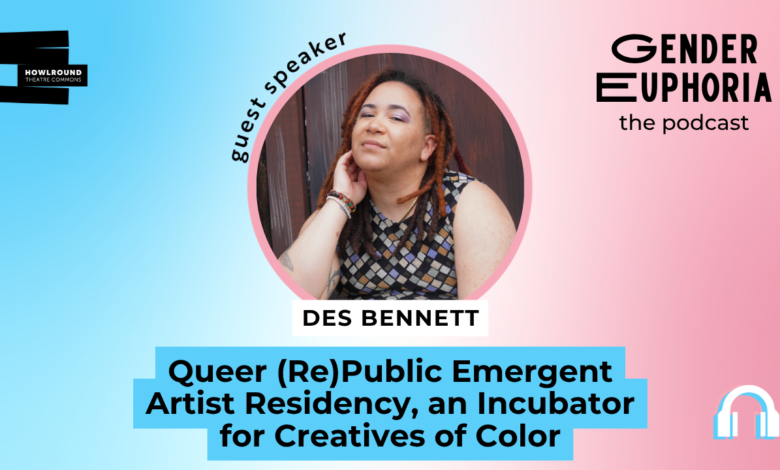
I’m your host, Nicolas Shannon Savard. My pronouns are they, them, and theirs. Today I am here with Des Bennett of The Theater Offensive in Boston. We’re going to be talking about the Queer [Re]public Emergent Artist Residency. But before we dive fully into that, Des, could you tell us a little bit about you as an artist?
Des Bennett: Yeah, hello. My name is Des Bennett. I use they/them pronouns. I’m the associate director of Queer (Re)public programming at The Theater Offensive, and I am a theatre artist at large. I direct. I primarily do a lot of dramaturgy and new development work. That’s how I kind of found my way to leading our residency. I’ve led new play festivals since I was in college, and this feels like the grown-up version of that. I’m also a 2D artist. I do a lot of collage work and make zines. I love zines as something that we can use as archive and also distribute information, distribute ideas, distribute radical imagination. I’m also a drag artist under the name Desdemonic, where I explore villainy in a queer and Black community. My art handle is making whatever the hell I want, and that is kind of my whole vibe. I feel like the interdisciplinary way in which I approach art and the way that creativity just shapes my daily existence really is apparent in the ways that we also do a lot of multidisciplinary transmedia art here at The Theater Offensive. It’s exciting to be able to shape programs that allow other artists to work in that kind of way.
Nicolas: I have so many follow-up questions about all of that that would get us so off track, but I’m going to stay focused.
Des: That’s for the next episode.
Nicolas: Different episode. Here we go. How did you find your way to The Theater Offensive and Queer (Re)public?
Des: Yeah. In my senior year of college, I went to Northeastern University down the street. We had to do a senior project that was research theatre companies that you might want to work at in the future and do a deep dive on their values, their organizational structure, their programming. The Theater Offensive was the one that I really hung onto because at that time, they had just gone through a strategic planning shift under Harold Stewart’s leadership. There was a lot of signaling around “this is going to be a place where you could work that works with youth.” It works with emerging artists. They’re working with emerging strategies. They’re taking cues from Black feminist leaders. This is an organization that’s really rooted in the history of Boston, which as a transplant is something that’s very important to me to be deeply knowledgeable and involved in the continuation of the ways that QTBIPOC folks have fought for liberation and defined culture in Boston.
A friend of mine actually started working at TTO before me. Shout out to Robbie Flanagan, who is our development operations manager. He started working at TTO and was like, Des you have to work here. I kind of waited patiently in the wings for their programs manager position to open up and was able to meet the previous programs director, Tonasia Jones, at their gala. I think this is just a story of if you’re interested in working at a place, you got to find where they’re having events and show up and be like, “hi, I want to work with you. This is my dream job. How do I get here?”
I was really patient and also determined and joined the team in fall of 2022. We’ll talk about this a little bit later, but in my first week, truly, I signed my contract and the next day I was on a road trip to Double Edge Theatre, which is our harvest partner on the Queer (Re)public Residency to understand what the partnership was like, see the work that they’re doing there, get to know the people. I didn’t really understand that that would be such a defining relationship and defining place, sense of place for me and for the work that I would be doing at TTO.
I skipped a bit, which is that in the interlude of waiting patiently to have a full-time job at TTO, I also directed their True Colors troupe. That season, the theme was queer republics. TTO was really trying to understand what the phrase queer republic brought out in people and what it meant to people, especially youth, which was really, really fascinating. I loved having those kinds of conversations. I directed and then was able to transition to programs manager and then over the years have moved through the company and now the associate director of our queer public programming.
Nicolas: Can you tell me a little bit about what the Queer (Re)public Residency is? Who are the artists that the program aims to support? What are the goals of this residency? What is it that you do in your time together there?
Des: Yeah, all good questions. The residency is one of those things that I feel like we keep on the down low sometimes, but is beginning to become really one of our flagship programs.
Nicolas: So you’re letting the podcast audience in on secrets here now.
Des: Yes.
Nicolas: Listen to Gender Euphoria, you’ll be in the know!
Des: Exactly. You’ll get all the gory details. But no, we’re actually really trying to share a lot more about the residency because it is something that is so transformative. It’s very, it is a radical residency program and we’re really wanting to share this work and specifically the format of the residency, the challenges, the successes with people to be able to replicate something like this and to really like learn from what we’ve learned by engaging with it.
But the residency started really from this kind of mindset, the scarcity mindset of there’s really not a lot of opportunities for QTBIPOC artists in Boston and nationwide to really incubate their work without the kind of pressures of an institution telling them what their work has to be.
Part of the work that I was doing before I came to TTO, even as an undergrad, was how do we keep artists in Boston? And how do we keep them from leaving to go find other opportunity because there isn’t opportunity here. And so most of my artistic mission—personal mission—is to create more artistic opportunities in Boston and keep artists here and keep them being able to sustain themselves here. It’s an expensive city, but it’s also one full of amazing culture.
So it really grew out of that void and this desire from really Tonasia Jones to say, what kind of residency could we create if we think about this from an abundance mindset and a mindset of we can create the world that we want to see, we can create the programs that we want to see.
And this really stems from our “Queer Liberatory Aesthetics,” which really identify key values that go into QTBIPOC work and creating it and the cultural impact that it has. It really comes from the idea of spaces and segregation, honoring the kitchens, peers, and community centers. The spell for that is we make magic wherever we go, making do, making beautiful, and making the spaces our people most need. We remember and uplift the queer stories that shaped this place. We make our own because we refuse to be disappeared or forgotten.
So the residency is really about making that space for artists. Part of the particularity of that is a), this is a dedicated residency to QTBIPOC emergent artists. b), we incubate the work for twenty-two months, which is one of the longest residencies for new work development.
Oftentimes you’ll have someone like, you know, casually, you know, we’ll do a reading, then we will do a workshop, then we will do a full production. And it’s kind of this extended, maybe we will, maybe we won’t, kind of relationship. But we say, you know, we really want to work with you for these two years and develop something really special. It is fully funded in the sense that we provide an artist’s stipend. Each time we have kind of our residency intensives, all artists are paid additionally, all their creatives and collaborators are paid additionally. They receive housing, travel, meals as needed, especially when we’re out of the city and traveling together. And they receive dedicated rehearsal space for weeks out of the year in order to develop their work, as well as mentorship, cohort meetings, leadership, artistic development.
We work with a leadership coach on what it means to be a collaborative leader, and really like decolonize the leadership practices in working in this way where you’re a lead artist, but you’re also working with your friends to lead like a particular vision, and want them to be able to influence that.
We have three different levels of the residency that folks can enter through. The first is True Colors, which was originally dedicated to youth, but has expanded to also be open to educators and folks who are wanting to develop a new practice within theatre, but also just live performance in general. That could be like vocal workshops, that could be devising workshops.
And then the next kind of tier—which is really the Queer (Re)public Residency leg of it—is the Level One, which is usually a project that is almost like brand new in its baby stage, that is working towards its first public showing. That has been, generally, our most flexible residency because you could be working towards a reading; you could be working to create a first demo of your album. That hasn’t been something that we’ve done, but I would love to do that.
Nicolas: Speaking that into existence.
Des: Exactly. We’re really having a lot of discussions about how do we move this away from just kind of like theatrical type performances. But in the past, it’s been new play development. And right now we’re working on a drag theatre project that I’ll tell you a little bit more about later. So it’s a very interdisciplinary piece and a very experimental throughline.
And then our kind of most robust production-wise residency is the Level Two. Usually it’s a project that has already had a public showing but is wanting to be reworked or explore an essential piece of the experimentation that they really need to be able to incubate and take that time to play off of each other. Often it involves bringing in new collaborators or bringing in a new element to the work that hadn’t been explored before and results in a full production of the work or workshop production. It kind of depends on what the needs are of the play, but typically it’s working towards a full production. And we also work with all of our artists to really define like, yes, we want you to be able to leave the residency with something that you’re really proud of, but we also want to help set you up for the next steps as well. So are you looking to tour this work? How do we create a piece together that is also tourable and doesn’t just live in one theatre in Boston in its grandest form? Or are you trying to do workshops across the city in schools? Are you trying to get published? There are lots of avenues for success that follow the residency that we’re also trying to set people up for success in, which I think is maybe one of the hardest parts of the residency is like planning that far into the future.
The residency culminates in a festival, usually in the culminating June of the residency program called the Queer (Re)public Festival, where we show all of the work. It’s a week or two of workshops and performances, work-in-progress showings. And then we also do altar work, ceremony work. We’re thinking about having a mutual aid market. There’s lots of ideas about how we want to include the community in this work that isn’t just performance, but also giving back to the community as they join us in the celebration of the work that we’ve created together.
We work with over a hundred artists, technicians, crew members, designers, venue staff, front of house staff volunteers for the festival. And so it’s a huge opportunity for community. It’s also a huge opportunity for employment for queer folks who are involved with the work that we do outside of just who’s on stage.
Those are kind of the bones of the residency. It’s a lot of bones, lots of bones.
Nicolas: It’s a whole skeleton.
Des: Oh yeah, absolutely.
Nicolas: I’m gonna jump a little bit back to this road trip right from the beginning. So I was surprised and honestly kind of delighted and then really inspired to learn that part of the Queer (Re)public Residency takes place on a farm in rural Massachusetts. I grew up in New Hampshire, so like when I think Boston, that was the big city. And then I saw a bunch of theatre happening on a farm and I was like—okay, here we go! So you have this partnership with Double Edge Theatre that you called a Harvest Partnership. I’m intrigued, what does that mean?
Des: Yeah, a Harvest Partnership is something that we are… I can’t say that we’ve coined it necessarily. I’m not sure where the phrase came from honestly, but we define it as a commitment to mutual collaboration with another organization through program development, organizational learning, and resource sharing as a means to water and harvest both organizations’ crops, which for both of us is life-sustaining, liberatory art.
And in particular, our partnership really aims to uplift the work of Queer (Re)public Residency. Yeah, we have been working with Double Edge for many, many years and actually both of our organizations grew up kind of in the same cohort. They’ve both been around for roughly forty-ish years, thirty to forty years. Double Edge also used to be based in Boston before moving out to Ashfield, Massachusetts and produced TTO’s first full production.
So this partnership goes really deep, but Double Edge itself is a cultural cooperative based in Ashfield. They have a one hundred ten acre center for art, living culture, and art justice. They farm, they eat, they live, they make art all in the same place. Many of the people who are currently working at Double Edge grew up in the area and have literally physically built the facilities that they work out of. So it’s a really, really special place to make art and they’ve been making art for a lot longer than we’ve been there.
And our partnership is rooted in three week-long residency intensives at Double Edge where we bring about twenty to thirty QTBIPOC people to their farm and create art. Part of the reason why we work together is because there just physically isn’t space in Boston to sustain three individual projects with multiple people coming from different places and the kind of breadth and relationality that’s needed and feels like it can only exist when you’re able to detach from a city.
We recently, me and Cariel Klein, who is the producing director at Double Edge Theatre and really my partner in crime there, we recently did a talk on the rural-urban divide and bridging it through this partnership. And it’s really a beautiful thing to be able to bring a bunch of Black people to the woods. That’s not something that I think many of us have been able to grow up with or have had the privilege to grow up with. And to create art in that kind of space is extremely freeing. I mean like your mind just quiets and is then able to be open to more creativity, more relationality.
Many of the artists who have worked with us in the residency, especially those who have been kind of like repeat creatives, collaborators with us, also start to form a relationship with the land that’s there as well. Many start their mornings going down to the river on their property or walking through the labyrinth that they’ve created. We swim in the lake there. There’s like my consistent waterfall that I go to on my day off.
There’s deep relationality that comes with being able to incubate the work there for three different residencies over the two years and that kind of return to place in that way. Oftentimes, you know, we’re just inhabiting a rehearsal hall, a cold black box theatre where there’s like no light coming in.
So it’s a very different and special experience that’s able to have there. Double Edge supports by offering a lot of administrative support when it comes to housing us, when it comes to helping make sure that we are logistically supported. They have a lot of staff that is present and is working behind the scenes to make sure that, you know, food is made, that the rooms are set up the way that we need them to be, that we have the supplies that we need when it comes to tech, if they have that kind of tech.
One of the things that I think we run into oftentimes is like we’re making work in a barn, the tech is different. But also they have like wild capabilities of like flying people outdoors or like lighting a show in a pond. So there’s really like a dichotomy there of what’s possible, which is really a wonderful creative problem to have.
Nicolas: Using the space that you got.
Des: Exactly. And they use every bit of the space that they have. And I think that’s deeply inspiring for the artists to think outside of the boxes that we usually create theatre in. And that’s really the, you know, the huge value of it is that kind of expansion of imagination, expansion of resources, expansion of capacity. Because, you know, each one of our organizations might have, you know, we’re an organization of like, I think, less than fifteen. And we partner with an organization that’s like, thirty to forty. And that just expands both of our capacities to hold the residency.
Yeah, so it’s, it’s definitely one of the most life affirming parts of this work, not only for myself, but I think for the artists as well. There is a lot of love for this aspect of the residency for sure.
Nicolas: All of that just sounds wonderful. And I very badly want to go see some beautifully lit theatre on a pond now. I’m completely changing directions here. Just flagging that. From what I’ve read, Queer (Re)public is, and you mentioned earlier, pretty strongly rooted in emergent strategy and queer liberatory aesthetics. I apologize in advance for this impossibly large question. But how do these practices of emergent strategy and queer liberatory aesthetics inform your work in the program? Incomplete but honest answers only.
Des: Incomplete for sure. Yes, it is an impossible question that I’m still consistently trying to answer.
Nicolas: Quick bit of context on emergent strategy. The concept was popularized, especially in social justice oriented circles by adrienne maree brown, in her book Emergent Strategy, Shaping Change, Changing Worlds, published in 2017. The author describes the text as, and I quote, “a guidebook for getting in right relationship with change, using our own nature and that of creatures beyond human as our teachers.” It’s inspired by and engages deeply with the work of science fiction author Octavia Butler, as well as other Afrofuturist and feminist thinkers. Highly, highly recommend reading it.
Des: First, the way that I define emergent strategy is a process of how to navigate change or plans, your best laid plans, that get turned upside down due to unforeseen circumstances and the methods that you use in order to make your next plan of action. And for us, that’s towards the goal of creating queer and trans life-affirming liberatory art. And of course, adrienne maree brown in Emergent Strategy defines it in many ways, but the way that I cling onto the most is emergent strategy is “how we intentionally change in ways that grow our capacity to embody the just and liberated worlds we long for.”
And I’ve recently been thinking about it as like, it feels like I talk often about producers having to be time travelers who travel into the future and they say, “In two years, you’re going to be thinking about how to tour this gigantic set that doesn’t fit into a van.” And I have to come back from the future and be like, “Hey, we need to be thinking about this because you’re gonna need to know about this later.”
But it often feels like, when it comes to emergent strategy, that it feels like a process of time traveling, but your GPS is really broken. And so you’re landing in different timelines that you did not prepare for, and really having to navigate what comes next. How can we make the most of this possible change of plans?
There’s a lot of delight in general, in TTO itself being really grounded in emergent strategy, even before it was publicly named as something that we really dedicated ourselves to. And what I mean by that is that TTO grew out of a guerrilla theatre troupe, United Fruit Company, which was a gay theatre troupe founded in 1984 in response to the HIV AIDS crisis and was itself like an emergent strategy towards responding to the US government’s poor public health response to the crisis and emergent strategy towards gay liberation.
So I feel as if TTO over these, you know, thirty-seven years of existing has really continued to clarify and shift its mission in order to really uplift emergent strategy and uplift, you know, ever unfolding struggles, successes, polycrisis that we find ourselves in that inhibit queer and trans liberation.
The way that emergent strategy kind of functions within the residency itself, again, the residency is an emergent strategy of TTO to continue to fight for QTBIPOC liberation in the arts by being its own methodology to creating space for QTBIPOC artists, to creating job opportunities for QTBIPOC artists. But then within the residency, each year we’re kind of growing and shifting the way that we run the residency, the way that we structure it, how we decide who and how we want to support the artists that we’re working with.
And so from the pilot year, for example, the first pilot year was—I had come in truly at the last few months of their residency. The first thing that I had noticed was that their projects were being shown asynchronously. So each of the artists were kind of in a different part of their process, which I think actually led to a lot of disconnection, because they couldn’t relate to each other on what struggle they were in in that very moment, not to mention that their projects were so different from each other.
One of the major things that we shifted was that we all were starting on the same—not the same playing field, but kind of starting from day one, we’re all going to residency together three times. We’re all going to perform together kind of in rep at the Queer (Re)Public Festival. Yeah, so the changes that were implemented between, you know, pilot year and then our first official year were that we were all working together on the same timeline.
We really emphasized the necessity for cohort and chose artists whose work could kind of bounce off of each other. So if anyone was at the Queer (Re)Public Festival in 2025, the work we were doing with River Guidry in Theater of Union was a practice towards devising work within a community that also would promote social justice within a particular community. So they might be examining a particular question, a particular phenomenon, a particular social justice issue, or even just like, what does it mean to be an ancestor? Those kinds of questions within community and create a work based on that.
Their kind of methodology around Theater of Union then created a lot of conversations and inspiration and methodology for the other works that were happening alongside them. And through workshops that River was leading as part of their residency, all of the artists participated in those workshops and all of the artists were able to learn more about how to use the emergent strategy that they were even talking about in Theater of Union within their own work. So that kind of fecundity of one person’s work then influencing another’s. So really being intentional about choosing projects and artists who we think will be able to really learn from each other and also thematically align in some way and align towards a particular practice.
So that was a huge change that we made, not only in the way that we structured the residency, but also in how we chose artists because it became relational, not just dependent on the success of one person. And then there’s micro ways in which we are constantly running into our own capacity or our own capacity for imagination, honestly, of how do we push past this obstacle of… a good example is ICE at the airport.
That’s an obstacle that we are currently navigating when we work with artists who are coming from outside of Boston, who are taking planes, is that it’s scary to fly. It’s scary to go cross state lines right now. So that is an obstacle that we’ve had to shift how we interact with folks when it comes to travel. Or we have to structure the residency to accommodate the ever shifting ways in which capitalism means that we have artists who are working day jobs who can only come with us for a weekend of the residency. So how does that drastically shift how we even schedule that week?
So there’s micro ways in which we’re constantly reevaluating process and how we move for the process, and that’s different for each artist. And so having as producers across TTO and Double Edge, how we show up to those challenges, I think is really rooted in emergent strategy and a deliberate, consistent decision to be in praxis together and to enter conflicts, enter issues within the industry as partners, and not just partners with each other, but also partners with the artists. There’s a lot of transparency that has to come with that as well that I think is radical transparency, and that I think really defines our artist-producer relationship as well.
Nicolas: So many things!
Des: So many things.
Nicolas: So many things.
Des: I could talk about this forever. People usually only give me an hour.
Nicolas: I have a feeling this is related. Pulling from your website here, I am interested to hear more about the work you’re doing with the residency in decolonizing the relationship between artists and producers. And this is the question that I sent you that had five parts because my brain was going in fifteen directions. But I will ask them one at a time.
Broadly speaking, what does it mean for you as a producer in this residency to be decolonizing that relationship? And I guess, what are some of the aspects of the traditional—meaning patriarchal, white, Eurocentric, capitalist, et cetera—producer-artist relationship that you’re questioning, resisting, intervening in here?
Des: Thank you for asking this huge, huge question that I certainly…
Nicolas: I apparently only ask huge… Huge questions. …impossible questions.
Des: No, but I love that. And also…
Nicolas: I know you’re going to have things to say.
Des: Oh, yeah. And so much of this is in draft because I think one of the biggest pieces that we’re still working on organizationally when it comes to decolonizing is just allowing ourselves to sit in what we know and what we don’t know and actually talk about it.
But yeah, I think one the biggest things that we aim to decolonize is the hierarchy between producers and artists. And there are, of course, always going to be that kind of bottom line ideology. Really, one of the things that we aim to be transparent about is financial transparency. And that is a radical thing that we’ve begun doing with our artists, particularly our resident artists who are operating at a level in which financial decisions about their work really influence who they’re able to hire, what they’re able to explore creatively, the amount of time they have to do it. All of those kinds of questions are really tied to finances and really tied to money, and resources are something that is finite.
So we’re constantly balancing the: what is the reality we’re in versus what we want to manifest when it comes to abundance. And how do we do that? And a lot of it comes through transparency and consent, in a way. So in this way, we work with the emergent artists to really have them understand the budget and how we’re managing and considering their needs and also allowing them to have influence on that budget and make informed decisions about how their work is funded, how that money is utilized.
And so we’ll sit down with an artist and say, here’s the budget line by line. What isn’t here that we need to be thinking about? And if this is the finite number, what decisions do we need to make? What concessions might need to be made in order to bring a certain collaborator on or build this huge thing or whatever it is?
And then I think the other huge way that we disrupt this is not really working towards a profit or finite goal. All of our programs and tickets are pay-what-you-can. This isn’t something that we plan to really change. And so we’re not trying to maximize sales or leverage profit in that way. We’re always trying to maximize artistic development and not necessarily the end product, but a feeling of I accomplished something and I feel like this was excellent work that I was able to do. And I was able to do it with care and with grace and without urgency. I think one of the biggest thing that I think is hard for literally all creatives right now is resisting urgency.
Yeah, I just watched you be like, yeah. It’s almost an impossible task, I swear.
I often find that when you’re trying to resist urgency in one avenue, you actually lead to creating urgency in another. And I think that is a constant battle we’re having, especially because the residency doesn’t exist in a vacuum. It also exists alongside other programs that we’re working towards all the time. But when it comes to urgency, I mean, the length of time that we have to incubate the work in itself is a disruption against that. We’re not asking you to turn around a product in a year or a couple months. We’re a sort of end goal, an ideal end goal of what the work might look like at the end of your residency and at the festival. But that goal can change. And that goal might change for a lot of different reasons. Again, emergent strategy: not being beholden to “it must be this” but “what are the different ways that this work might emerge?” What are the kind of goalposts in which we make the decision about whether this is a full-scale production or a workshop because you’re a burnt-out artist and you need more time and you don’t want to push yourself towards a particular goal? Or how do we really push your dreaming and imagination and reach for that higher goal? How do we fully support that?
So yeah, I think that really assists to destabilize that relationship. And really, I mean, I aim to always balance what is the issues around capitalism and racism and queer and transphobia societally and within organizational processes or within artist-producer relationships. Because oftentimes, you might be in a particular struggle having a particular conflict. And it’s like, the problem is not us. The problem is society. Or the problem is something that me and the artist don’t have control over. It could be the venue is putting particular pressures on us.
Oftentimes, it’s also partnering with each other to say, we’re trying to fight the same system. Let’s not use that system on each other. And let’s not turn it back as a weapon that actually destroys trust. It destroys really the purpose and vision that we’re all moving towards, not just within this residency, but within changing the ecosystem of Boston theatre, changing the relationship between artists and Boston itself, and really looking at those tenets of white supremacy and really, as much as possible, not allowing them to exist in our work or our relationship with our artists.
Nicolas: Cutting in to provide a reference here, Des is talking about the anti-racist framework proposed by Tema Okun in her article, “White Supremacy Culture”. In its original publication in 1999, Okun describes fifteen key characteristics of white supremacy culture as it shows up in organizations and offers antidotes or shifts in praxis that can disrupt white supremacy. She published an updated version of the article, as well as a website in 2021 in partnership with Dismantling Racism Works. Both are linked in the transcript for you. Okay, back to Des.
Des: And being super open to feedback, we have a pretty rigorous debrief process where we debrief each engagement that we have with our artists, either as a group or through feedback forms. And we then implement that feedback and solutions for our next residency or next process. And there will always be roadblocks. There will always be, I think, a limit to what we can do, but we continuously try to push past that limit when it comes to what feels comfortable as an organization.
Nicolas: I think you started to touch on it a little bit, but what are some of the areas that you hope to deepen that decolonizing work going forward?
Des: Yeah, it’s tricky. I think one of the ways is spatially and within our partnerships, how we’re able to influence other organizations to decolonize, to continuously become welcoming spaces for QTBIPOC people without also doing a lot of that labor ourselves.
Nicolas: And that is the trick.
Des: That’s the trick. Yeah, that’s the rub. One thing that I will kind of drop as a resource is the “Decolonization Rider”, which is by… Emily Johnson created this. It was originally designed to create conversation with organizations and artists, specifically Indigenous artists around things like land acknowledgements, but going really beyond that. And a lot of the work and opportunities for implementation are not just related to Indigenous needs and Indigenous practices and solidarity. I think there’s a lot of things that we can learn from Indigenous practitioners and artists about how to engage in work in a decolonial way and truly decolonial, not the kind of metaphorical, but truly in the praxis.
And so I think a lot of the ways that I myself keeping my mind and practice open to is aligning myself more with Indigenous practices and things that we can learn from the really complex organizational society-wide questions that decolonization really poses to us about land, about space, about capital. These are all things that I think we’re thinking about quite heavily. And when it comes to that also, inhabiting organizations and venues and having partnerships with folks who feel the same way and who are also aiming to truly decolonize.
And I think that is a culture shift that underpins a lot of ways in which we can even really fully have a decolonized practice. I think a lot of people are experiencing this within institutions, within educational institutions is like, again, this question of how much can you actually decolonize when the container is literally not built for that. And I think that’s true for the nonprofit industrial complex. I think that’s true for just theatre, the theatre industry at large.
So a lot of the things that I’m thinking about are how do we shift culture outside of us so that we can even further decolonize the industry and our relationship with it and who we work with and where we work, all those kinds of things.
Yeah, that’s the first thing that’s been on my mind recently. The first…
Nicolas: First twenty?
Des: Yeah, first twenty. First twenty things. I’m like, yeah, I’m thinking about Land Back. I don’t know. Just an easy one to start.
Nicolas: Are there practices or general shifts in approach that you would hope other producing organizations might learn from the example that TTO is setting?
Des: Yeah, I think this is a good opportunity to bring up the Queer Liberatory Aesthetics, which are really our guiding values towards creating a QTBIPOC aesthetic, but also it just honors the cultural contributions to society and art that QTBIPOC folks have made and the methods that they use to do it.
These were created by cultural strategists Sage Crump and Maria Cherry Rangel and other groups of local and national artists to really develop an aesthetic of values and methods that continue to come up in QTBIPOC art, but also are, I think, what society often sees as the honey that comes from our labor.
And not to say that I think this is an extractive way that we can share our methods, but more so that the things that make our work feel special and meaningful and life-affirming are also things that can be practiced in other organizations and by other practitioners.
So QLA is a set of eight pillars around that. Really just like they shape the way that we navigate conflict. They shape the way that we think about programming. They navigate the way that we think about relationships, what kind of collaborators we want to work with. And so in the way that you might think about a rider, these are kind of like our ways of saying, this is how we work. This is how we want to work with other organizations, with other artists. This is what we’re valuing in process. And I already spoke about one, which is “Space and Segregation.”
But another one I think about is “Medicinal and Healing.” And I bring this one up because I think it’s honestly one of those that we need the most in order to decolonize, which is the understanding that we’re born with the ability to heal ourselves and our kin. And is really offering strategies towards recognizing that harm is systemic and not just interpersonal and how we embed those kinds of healing into our own organizational culture and then use that as medicine outward.
It’s where we often turn when we’re trying to, you know, resist urgency and say, we actually need to slow down. We need to rest. We need to reflect. We need to emotionally process. The work that we do is extremely heavy. And oftentimes we find ourselves just moving right past it to the next thing. I think this is a really key one for us right now as we’re entering a period of producing more, producing larger scale, that looking back and saying, and how do we prioritize this? Because this is key for our success, too. And it’s key for our wellness and the work feeling good for us.
Within that too, it’s also like allowing us to think about the fact that we don’t want to burn ourselves out by trying to fix the whole world and be the savior. And I think a lot of times people look to the QTBIPOC organization or the QTBIPOC artists and Trans and Black people to fix all their problems. And it’s like, girl, I need to go lay down. You need to figure this out yourself. And so in some ways the QLA offers an ability for us to engage with folks without also burning ourselves out, having to be the only physical individual teachers of the work that we do in the process in which we do it.
Nicolas: I cannot emphasize enough how important that is.
Des: I appreciate that.
Nicolas: So yeah. Yeah. We’ll definitely link the Queer Liberatory Aesthetics info in the transcript so folks can read the whole thing.
Des: Yes, please do.
Nicolas: It is good stuff.
Des: It’s a really beautiful document.
Nicolas: Yeah. So looking ahead, what is in store for the Queer (Re)public Emergent Artist Residency in the coming months?
Des: Well, first of all, I’ll use this opportunity to just share about our residents because they’re all such wonderful people. And I’m really excited to share their work with the Boston community. Our True Colors resident artist is Desiré Graham, who is working on a song research project and will be offering workshops and a singing session as their kind of contribution to the festival. They’ll also be having a few workshops in Boston, so keep your eyes out for those in the coming year leading up to that as practice and really like doing that kind of research of how can I implement this? How can I better myself as a teacher and community?
Our Level One artist is Javi Sanchez, AKA King Killabite. He is a Filipino-Japanese drag artist and drag king specifically, who is embodying the character of Killabite, who is an oni, half human, half demon character. And the work that Javi’s working on is a theatre drag amalgamation. It will include other drag performers in the scene, who I’m really excited to be working with in this capacity, and will be like a long form drag performance, exploring King Killabite’s background and journey, rediscovering his heritage.
And then our third artist is Ian Andrew Askew, who actually directed In the Space Between, which was part of our first Queer (Re)public Festival last year. And Ian is working on a project called Sorry John Henry the song does not end, which is inspired by the musical John Henry, and is really an experimental opera version that destabilizes the myth of John Henry in terms of all of the stories that have been told about John Henry that actually miss the point of this anti-capitalist story. So it is an opera that is going to be exploring music, it’s exploring technology, and exploring our relationship to capital capitalism as Black queer people.
And so those are the artists. We’ve already done one residency intensive back in April that was really beautiful and was really like a kickstart to the whole process. And we go back to residency in September for a week. They’ll be working towards their projects, bringing in even more collaborators. One of the things I’m looking forward to is some cross-sharing that we’ll be able to hopefully do between the song research project and the other projects that are also still also working with music and working with voice. And then we have a third residency next April. And then the Queer (Re)public Festival that will be happening in June 2027, which will be twice as long as the first one. The first residency was basically a weekend. We’re extending it to two weeks and really spreading out the projects so that each of them are able to really find the ways in which they bounce off of each other, but also give the spaciousness of working and presenting each of them so that everyone can see the work and don’t have to feel like, oh no, I missed this one on Saturday because, you know, this other one was happening.
So we’re really trying to give as many opportunities for people to see and participate in the work as possible. Yeah. So I’m really, I’m really excited about the next couple months. And, you know, there’s so much that we learned from the first residency and the first festival where it was like, this is a massive thing that we’re doing actually. We need to really anticipate it and grow in our capacity and our, you know, ways of thinking about it in so many ways so that, again, we can be dedicated to this feeling like something where we’re also in a culture of care with our own work so that we can put this on and feel really good and proud about it.
So yeah, there’s a lot of kind of behind the scenes things that are happening to help support that work. That, yeah, I’m just really, really proud of our team, really proud of the artists for continually being in relationship with us in which we can grow and really create a residency that is just, I don’t know, like truly consistently hearing from them unlike anything they’ve been a part of and wanting to make that as sustainable as possible.
Nicolas: That is a solid little button to end on. So in closing, I’ve got a couple of questions that I ask all guests of Gender Euphoria: The Podcast. The first one is I would like to invite you to give a shout out to a member of your queer trans artistic family tree who is someone who has inspired you, supported you, showed you a path to becoming the fabulous queer artist that you are today.
Des: I’m going to shout out Alison Qu because Alison is someone who I started early career with working at Central Square Theatre as a dramaturg and we had partnered with CHUANG Stage like truly right before CHUANG Stage like really blew up outside of Emerson. And I just remember this like fervent feeling between us of like really wanting to change the landscape of Boston theatre and this desire for partnering and lifting each other up in that pursuit.
And the work that CHUANG Stage does is so phenomenal. Anytime I’m like walking into that space and just seeing them continuously grow in a way that I think like is so steady and really aims to support the artists. They are the definition to me of like creating a culture of care for their artists and creating work that really touches and reflects and gives back to the community. I find the work that CHUANG Stage does led by Alison Qu to be some of the most inspiring in Boston and like in the nation. Like I’m constantly taking my cues from them and we have some secret inspiring and very exciting collaborations coming in the future. And I love working with that team. So shout out to Alison.
Nicolas: And finally, would you leave us with a snapshot of joyous queer community?
Des: To me, joyous queer community has really looked like bringing my gaggle of queer, Black, and Brown and trans friends to the beach. And truly, anytime I’m able to spend time with QTBIPOC people in nature feels so healing and like such a beautiful and joyous resistance to all of the things in our society right now that tell us that we, you know, shouldn’t be able to rest and shouldn’t be able to play and shouldn’t be able to have joy. It feels like such a big release into all of those things. And yeah, I love to bring many blankets and lots of food and a little craft and truly just like camp out for the whole day, like until sunset, truly. That is really the most healing and joyous part of community that I’ve been experiencing recently.
Nicolas: That sounds lovely.
Des: Thank you. I hope you get to do that. I hope anyone who needs to go to the beach can go to the beach this weekend.
Nicolas: Get yourself to the beach by the end of the summer.
Des: By the end of the summer? By the end of the week, bro!
Nicolas: Okay, by the end of the week. I’m in Michigan. I’ve got to travel a bit further to get to the beach.
Des: That’s so real. Any body of water, any body of water. Like, I cannot emphasize enough the power and cleansing of just putting your feet in water.
Nicolas: This has been Gender Euphoria: The Podcast. Hosted and edited by me, Nicolas Shannon Savard. The voices you heard in the intro poem were Rebecca Kling, Dillon Yruegas, Siri Gurudev, Azure D. Osborne-Lee, and Joshua Bastian Cole. The show art was designed by Yaşam Gülseven. This podcast is produced as a contribution to HowlRound Theatre Commons. You can find more episodes of this show and other HowlRound shows wherever you find podcasts, including on noncommercial open source apps like Anytime Podcast Player for iPhone and AntennaPod for Android. If you loved this podcast, please share it with your friends, your colleagues, your students. You can find a transcript for this episode along with lots of other progressive and disruptive content on howlround.com. Have an idea for a meaningful podcast, essay, or TV event that the theatre community needs to hear? Visit howlround.com and submit your ideas to the knowledge commons.