You’ve chosen the dress. It’s bold, unapologetic, and it walks into the room five seconds before you do. The real question isn’t what you should add to it, but how to avoid undoing everything that makes it special.
Here’s a tip you’ll thank us for: when a dress is doing something memorable, your accessories should step into a quieter. Don’t assume that a big look needs more elements to feel finished. The opposite is what will make your look pop. Once you understand that balance is about restraint and not adding up stuff to your look, everything else comes together.
Change Your Mindset: The Dress Is the Star
Every outfit tells a story. Your statement dress should not be a subtle narrative. It should be dramatic and bring out your qualities. Have you chosen sequins? Intricate beading? An architectural silhouette or just a color that doesn’t easily blend? You already have the visual weight you need.
There is an interesting concept often discussed in styling courses at places like the Fashion Institute of Technology, which explains how the human eye prioritizes detail, contrast, and movement when processing an outfit. In simple terms, the more visually complex something is, the more attention it commands. If you add to all this a multitude of focal points, the eye has nowhere to settle. Your result? Instead of looking elevated, your look will just feel restless.
Restraint is not about playing it safe, in this case. The best course of action would be to allow enough space for the strongest element in your outfit to shine.
Jewelry: Where Restraint Becomes Style
If there is one category that can instantly elevate or completely overwhelm your dress, this is it.
It is so tempting to keep adding pieces to your ensemble. We always advise against, though.
You should typically start this introspection at your neckline. It will dictate whether your statement look needs balance or space. Have you chosen a strapless or sweetheart neckline thinking you can add that statement jewelry piece? Think again. Openness doesn’t mean you need to fill it at all costs. Bare skin often looks more intentional and modern. A necklace, if you insist on adding one, should be a muted dress extension of the dress, not a new sentence altogether.
With high necklines and halter styles, necklaces feel unnecessary at best and cluttered at worst. With a piece like this, attention naturally moves toward the face. Wear earrings as the primary accessory. They will add style and not clutter the whole look.
With V-necklines, a delicate chain that follows the line of the neckline can be beautiful. But if the dress already has embellishment along that area, stay away from it.
The golden rule that separates polished looks from overdone ones: a cluttered dress calls for simple jewelry. Scale your accessories back to pieces that support your look: small earrings, a slim bracelet, or a single ring can be just enough.

Shoes: The Anchor of Your Entire Outfit
The biggest mistake you could make is treat your shoes as an afterthought. They’re not a finishing touch. They will affect your movement and posture and have a heavy say onyou’re your outfit reads.
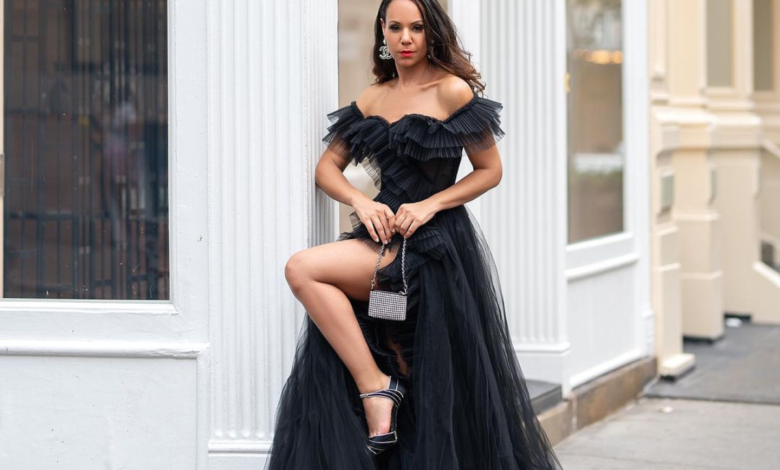
With a floor-length gown, shoes become more about continuity. They are not fully seen, but they are important in maintaining the elegance of your silhouette. Clean lines, minimal straps, and classic shapes tend to work best.
With shorter or midi-length statement dresses, proportion becomes important. Pick a pair of stilettos to elongate the leg. Go for kitten heels if you want to stay elegant but comfortable.
In fact, comfort is not just a practical concern. Research published in the Journal of Foot and Ankle shows that more than 70% of women experience discomfort from formal footwear, and that discomfort changes posture and gait in noticeable ways. Even the most beautiful outfit loses impact when the person wearing it is adjusting their stance every few minutes.
Another important aspect: don’t overdo color matching. Matching textures and finishes is more important. For example, a satin dress will go better with shoes that share a similar softness or sheen. A dress with many embellishments will appear more grounded with metallic footwear.
Bags: The Detail That Can Change Everything
Your biggest mistake? Waiting to pick the bag until the last minute. This should fully complement your outfit, not just match in classical sense.
Remember: scale and form matter more than fashion trends. A clutch or a small, sculptural minaudière will align with the elegance of the dress. Anything too large immediately feels disconnected.
Pay close attention to how much personality the bag adds. If the dress is bold, the bag should be understated. If the dress is more minimal, the bag can introduce texture or detail.
Texture: The Layer You Shouldn’t Overlook
Have you wondered why some outfits fail? Texture is not something people always consciously notice, but it plays a significant role in how consistent a look feels.
When textures are in conversation with each other, the outfit reads as intentional. A heavily beaded gown and a smooth satin clutch will add contrast without competition. A soft silk dress with subtly textured shoes adds depth without drawing attention away from the main piece.
Your outfit’s balance will not be based on exact matching. It will rely on harmony.
How to Build a Balanced Look Without Overthinking It
When you strip everything down, most well-styled outfits follow the same principle: one element leads, and everything else supports it.
Let’s look at a very simple example: Is your dress covered in sequins? The rest of the look must be muted, allowing the texture and light of the fabric to remain the focal point.
On another hand, if a dress is bold in color but simple in shape, there is more room to introduce jewelry or refined accessories.
You are stepping in that outfit not to create perfection, but clarity and balance. Studies explore the idea of “enclothed cognition,” which essentially shows that what we wear influences how we feel and how we perform. When your outfit feels intentional, that confidence translates into how you move, how you interact, and how you carry yourself. And that is what people notice.
The Final Shift in Perspective
We always like to give this piece of advice: think of it not in terms of adding, but rather of editing. Elegance is not about how much you include, but how thoughtfully you choose what stays.
If you’re ready to build a look around a dress that already knows how to stand on its own, take a look at the collections available at New York Dress. The right piece doesn’t need much. Just the right finishing touches and the confidence to let it lead.
Source link