 During the American Revolution, the Province of New York was a stronghold of Loyalism. While a difficult matter to estimate with any degree of certainty, available records would seem to indicate that the Loyalists may have constituted an actual majority of the total population.
The statement has even been made that New York furnished more men to the British forces engaged in the war than to the American.
What was true of the state as a whole applied equally to the then recently settled region extending from a point a few miles above the city of Albany to Lake Champlain.
 This area lay directly across the old war trail that ran through the Champlain Valley from Canada to the Hudson River, and within easy striking distance of the French fortified posts at Ticonderoga and Crown Point; consequently, during the entire period of the Colonial Wars (1689-1765) it had been unsafe for occupation.
The fall of Quebec in 1760 removed the menace of the French and their Indigenous allies, and the region above Albany was soon opened for settlement in the manner usual to the colony.
The lands were granted in large tracts to speculators in what is now Washington County, NY: the Cambridge Patent of 31,500 acres in 1761, the Anaquassacoke Patent (near the towns of Cambridge and White Creek) of 10,000 acres in 1762, the Wilson Patent for 8,000 acres in 1765 (in the towns of White Creek and Jackson), and others in like manner.
These speculative proprietors in turn disposed of their holdings as rapidly as possible, usually by means of long-term leases on easy payments.
The tenants who leased these lands included large numbers of recent immigrants from Europe, some Scotch and Irish from the British Isles, with many Germans from the Rhine provinces.
There was one small group of these new arrivals who could have been classed as of either Irish or German derivation. They were from Limerick County in Ireland, the descendants of refugee Germans from the Palatinate who had been colonized in Ireland during the reign of Queen Anne in an attempt to promote the Protestant interest in that kingdom.
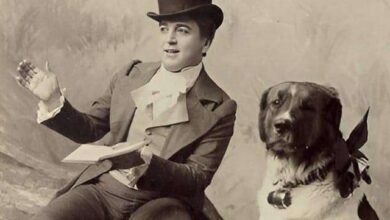
 Due to the ministrations of John Wesley (1703-1791), these Irish Palatines had become zealous Methodists. The exactions of land lords eventually rendered living conditions in Ireland so difficult that in 1760 Phillip Embury (1729-1775, a father of American Methodism), a lay preacher, conducted a party of his neighbors to the city of New York for the purpose of establishing there a linen industry.
Cheap land on the frontier proved more attractive than the fabrication of linen, with the result that in 1773 Embury negotiated from James Duane, lawyer of New York City, a perpetual lease covering lands in the Camden District of Charlotte County (near the Battenkill) on behalf of himself and the following associates: David Embury, Paul Heck, John Dulmage, Edward Carsca1len, Peter Sperling, Valentine Detler, Abraham Binninger, Nathan Hawley, Elizabeth Hoffman, and Peter Miller
Peter Miller had been a weaver by trade. He had not come with the original party but had sailed from Ireland with his family in April, 1769, and on the long voyage to America one of the small children had been lost overboard. Soon after landing at New York City he had removed to Charlotte County and in 1773 participated in James Duane’s lease to Embury to the extent of 125 acres.
In the year following he secured, on a lease forever from Ryer Schermerhorn, an additional 210 acres just across the Battenkill in the Cambridge District of Albany County. The rent of the Cambridge farm was not to begin until five years after the date of the lease; it amounted to £7 annually in “York currency.”
By 1776 Peter Miller had made considerable progress in his farming, having cleared and fenced 46 acres of land, and erected a house and farm buildings at a cost of £39 “York.”
In addition, he had gotten together a respectable head of stock consisting of two mares, two colts, six cows, a yoke of oxen, a young steer, two calves, six sheep, and fourteen swine of assorted sizes. Relatively, he had prospered.
The advent of the political troubles in 1775 found a large section of this frontier population apathetic toward the issues involved. The foreign immigrants had not been long enough in the country to have become imbued with the political philosophy of the Revolution; they had come to America as a result of economic pressure and they had come land-hungry, intent only on the laborious task of establishing farms.
As a rule, these immigrants were not “politically minded”; they preferred a stable government under whose protection they could continue to clear their farms in peace, and in this case the established British institutions seemed to offer the desired strength and security.
The conditions and opportunities that they had found in the new country were so great an improvement over those that they had left in Europe that an armed insurrection seemed to most the height of folly.
As to the little Methodist colony in the Camden District, it was naturally influenced by the attitude of John Wesley, who was a militant opponent of the Revolution.
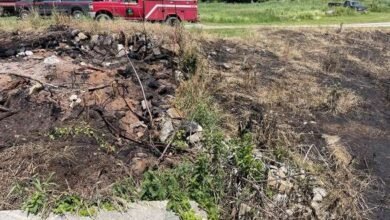
 [The colony built the Ash Grove Methodist Episcopal Church in White Creek, NY in 1788. Organized in 1770 by Embury, the original building in Washington County was eventually moved to Sandgate, Vermont,]
With a population so constituted, a strong Loyalist sentiment would be expected, and such was the case on the Champlain frontier.
Moreover, there was scattered through the countryside a sprinkling of half-pay British officers, many of whom had settled down in the province following the reduction of two battalions of the 60th, or Royal American Regiment, at the conclusion of French & Indian War (1754-1765).
(Half-pay was a kind of retainer and partial retirement that allowed the British Army and Royal Navy to maintain a reserve of trained commissioned officers. A notable half-pay officer in the area was Captain John Nordberg, the elderly caretaker of Fort George at the south end of Lake George, who was taken prisoner.)
These retired officers were persons of consequence in their communities, the natural leaders of public opinion, and as a matter of course their influence was actively exerted in their neighborhoods in the interest of the constituted authority.
Despite their numbers, the New York Loyalists were unable to offer any effectual resistance, and the Revolutionaries were soon in control of the government.
For the balance of the year 1775 the cause of the Revolution was everywhere successful and, with an American army invading Canada by way of Lake Champlain, the Loyalists on the border could do little but bide their time and wait for the tide to turn.
The tide did turn in the following year, but the difficulties of the Loyalists increased rather than diminished. A neutral attitude would have suited many, had it been possible to maintain it, but the inhabitants were required to take an oath of allegiance and serve in the militia or else to submit to some form of restraint.
There was the case of Peter Miller, farmer of Cambridge District in Albany County, who refused to subscribe to the oath of allegiance on the ground that he had already taken one as a British subject.
 John Younglove, chairman of the Cambridge District Committee of Correspondence, entered a complaint with the county committee, and it was voted “to apprehend the said Peter Miller, dis-arm him, and place him under bonds for his future good behavior.”
The expense of his subsequent arrest and appearance before the committee in Albany, nineteen shillings and five pence, was ordered “levied by distress on the goods and chattels of the aforesaid Peter Miller.”
Until midsummer of 1776 the belief had been prevalent that a peaceful solution would be found of the matters at issue between the colonies and the Ministry, but with the adoption of the Declaration of Independence on July 4th it was generally realized that a serious conflict would follow, and there set in a steady trickle of the more zealous Loyalist partisans toward Canada.
The Johnsons and Butlers, the landed gentry of the Mohawk Valley, had already departed with their Highland Scotch retainers and Indian allies. Their example was soon followed by others, including such colorful figures as John Peters, a Yale graduate resident in Mooretown, Gloucester County (the subject of a an upcoming virtual talk), the Jessup brothers, lumber barons of Charlotte County, and sundry of the half-pay officers.
On July 12, 1776, the Albany County Committee of Correspondence passed a resolution requiring all the half-pay officers of the British Crown resident in the county to give a parole not to bear arms against the United States, hold any correspondence with enemies of the United States, or to depart the county without the leave of their district committee; the alternative offered was arrest and confinement.
On the day following the passage of this resolve, Francis P. Phister appeared before the committee and entered into a parole. Mr. Phister, a reduced lieutenant of the famous Royal Americans, lived at Hoosac Four Corners where he had a fine estate and a mill, and was known by the courtesy title of “Colonel” Phister.
During his service in the Royal American Regiment he had been an engineer officer and in the previous February had refused an offer tendered by General Philip Schuyler to serve as chief engineer of the American army in Canada.
He now under compulsion had given a parole, a violation of which would deprive him of the privileges that he might normally expect should he later find himself a prisoner of war.
As the months passed, the more restive spirits among the Loyalists continued to slip away toward Canada to take service in Sir John Johnson‘s newly organized Provincial corps, the “King’s Royal Regiment of New York,” or more familiarly, the “Loyal Yorkers,” which was being recruited from the Mohawk Valley and the Champlain region.
However, it was in the autumn of 1776 that the opportunity came for which so many of the Loyalists had been waiting. During the summer General Sir Guy Carleton had swept back the American invasion from Canada, and by October had penetrated deep into enemy territory at Crown Point.
Here he was held up by the lateness of the season and ultimately was forced to retreat to winter quarters in Canada, but while the British army was at Fort Crown Point Loyalist recruits flocked in.
 Among them was Peter Miller, who had earlier suffered arrest at Albany. He came with a party of some thirty Irish Palatine farmers from his neighborhood under the leadership of Justus Sherwood.
Sherwood, as proprietor’s clerk of New Haven, Vermont, had been active in the land troubles in the New Hampshire Grants that preceded the Revolution and just before this had been mistreated by a mob in Bennington, which cost the colonies the services of a brilliant officer. Sherwood would go on to serve as a Captain in the Queen’s Loyal Rangers, also known as John Peters’ Corps.
It is probable that these Loyalists had left their homes for what they believed would be but a temporary absence, the brief interval necessary for Carleton to reach Albany and restore authority in the province. The event proved quite otherwise, and it was just as well that they were not aware of the misfortunes that were to follow.
When the British army retreated over Lake Champlain, they had no choice but to go with it, hopeful of course that they would be back as soon as the season would again permit of active operations.
Read more about loyalists in the American Revolution.
This essay was drawn with minor editing for clarity from Thomas C. Lampee’s “The Missiquoi Loyalists,” in the Proceedings of the Vermont Historical Society, Vol. VI, No. 2, 1938.
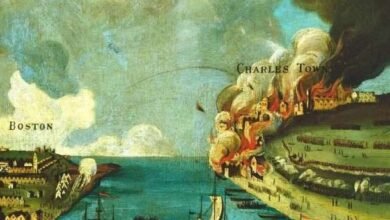
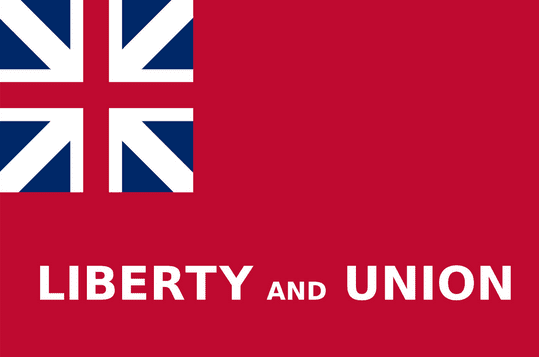
Illustrations, from above: The Taunton Flag, also known as the Liberty and Union Flag, hoisted by patriots in Massachusetts in 1774, it reflects the ambivalence about declaring independence found even among patriots; a map of Charlotte, Gloucester and Cumberland Counties during the Revolution; Philip Embury preaching his farewell address as the ship Pery leaves Limerick in 1760 with Irish Palatines; Ash Grove Methodist Cemetery in White Creek, Washington County, NY, said to be that of the second Methodist church in the United States (photo by Jonathan Lang); a 1779 map showing the Cambridge District; and reenactors portraying Captain Sherwood’s Company of the Queen’s Loyal Rangers.
Source link