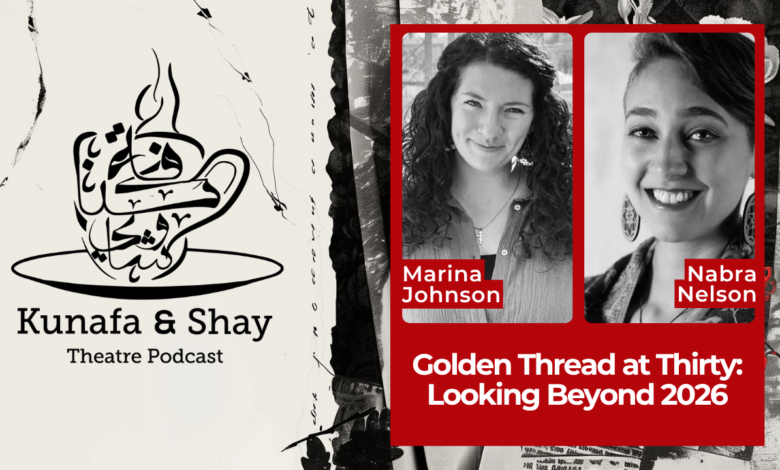
Nabra Nelson: Salam Alaikum! Welcome to Kunafa and Shay, a podcast produced for HowlRound Theatre Commons, a free and open platform for theatremakers worldwide. Kunafa and Shay discusses and analyzes contemporary and historical Middle Eastern and North African, or MENA, and Southwest Asian and North African, or SWANA, theatre from across the region.
Marina Johnson: I’m Marina.
Nabra: And I’m Nabra. And we’re your hosts. Our name, Kunafa and Shay, invites you into the discussion in the best way we know how, with complex and delicious sweets like kunafa and perfectly warm tea, or in Arabic, shay.
Marina: In each country in the Arab world, you’ll find kunafa made differently. In that way, we also lean into the diversity, complexity, and robust flavors of MENA and SWANA theatre.
Nabra: Season six of this podcast marks a double milestone, the thirtieth anniversary of Golden Thread Productions, the oldest MENA theatre company in the US, and my first year as the theatre’s new artistic director. Across ten episodes, we use Golden Thread as a case study to revisit landmark productions from 1996 to 2026, and trace shifting tropes, political urgencies, and aesthetic strategies that shaped the company’s early decades.
Marina: This season also expands to reflect on the past three decades for MENA theatres across the US, not as a closed chapter, but as a living archive, one that illuminates where we’ve been and where we’re headed.
In our final episode of the season, we turn toward the future with a look at the 2026 season of Golden Thread Productions. After tracing three decades of MENA/SWANA theatre, we ask, what forward-facing programming results from that lineage?
This episode offers a first glimpse at the plays, artists, and themes shaping the year ahead, and reflects on how legacy and risk sit side-by-side in season planning. We close not with nostalgia, but with intention, considering how the next chapter continues the ongoing project of building stages where our communities can see themselves fully and fiercely.
Nabra: So I first want to just give a shout out and be clear that the 2026 season was curated by the iconic Sahar Assaf, the previous artistic director. I know it’s natural to assume that since this is my first season as AD that I’m behind the selections of the season, but rather my goal in 2026 is to fulfill the brilliant vision of Sahar Assaf and fully realize the season she so lovingly set up for me. I’m very excited about it, but I need to give credit to her first and foremost.
So the season starts at the time of this recording in one week with a festival of Palestinian arts, which is two weeks of Palestinian programming co-produced with Crowded Fire Theatre Company. I will direct a staged reading of A Country Made of Salt by our resident playwright, Denmo Ibrahim. We will hold film screening of Alaa Shehada’s The Horse of Jenin, and we will produce the stand-up comedy show Amreeka, curated by Wafaa Bilal, who is a previous artist in residence at Golden Thread Productions, and is also this incredibly brilliant installation artist and performance artist. And that stand-up show will have an all-Palestinian lineup.
The first piece of this festival, as I said, is A Country Made of Salt by Denmo Ibrahim, and I’m really excited to be developing this piece. We’re doing a week-long workshop. It’s very much a new piece that’s being rewritten as we speak, and it follows an Egyptian-American archivist, essentially, who is searching for her identity and what being Arab-American means to her. And she does that by interviewing a bunch of different Arab-Americans from different backgrounds, including many Palestinians.
And so the first half of the play is essentially monologues from different Arab-American perspectives that are based on interviews that Denmo did do with people across the nation. And how Denmo describes this part of the first act is as a solo show with an ensemble, and I really love that structure. It’s really a new structure to me, and I think a pretty new structure in general to play with, and we’re still experimenting with what format that might look like, how much the main character embodies these different characters for these different interviewees, or how much other characters step in. Maybe these solo pieces kind of turn into a dialogue. It’s going to be really fun to play with.
And then the second act takes place in Cairo, where she kind of determines, okay, maybe I can’t find this purely in community. There’s also maybe a sense of identity in place in geography that I need to explore. And so she goes to Egypt to try to find herself in the space, and Egypt kind of is as overwhelming and wonderful as Cairo always is. But she realizes that, oh, this isn’t my home.
The US is my home, but this kind of is. I’m not having this cathartic kind of eureka moment that I expected when I stepped foot in Cairo, which I completely understand because stepping foot in Cairo, even as someone who grew up there, is always an overwhelming experience. And it takes a while for a person, I think, to feel settled and comfy and relaxed in that space. I remember I really didn’t like Cairo for the first year of living there. I had visited a lot growing up in my first eight years of life before I moved there. But then I was angry to move out of the US. I had aspirations of being in my fifth grade play, even though I was not into theatre at the time, and going to space camp in LA and all of the things. And so I was really mad. And then add on top of that everything that is Cairo, the absolute overwhelm. And it took me about a year to actually be like, okay, I like it here, and I’ve settled in, and I’m happy to be here.
And, you know, I think this play beautifully captures the atmosphere of Cairo. I reread it, and I did a lot of my director prep while I was in Cairo. And it was just so present to me. Some of the scenes were things that had happened the week before to me, basically, on that visit. So it really captures the spirit of our region, and explores the complexity of Arab American identity specifically, and the many different angles and perspectives that are embodied within that very, very broad identity, I guess, category that has emerged to encompass so many of our immigrant and diasporic communities.
Marina: So then we can turn to The Horse of Jenin. So The Horse of Jenin has a special place in my heart, because it’s created by my friend Alaa Shehada. I met Alaa the way that I meet so many Palestinian artists in Palestine, which is randomly through another friend. Instantly, after talking to him for like five minutes, I was howling with laughter. This man can just make you laugh. Even when he’s talking about like really dark things, it’s just he has a great sense of humor. And the way that he phrases things is so astute and witty and smart. And anytime you’re around him, it’s just an enjoyable experience.
So after we had met, I realized that he had written this monodrama, The Horse of Jenin. And for those of you who don’t know, in Jenin, so this city in Palestine, and maybe you know Jenin from the Freedom Theatre, which is in the refugee camp of Jenin, there used to be this huge horse. And this horse was created after one of the major invasions where the Israelis had destroyed a bunch of different buildings. This artist created a horse from the debris of all of those different buildings.
And so instead of looking at this, I mean, the destruction, of course, is a tragedy in all of these different ways. But it became the symbol of like hope and resilience and freedom that was then in this center part of Jenin. And so when Alaa was growing up there, he was around this horse for like twenty years as it was just there. But then shortly in 2023, after the genocide had sort of become a full blown force in Gaza, an Israeli bulldozer came into Jenin and it took the horse.
And people started to ask like, where is this horse? Like this horse has been a part of our lives forever. The horse is yet another detainee. The horse has done nothing wrong. Is it being held in an administrative detention? Like what’s happening with this horse?
He created this monodrama about the horse and the horse’s presence in his life. But also just, you know, as we’re hearing about the horse, we’re hearing about his life story in Jenin, being an artist there in these different ways. And so I have been so excited to see this monodrama and it did so well in the Fringe Festival last year. And he was supposed to come to the United States to present it. And we’d been texting and I was like, he was going to be in Massachusetts. And I really wanted to go to see the performance that he was going to be doing. But I thought, oh, it’s really hard right now for me to fly. I’m working on my dissertation. Let me know how it goes. Can’t wait to hear how you like Massachusetts. It was going to be his first time being there. And this was November. He had a valid visa, of course, to enter the United States. That’s why he was flying here.
And he was detained immediately by Border Patrol and instantly deported back to Amsterdam. I guess I don’t know if it’s technically deported, denied entry, what the situation is. But the US has since issued a travel ban on individuals who are coming in on documentation from the Palestinian Authority.
We could talk for a long time about what that means. But essentially because Palestinians in Palestine don’t have, unless you live in 48 and you are a citizen there, the 1948 regions, travel is just significantly harder.
And so what they’ve ended up doing, which I think is really kind of amazing. Of course, we wish that he could be here in person. But they’ve done this video tour. And so Golden Thread is part of this video tour where we’re getting to watch a videoed version of The Horse of Jenin. And I highly recommend that people come to see this because people frequently say to me, Marina, you’re talking about all of these amazing plays that are happening in Palestine. Why can’t we see them? Why aren’t they videoed?
Well, y’all, this is videoed. It’s touring the United States. I think this is a great model for a time when it’s not safe for people from Palestine to be in the United States. So please support this. He’s an incredible performer. And this is very much worth seeing. It’s like an eighty minute, one person show that will for sure touch your heart, make you laugh, and give you lots of interesting context into Alaa and Palestine.
Nabra: And it’s very possible that it’s being screened where you are. So check out that tour. It’s going to a whole bunch of different cities as a screening. And also a documentary called Palestine Comedy Club is being screened. The producers came back and said, here are some options of what to do because Alaa can’t be here in place of the live show. And so it’s really an exciting opportunity to still bring his voice and Palestinian voices to all of these companies who have committed to this screening. So I would definitely check that out.
And then the last part of our Festival of Palestinian Art this spring is Amreeka, The Comedy Show, which is actually the return of Amreeka, The Comedy Show that had a sold out run in 2023. And so we’re excited to bring it back. Let’s do some stand up comedy, this time with an all Palestinian lineup curated by Wafaa Bilal. So meaning that Wafaa picks the artist and really plans the feeling of the evening and is the artistic mind behind this show.
And Wafaa Bilal is really an incredible artist. I knew of his work, actually, I first was introduced to him at the ReOrient MENATMA convening in 2023. And, where he was the artist in residence at Golden Thread. And so he spoke and shared some of his installation work at that convening. And I subsequently looked into his work and it really blew my mind. I’d heard about some of it kind of, you know, through the grapevine, I guess, but never put a really a name to the art. He’s most famous for Shoot an Iraqi, which is where he constructed a room to live in for quite a long period of time that was rigged with a remote controlled paintball gun that anyone across the world could sign into a website and pull the trigger on this paintball gun and shoot him or shoot any part of the room.
And, you know, thousands and thousands of people tuned in anonymously and shot him. And it’s just such a brilliant and intense political commentary and social critique and examination, really, of human beings and that cruelty that leads to war, like the war in Iraq.
The question comes as like, why would a theatre company do a standup show? And, you know, it’s performance, it’s live performance on a stage. And I love the idea of thinking differently about different forms of theatre and thinking expansively about what theatre is and what it’s defined as.
You know, standup is such a beautiful and intimate experience of performance. It’s usually personal experiences being told. It is so appealing to us because it’s hilarious. And I think it’s really powerful to have an all-Palestinian lineup doing standup comedy, being able to laugh together, to laugh with Palestinians about Palestine. I think partially, at least some of them will talk about Palestine, I’m sure. That’s a really radical form of resistance. And so I’m excited to see what they’re bringing. We have the headliner, Suzie Afridi, and then the featured artists are Majdy Farres, and Lana Salah.
Marina: And I had the privilege of seeing Amreeka whenever Golden Thread had their sold-out performances before. So I’m excited that Amreeka is coming back. Not to keep tooting the Alaa Shehada horn, but Palestine Comedy Club, which Nabra mentioned, isn’t being shown here at this time, but it will be showing at other film festivals. And it’s a thing you can ask your local theatres to also host. Palestine Comedy Club is incredible. Alaa is a stand-up comedian, and there are many stand-up comedians both in the West Bank and in forty-eight, and in Gaza. I haven’t gotten to see any of the performers from Gaza.
I don’t know, the film really details the experience of telling jokes in Palestine. What that means, how jokes, just like any comedian changes their jokes as they go from, you know, city to village, etc. Seeing what these artists go through to construct their jokes and creating this club feeling has been really exciting to see. And so this documentary does a great job of showing that, and just showing the experience in general. They toured together, and that touring, as you know, in a space where movement is restricted, is quite a difficult thing. And the documentary highlights that beautifully.
Nabra: And that might be playing, again, as part of that national tour of Horse of Jenin that was kind of shifted. So a lot of the places that are screening Horse of Jenin might also be screening Palestine Comedy Club. And it’s kind of interesting to me, having stand-up comedy in conversation with Horse of Jenin, like we were doing it with Amreeka. They’re both comedies that center Palestinian artists, and that’s kind of really exciting. And again, as I’ve said, impactful format to share Palestinian voices.
Then our summer show is Arab Spring by Denmo Ibrahim. It’s going to be a world premiere. It is not about the Arab Spring in 2011. It is about Arabs, and it partially takes place in spring. Like Easter is part of kind of a motif in the piece. And it also, in the playwright’s notes, Denmo says that the structure of the piece is that of a revolution. And it’s the revolution of family and this interpersonal scale of revolution.
It also has some references to historic kind of resistance in Egypt, especially in the 1970s. And so it’s a very complex and interesting play that mostly centers on a brother and sister’s relationships as they try to bury their father who had recently died and figure out what his Arab-American version of his Islamic funeral is going to look like.
I really like the description. I think Denmo writes really nice and interesting and poetic descriptions of her work. So I’m just going to read this.
Yussef, a recovering addict, and Dina, his controlling big sister, return on the fourth of July to their childhood home in the suburbs to bury their deadbeat dad. Can they figure out, A) how to do an Islamic funeral before his body goes cold? B) who their estranged father was? And C) what family means without killing each other? Inshallah.
Marina: Incredible. And then, of course, as we talked about in a previous episode from this season, we have the ReOrient Festival and the MENATMA forum, both very much worth checking out. ReOrient is featuring five short plays that are all focused on Palestine and Iran. And the MENATMA forum, while of course it’s from the MENA Theatre Makers Alliance, a lot of these events are open to the public.
So it’s like a conference where you can pay a nominal fee and attend the different sessions. There are some, I think, that are closed specifically to people of MENA and SWANA backgrounds, but very much worth checking out if you’re interested in seeing some of the great programming that is happening.
Nabra is on the MENATMA board, and I am on the MENATMA programming committee for this convening with Nabra and some of our other wonderful colleagues.
And what was so great about the last time that I was on this committee was it was exciting to see what kinds of conversations are MENA and SWANA artists looking to have right now. So just like any conference that is set up where there are different panels and conversations, the same thing is true for this. And I love getting to hear, because Nabra and I talk together a lot about what we’re interested in, and we can see the way that theatres are programming their seasons, what they might be interested in.
But to get to hear from this whole community, to see what kinds of conversations are people looking to have as a group. And are these conversations that we’re all having in different ways together behind closed doors anyway, or are these actually larger overarching conversations? This provides a great community and affinity space to have these discussions. So I’m looking forward to solidifying that programming in the near future. And hopefully those of you who are listening will be able to come as well.
Nabra:: And the ReOrient Short Play Festival this year, it is centering Iranian and Palestinian stories, which I’m really excited about. We’ve got Dare Not Speak by Hassan Abdulrazzak, who is a London-based Iraqi writer who writes about a young woman who was murdered in a genocide, pitching her story to an artistic director at a theatre. And it’s kind of got a bit of a twist in there and is very much a commentary on recent political events, but also on the strange world of theatre and the artistic curation that often does not center those whose stories need to be told the most, and pushes away controversy. So very much needed right now and something I’m thinking a lot about now that I step into an artistic director role.
Camouflage by Ahmed Masoud, who’s a London-based Palestinian writer, has this solo show, but we’re presenting as four different actors taking on each of the four different monologues about four different Palestinians in Palestine, navigating their lives in different ways.
A thirteen-year-old boy who’s on a boat, leaving Palestine as a refugee, kind of in the waters between Turkey and Greece, that has a very thirteen-year-old boy concern on his mind. Another about a seventeen-year-old girl finishing her SAT exams and, you know, trying to reconcile, trying to find all the suitors that are kind of being presented to her, coming to her as a young woman, trying to find romance and build a future for herself. There’s another about a twenty-year-old taxi driver in Gaza who’s using Tinder to try to find a date, and then about a Palestinian actor who’s trying to be an actor in Israeli-occupied Palestine and all of the kind of messed up racist systems he has to deal with and the racist characters that he is asked to portray.
Then we have Regarding Antigone by Banafsheh Hassani, who’s a Montreal-based artist who is Iranian, and it’s a solo show where the classic Greek tragedy of Antigone, war photography, her weak memory, a revolution, state propaganda, a song she sang, and a cringed diaspora poetry come together into something inspired by a true story, where, in her words, quote, every line is a call to action. That’s something I’ll be directing, that I’m super excited to direct. It’s a really super, super interesting solo show.
Then there’s Homing Pigeons and Co. by Sepehr Jafari who’s a Bay Area-Iranian artist, that is this really strange genre-bending piece that has an Iranian woman in the back of a cop car in Iran and an Iranian woman in diaspora talking with each other and having this discussion that also has to do with a fish. It’s very interesting, very bizarre, and definitely worth checking out.
Then finally, Blood Fruit by Hannah Khalil, who’s a London-based Palestinian and Irish writer who has been produced by Golden Thread many times before. Very prominent, and it tells the true story of shop workers in Dublin in the 1980s who refused to handle South African fruits and did a very successful boycott in solidarity. Being prepared today, it’s obviously this clear commentary on boycotts right now and their power and how boycotts can make a difference when it comes to boycotting Israeli products, for instance, in solidarity with Palestine, which is really in the zeitgeist right now. Thankfully, building even more traction, but has been a part of the Palestinian solidarity movement for many, many, many, many years and is a very important part of that. Seeing how that has been effective in the past, it takes a long time, obviously, and it takes a lot of effort and it takes a lot of people standing up. This is a beautiful piece that really highlights that.
Marina: As we are closing up this season of Kunafa and Shay, I think it’s great if you take us into the 2027 season, which will be the first season at Golden Thread that you are curating. I’ll be really excited to hear what you’re thinking of as you go into this.
Maybe this is also the space to say, if you have curatorial ideas for Kunafa and Shay, we constantly get emails that are about different things that we try to theme each season. Sometimes we just can’t incorporate the emails that we’re getting to talk about different plays. If you’re like, oh, a season on X would be really great or a season on Y, let us know what you’re thinking because we’re starting to plan our next season now just because our lives are actually accelerating in busyness. We just need more lead time than we used to to plan seasons. But enough about Kunafa and Shay in this moment. Nabra, talk to us about the 2027 Golden Thread season.
Nabra: Well, similarly, it’s also really helpful if you’re a MENA playwright, send me your plays. I’m very open to just getting emails from folks. It’s so helpful to just have something fall on my desk, metaphorically. This is my job, is to know what the atmosphere of MENA theatre is and to know what new plays are exciting; to read so, so, so much. Oh my gosh, the amount of plays I’m reading at a rapid pace is amazing and really fun and great.
And so I’m really realizing it’s so interesting to be in this position because I’m realizing how much my perspective on season planning has shifted in the artistic director role, even though I’ve been on season planning committees for the regional theatres I worked with for almost a decade. I see it in a whole different light in this particular position.
And one of the things that I’m realizing, I don’t know if every AD feels this way at all, but I feel like all we’re waiting for is the perfect play to fall on our desk. So this idea, I’ve always felt like artistic directors are very inaccessible, probably because I worked at regional theatres. Especially as an artist, a playwright myself, it always feels like this giant gate that we can’t pass.
But I’m like, oh my gosh, it’s actually such a gift to just be sent a play because it might be exactly what we’re looking for. And if it’s not, it’s just one email. And I believe, of course, that part of my job at Golden Thread is also building community and staying in touch and following the work of MENA playwrights at all stages of their careers. And so I’m just really grateful to be in that position and navigating how to pick a season when there’s so many incredible works that I’ve already read. And we have three main stages that we do and then some new play development, which is great, but it’s a lot of pressure.
And I knew that this would be an incredibly difficult element of the job. Thankfully, we’ve got the other staff members who are a part of this and have their own feedback and opinions on pieces that are integrated into this. And maybe there will be some other system that is developed over time. But for now, there’s just a lot of reading and a lot of narrowing down from so, so, so many really brilliant plays. And then a lot of what I’ve been doing and thinking about is taking some of the brilliant plays that maybe Golden Thread can’t or won’t produce for whatever reason, constraints, size, budget, and just the amount of main stages that we have, slots that we have available, and starting to really share that with other institutions that might be able to do that and might be interested in it. I just want to see, you know, more MENA and SWANA theatre everywhere.
So I’m so grateful to kind of be that mind database in some way. And I think Kunafa and Shay has been a little bit of a, that place, Marina and I have always been available to give suggestions on plays since we read so many and watch and are attuned to a lot of plays from across the region through this podcast research.
So please, other folks do more plays so that I feel less pressure and so that we just have more MENA and SWANA at work out there.
And so looking towards the 2027 season, I’m really intent on curating works that are for and by the MENA community, where everyone is welcome, but where we know this is us and this is home. That is how I intend to continue and evolve Golden Thread’s legacy.
I believe people are more compelled by being invited over to my grandmother’s house where they don’t understand what everyone’s saying because they are all speaking Arabic, and maybe they don’t know exactly what they’re eating, but it’s delicious. And instead of me trying to explain my grandma’s house in ways that they would understand, they’re being invited into that space and experiencing it.
Being invited into our spaces the way we curate them is a gift, and you can feel that gift without it having to be translated. No matter who you are, you feel completely welcomed at my grandma’s house. Marina knows this. I’ve got a photo of my gigantic Nubian family at grandma’s place on Friday, we all gather, and Marina is just there. She’s part of the family photo, even.
We gather every Friday so we can have a family photo every week, but it wasn’t even a question. It was like, yes, Marina, come here. We’re all taking a photo. Why would you stand out of this photo? You’re going to stand into this photo, and it’s kind of a super cute, hilarious picture because she does stand out, the sweet woman. She speaks some Arabic, of course, so that helps, but it was not a question. You’re invited in, and you’re going to feel like you’re not a Nubian with the Sharif name, but you’re still a part of this. That’s the feeling that I want to have at Golden Thread and continue to cultivate, and I especially want MENA folks to come into that space and say, yes, this is my space, and yes, this is the story I needed, and this speaks to my complexity. I’m not being pandered to. I’m not being educated about myself. I’m exploring something even deeper, maybe, about my identities or where I’m from or other people from this background.
I want folks of MENA and SWANA backgrounds that are represented on a stage to feel engaged even more deeply, and they are really the center of who I’m thinking about when I’m curating what pieces might want to be on the Golden Thread stage.
And if you don’t know what’s going on, you learn, and you feel amazing about that learning, and if you’re part of the family, you feel fulfilled in a way that only art and family can provide. That is how I want Golden Thread to feel because that’s how it’s always felt to me.
Nabra: This podcast is produced as a contribution to HowlRound Theatre Commons. You can find more episodes of this show—and other HowlRound shows—wherever you find podcasts, including on noncommercial open source apps like Anytime Podcast Player for iPhone and AntennaPod for Android. If you loved this podcast, please share it with your friends. You can find a transcript for this episode, along with lots of other progressive and disruptive content, on howlround.com.
Marina: Have an idea for a meaningful podcast, essay, or TV event that the theatre community needs to hear? Visit howlround.com and submit your ideas to this knowledge commons.
Marina and Nabra: Yalla! Bye!